16 Guard Buzz Cut: What It Actually Means (And the Real Length in mm)
Quick Answer
“16 guard” isn’t a standard barber clipper guard — it almost certainly means a 16mm length setting on an adjustable trimmer. Professional clipper guard sets (Wahl, Oster, Andis) only run from about #0000 up to #8, and #8 already maxes out at 1 inch (25mm). There’s no official “#16” in that system.
Where “16” does show up is on adjustable trimmers and multi-length guide combs, which are commonly numbered directly in millimeters rather than using the classic 1–8 guard scale. On that type of tool, a “16” setting simply means 16mm of hair.
16mm works out to about 0.63 inch — almost exactly a standard #5 guard (5/8″, ~15.9mm). So if 16mm is what you’re actually after, you don’t need to hunt down a “16 guard.” Ask for a #5, or state the measurement directly and skip the ambiguity.
Most pages ranking for this phrase state a specific length with total confidence, and none of them agree — estimates online range from a quarter inch to two inches for the same term. That’s the clearest sign the “standard” doesn’t exist. What follows is what’s actually defensible, plus what you need to get this length right.
Quick Reference
| What it likely means | A 16mm setting on an adjustable trimmer — not a classic professional guard number |
| Closest classic guard | #5 (5/8″, ~16mm) |
| Length in inches | ~0.63″ |
| Visual result | Full, even coverage with visible texture; minimal scalp show |
| Maintenance | Trim every 3–5 weeks to hold the length |
| Works with a fade/taper? | Yes — see below |
What “16 Guard” Actually Means
Clipper guards follow one of two different numbering conventions, and the mismatch between them is where the confusion comes from.
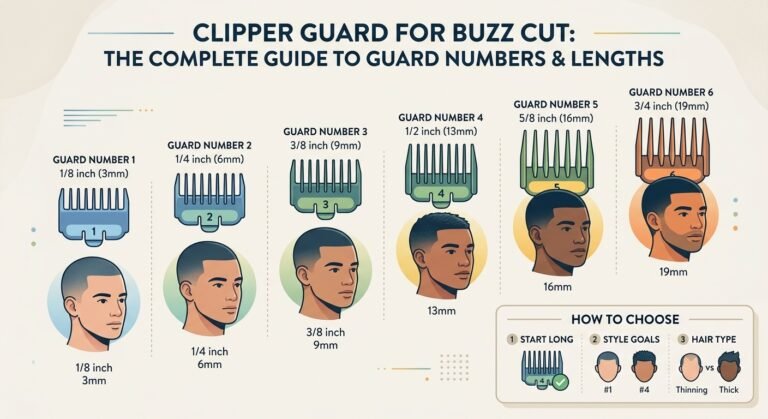
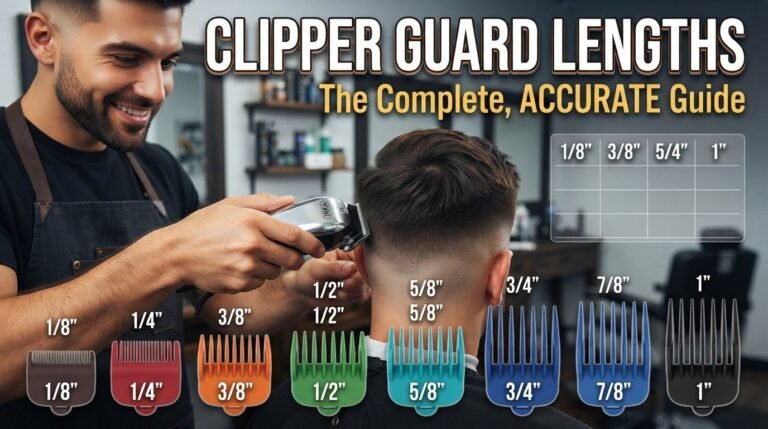
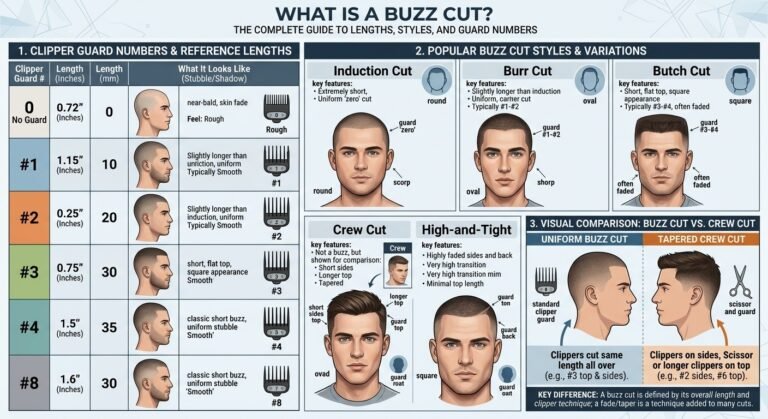
The classic barber system numbers guards 1 through 8, each roughly corresponding to that many eighths of an inch: a #1 leaves about 1/8″ (3mm), a #4 leaves about 1/2″ (13mm), and a #8 — the longest most sets include — leaves about 1″ (25mm). This is what a barber means by default when they say “guard number,” and it doesn’t go past 8.
Adjustable trimmers use a different convention. Many modern beard and hair trimmers replace guard swapping with a dial or lever that locks into a range of millimeter settings — commonly somewhere between 0.5mm and 20–30mm. On these, the number is the length: setting “16” means 16mm, full stop. Wahl, for instance, sells a 10-position adjustable guide comb rated for 12mm to 21mm in roughly 1mm steps — a range that runs directly through 16mm as one of its ten settings.
A “16 guard” doesn’t exist in the first system. It only makes sense in the second, where it just means 16mm. Exact millimeter equivalents can still vary slightly by brand, so if precision matters, say the measurement rather than relying on the number alone.
Related: Clipper Guard for Buzz Cut: The Complete Guide to Guard Numbers, Lengths, and How to Choose
How Long Is 16mm, and What’s the Closest Guard?
- Millimeters: 16mm
- Inches: ≈ 0.63″ (16 ÷ 25.4)
- Closest classic guard: #5 — 5/8″ (0.625″), about 15.9mm, close enough that most people won’t see a difference against a true 16mm cut
This sits on the longer end of what most people still call a “buzz cut”: short enough to stay low-maintenance and clipper-only, long enough to show real texture and lie down slightly instead of standing straight up. It’s noticeably longer than a classic short buzz (a #1 or #2, in the 3–6mm range).
What a 16mm Buzz Looks Like
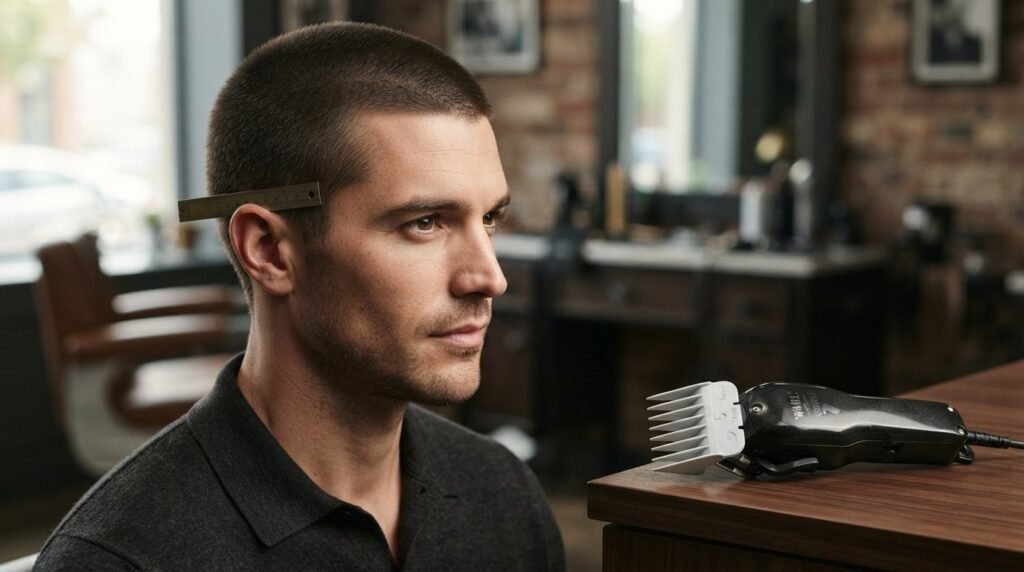
Full, even coverage with visible texture and minimal scalp show. From a few feet away, it reads as a short, neat haircut rather than a shaved one — a meaningfully softer look than a #1 or #2.
- Texture: Visible movement and direction, especially with any wave or curl
- Contrast: Low hair-to-scalp contrast compared to shorter buzzes
- Styling: Lies mostly flat on its own; a light paste or cream adds direction without looking overtly styled
The same nominal length won’t look identical on everyone — hair type changes the read, covered below.
Related: Hair Clipper Guard Sizes: The Complete, Accurate Guide
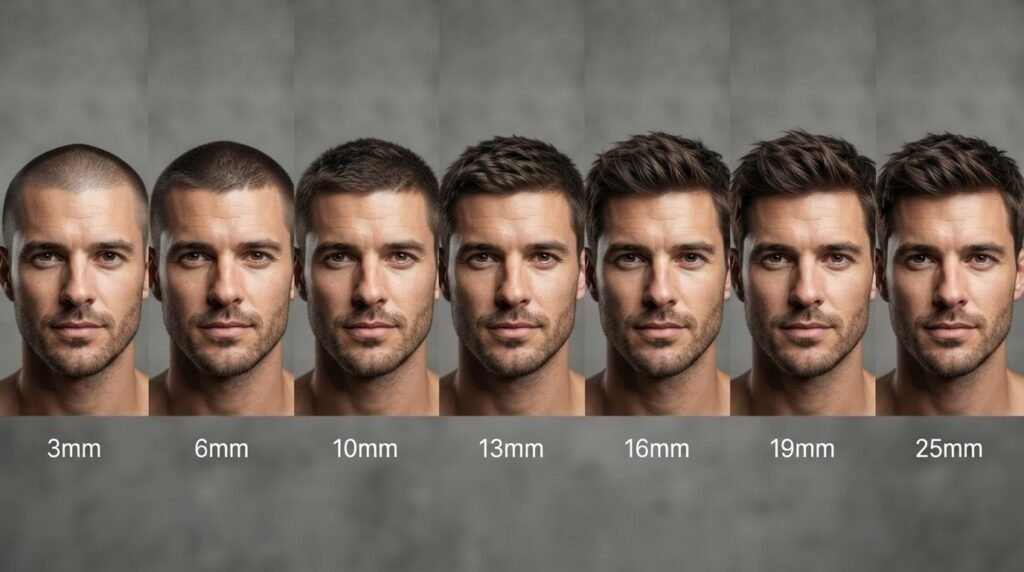
16mm vs. Other Buzz Lengths
| Length | Classic guard | Visual result | Good for |
|---|---|---|---|
| 3mm | #1 | Very short, scalp clearly visible | Maximum low-maintenance, sharp look |
| 6mm | #2 | Short, slight scalp show | Classic clean buzz |
| 10mm | #3 | Short-medium, minimal scalp show | Balance of short and textured |
| 13mm | #4 | Medium, some texture | More coverage, still low-maintenance |
| 16mm | #5 | Full coverage, visible texture | Longest “true buzz,” most versatile |
| 19mm | #6 | Noticeably longer, more movement | Borders on a short crop |
| 25mm | #8 | Longest standard guard | Short crew cut / textured crop territory |
16mm sits in the zone between “obviously a buzz cut” and “short haircut you could style” — a reasonable middle point if you’re unsure which way to go.
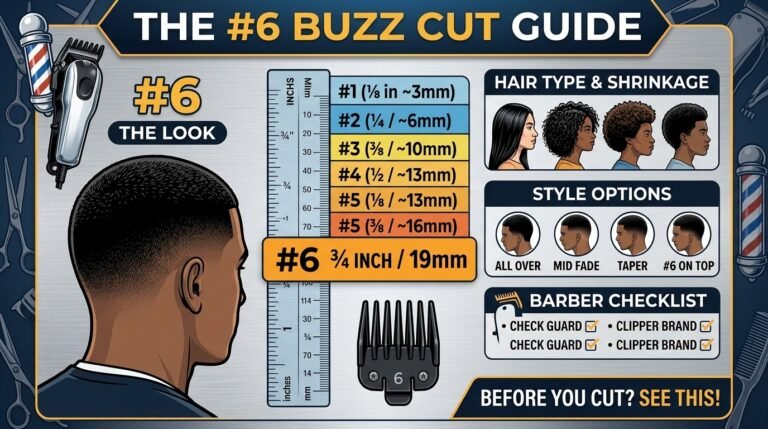
Related: 6 Guard Buzz Cut: Length, Look, and Everything to Know Before You Get One
16mm on Different Hair Types
The same cutting length looks different depending on what it’s cutting:
- Straight hair lies flattest and shows the cleanest line — this is where 16mm reads most clearly as a buzz cut.
- Wavy hair adds visible texture and slight lift, looking a bit fuller than the same length on straight hair.
- Curly hair shrinks visually — 16mm of curl typically looks shorter and denser than 16mm of straight hair, because the curl coils back on itself.
- Coily/tightly curled hair shows more shrinkage still; the finished look can read shorter and fuller than the stated length suggests.
- Thick/dense hair reads fuller and more solid, with less scalp visibility at the same setting.
- Fine/thin hair reads lighter, and may show more scalp depending on density.
None of these is “better” for the cut — they’re different starting points for the same clipper setting, which is why a photo alone (without a stated measurement) often miscommunicates what someone actually wants.
Hairline, Density & Scalp Visibility
At 16mm, expect full coverage with minimal scalp show — this length doesn’t expose the scalp the way a #1 or #2 does. A receding hairline or thinning crown will still be visible, just with softer contrast than at a shorter setting. Uneven density is also less noticeable here than at very short lengths, which makes 16mm a comparatively forgiving choice. That’s a styling effect, not a fix — the cut changes how hair looks, not what’s underneath it.
Uniform Buzz vs. Taper/Fade at 16mm
These read as different haircuts, so it’s worth being specific about which one you want:
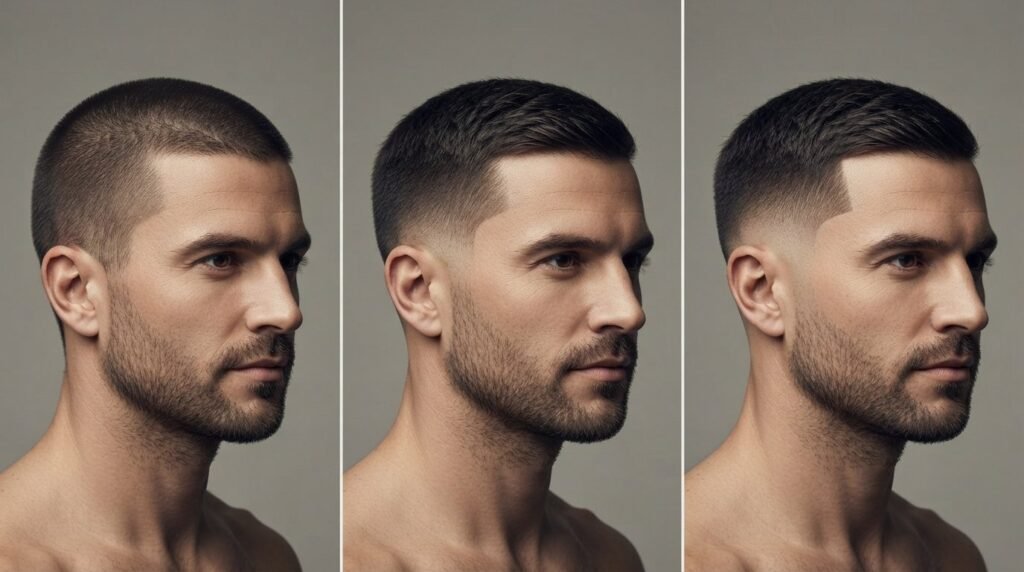
- Uniform 16mm buzz — the same length everywhere: top, sides, back. Lowest maintenance, most classic buzz look.
- 16mm top with tapered sides — the top holds at 16mm while the sides gradually shorten toward the hairline. More contrast, similar upkeep.
- 16mm top with a fade — a sharper transition down the sides, sometimes to skin. More visual contrast, more noticeable regrowth, and shorter intervals between barber visits to keep the fade line clean.
Ask for “a 16 guard buzz” with no other detail and different barbers will make different assumptions about which of these three you mean.
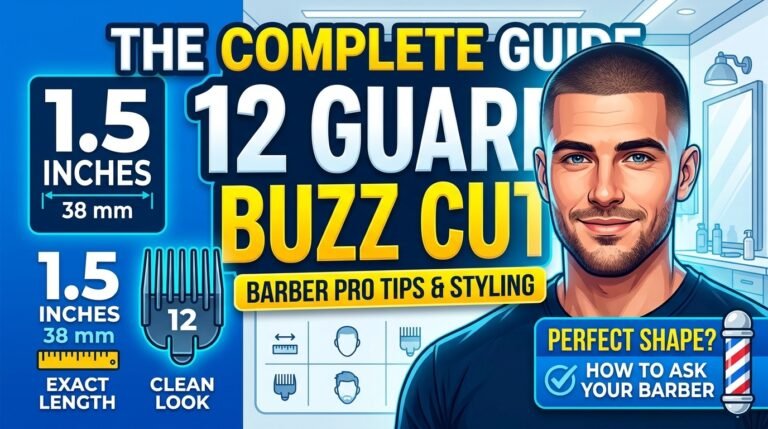
Related: 12 Guard Buzz Cut: The Complete Length, Look, and Barber Guide
How to Ask a Barber for This
Lead with the measurement, since “16 guard” isn’t a term most barbers use by default:
“I’d like about 16 millimeters — a bit over half an inch — the same length all over. If you don’t have an exact 16mm setting, a #5 guard is close enough.”
Then specify:
- Uniform vs. tapered/faded sides
- Neckline finish (natural, blocked, tapered)
- Hairline treatment (soft/natural vs. sharply defined)
A reference photo communicates the look; the measurement communicates the length. Bring both if the outcome matters to you — a photo alone doesn’t specify length, and hair-type differences mean the same length won’t necessarily match the photo’s result (see hair-type section above).
What If Your Barber Doesn’t Have a 16mm Option?
Most shops carry the classic 1–8 set, which stops at 25mm and has no dedicated 16mm attachment. Two fixes:
- Ask for a #5 guard — close enough (5/8″, ~16mm) that the difference is negligible.
- Ask if they have an adjustable clipper or trimmer that locks to 16mm directly — many shops keep one for detail work even when it isn’t their primary clipper.
Doing a 16mm Buzz at Home
- Use a clipper/trimmer that supports 16mm — a #5 guard on a standard clipper, or an adjustable trimmer set to 16mm or the nearest available step.
- Start with dry, detangled hair.
- Cut against the direction of growth for the most even result, going slowly on the first pass.
- Work in sections, going over each area two or three times to catch spots the first pass misses.
- Check the crown and back with a mirror — the easiest areas to miss or cut unevenly, since you can’t see them directly.
- Save the neckline and around the ears for last, using a trimmer with no guard for clean edges.
- If you’re not confident, start longer (19mm/#6) — you can always go shorter, but not the reverse.
A tapered or faded version is genuinely harder to blend well at home — a good reason to let a barber handle it the first time.
Maintenance & Grow-Out
Trim roughly every 3–5 weeks to hold a consistent 16mm, depending on growth rate and how strict you want the length. Growth is noticeable but not dramatic at this length — most people can stretch a week or two past their usual trim before it looks visibly overgrown. As it grows out, expect a gradual softening of the buzz look and more styling options by weeks three to five, eventually transitioning toward a short crop if left uncut.
Standard shampoo care is fine. Shorter lengths expose more scalp to sun and product buildup than longer hair does, so a scalp-friendly product and sun protection outdoors are reasonable precautions. Neckline and hairline touch-ups grow in faster-looking than the rest of the cut and are easy to handle yourself between full trims with a guardless trimmer.
Common Mistakes
- Assuming “16 guard” is universal. It isn’t — specify millimeters.
- Confusing the guard number with millimeters in the classic 1–8 system — a #5, not a “#16,” gets you 16mm there.
- Relying only on a photo, without stating a length.
- Not specifying uniform vs. tapered/faded, then being surprised by the result.
- Rushing the crown and back during a DIY cut — the most common source of unevenness.
- Expecting the cut to hide hairline or density issues — it softens contrast, it doesn’t change what’s underneath.
Troubleshooting
It looks shorter than expected. Guard measurements vary slightly by brand, and curly or coily hair shrinks visually at any given length. Next time, state millimeters rather than a guard number.
More scalp is showing than wanted. More common with fine or thin hair at the same setting — a slightly longer length (19mm) may read fuller.
Got a taper when you wanted uniform, or the reverse. A communication gap, not a cutting error — specify “the same length everywhere” or “tapered sides” explicitly next time.
One area looks thinner or uneven. Usually a density or growth-pattern issue that becomes more visible at shorter lengths, not a mistake in the cut — a slightly longer overall length can make it less noticeable.
Is a 16mm Buzz Right for You?
Consider this length if you want more coverage and texture than a short buzz, low daily styling effort, a uniform low-maintenance cut, or something forgiving of minor scalp or density unevenness.
Consider a different length if you want maximum scalp exposure and high contrast (go shorter, toward 3–6mm) or enough length to actively style day-to-day (go longer, toward 25mm+).
Reference Photo Checklist
A useful reference photo shows front, side, and back angles where possible, hair texture reasonably similar to yours, a comparable hairline shape, and the finished look rather than a mid-cut shot. Pair it with a stated length — the photo shows the look, the measurement sets the length, and neither alone gives a barber the full picture.
FAQ
What is a 16 guard buzz? Most likely a 16mm buzz cut using an adjustable trimmer numbered directly in millimeters — not a standard professional clipper guard, since that system only runs 1–8.
How long is a 16 guard? About 16mm, roughly 0.63 inch — close to a standard #5 guard (5/8″).
Is a 16 guard the same as 16mm? Functionally yes, on a tool numbered in millimeters. On the classic 1–8 guard system, there’s no “16” — ask for a #5 instead.
What does a 16mm buzz cut look like? Full, even coverage with visible texture and minimal scalp show — one of the longer lengths still generally considered a buzz cut.
Is 16mm considered long for a buzz cut? Relatively, yes — near the top of typical buzz lengths, just before a cut starts reading as a short crop.
Can you fade or taper a 16mm buzz? Yes — the top can hold at 16mm while the sides taper or fade shorter; specify which you want.
Does it work on curly hair? Yes, though curl pattern makes it look somewhat shorter and denser than the same length on straight hair.
How often should you maintain it? Roughly every 3–5 weeks to hold a consistent length.
Can you do it at home? Yes, for a uniform length with the right clipper or trimmer setting. A tapered or faded version is harder to blend without experience.
What if your barber doesn’t have a 16mm/16 guard option? Ask for the closest classic guard (#5) or for an adjustable trimmer set to 16mm.

Daniel Carter is the Senior Men’s Grooming Editor at FadeBuzzCut, where he specializes in fade buzz cuts, barbering techniques, men’s hairstyles, and evidence-based grooming advice. With more than 12 years of experience researching haircut trends, clipper techniques, face shape recommendations, and hair care, he creates in-depth guides that help readers confidently choose, maintain, and style modern buzz cuts.
Daniel works closely with experienced barbers, grooming professionals, and trusted industry resources to ensure every guide reflects current barbering standards and practical, real-world advice. His editorial approach combines expert research, clear explanations, and user-focused recommendations to make men’s grooming accessible for beginners and experienced enthusiasts alike.
At FadeBuzzCut.com, Daniel oversees editorial quality, content accuracy, and regular updates so readers receive reliable, up-to-date information on fade buzz cuts, beard combinations, hairstyle trends, clipper guard lengths, maintenance routines, and grooming products. Every article is written with a commitment to Experience, Expertise, Authoritativeness, and Trustworthiness (EEAT) while delivering helpful answers for both readers and AI-powered search experiences.
Whether you’re choosing your first fade buzz cut, comparing low, mid, or high fades, or looking for practical maintenance tips, Daniel’s goal is to provide trustworthy guidance that helps you achieve the best possible results.