Short Buzz Cut: The Complete Guide to Lengths, Styles & Maintenance (2026)
Guide reviewed for accuracy: August 2026
Key Takeaways
- A short buzz cut generally means a clipper guard between #0 and #3 — skin-close to about 10mm.
- Guard number alone doesn’t guarantee a result: clipper brand, blade condition, and hair texture all shift the finished length.
- Fades and skin fades need touch-ups sooner than the rest of the cut — regrowth shows fastest at the blend line.
- Face shape and hair type should guide fade height and top length, not dictate a single “correct” version.
- A short buzz cut typically needs a trim every 1–4 weeks, depending on length and growth rate.
Table of Contents
- What Is a Short Buzz Cut?
- Guard Lengths Explained
- Very Short Buzz Cuts
- With Fade
- Military-Inspired
- By Face Shape
- By Hair Type
- Hairlines
- With Beard
- Style Ideas
- Pros and Cons
- Cost
- How to Ask a Barber
- Common Mistakes
- DIY Basics
- Maintenance
- Grow-Out Guide
- vs. Other Cuts
- Men & Women
- Personalizing Yours
- Decision Guide
- FAQ
A short buzz cut is one of the easiest haircuts to live with and one of the trickiest to get exactly right. The length is measured in millimeters, the difference between two clipper guards can change your whole look, and the wrong fade height can throw off proportions you didn’t even know you had. This guide covers guard numbers, fades, face shape, hair type, barber requests, cost, and upkeep — everything worth knowing before you sit in the chair.
Quick Answer: What Is a Short Buzz Cut?
A short buzz cut is hair clipped to a uniform (or nearly uniform) length with clippers, typically a guard between #0 and #3 — short enough to show the scalp or come close to it. It differs from longer buzz-cut variations mainly by length and by how little styling it needs. The right length depends on hair type, face shape, and personal comfort with scalp visibility — not a single universal answer.
Short Buzz Cut Finder
| If you want… | Choose… |
|---|---|
| The shortest option | Very short buzz cut (#0–#1) |
| A little more length | Longer guard buzz cut (#3–#4) |
| More contrast at the sides | Buzz cut with fade |
| A clean, classic look | Traditional short buzz cut |
| A military-inspired look | Short military buzz cut |
| A subtle side transition | Buzz cut with taper |
| Help choosing a length | Guard-length guide |
| Help talking to a barber | How to ask for a short buzz cut |
| Help choosing by face shape | Face-shape guide |
| Help choosing by hair type | Hair-type guide |
| Easy, low-effort upkeep | Maintenance guide |
What Counts as a “Short” Buzz Cut?
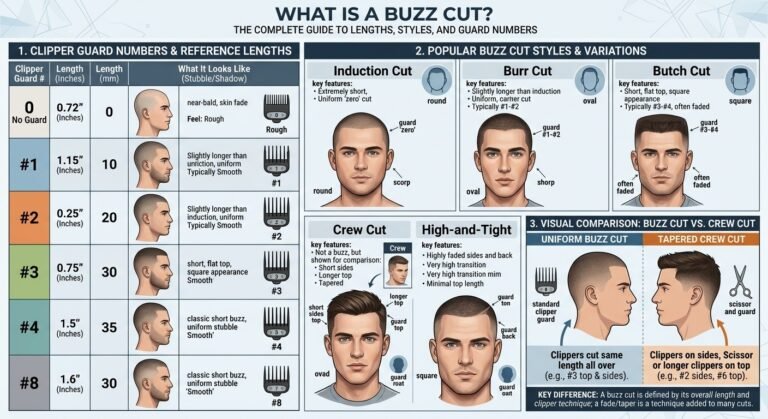
“Buzz cut” is an umbrella term for any clipper cut using a single guard or a close blend of guards; “short” narrows that to roughly the #0–#3 range — skin-close to about 3/8 inch (10mm). Past a #4 guard, most barbers describe the result as a “longer buzz cut” or edge it into crew-cut territory, where there’s enough length for slight texture or direction on top.
Because clippers, blades, and hair itself all vary, the same guard number won’t look identical on every head. A worn blade, a heavier hand, or coarse hair pushing back after cutting can all shift the finished length slightly. Treat guard numbers as a strong starting point, not an exact promise.
Short Buzz Cut Guard Lengths Explained
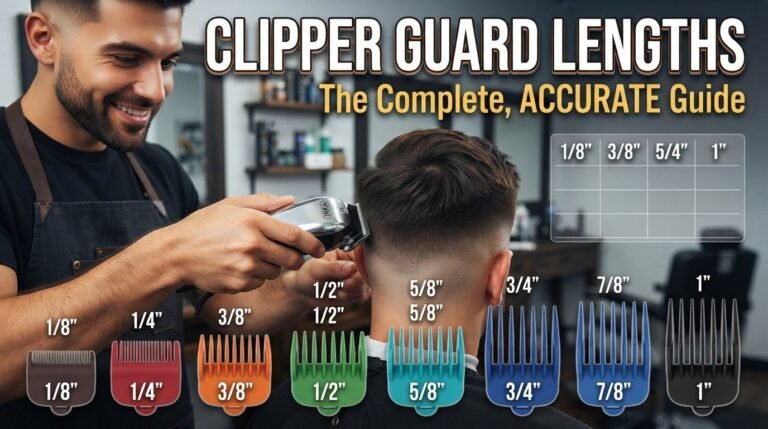
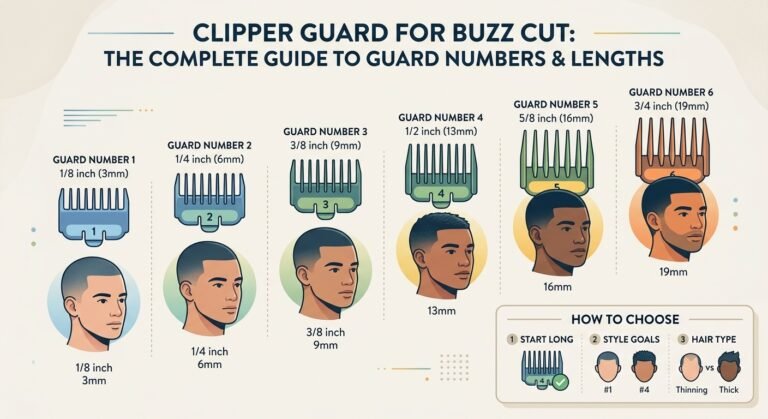
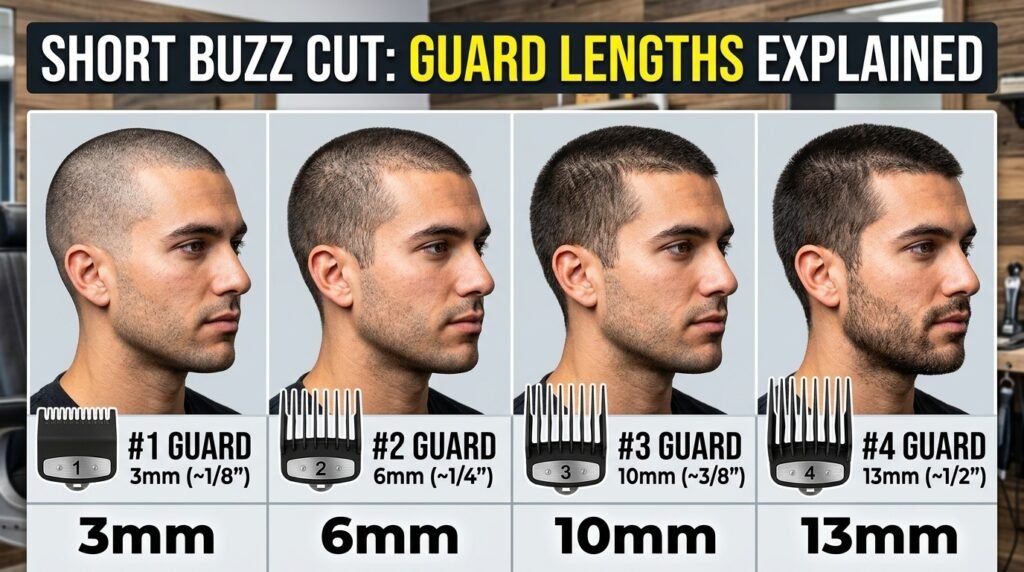
Clipper guards are numbered attachments that control how much hair is left after each pass — lower numbers leave less hair, higher numbers leave more.
Guard Length Chart
| Guard | Approx. length | Look |
|---|---|---|
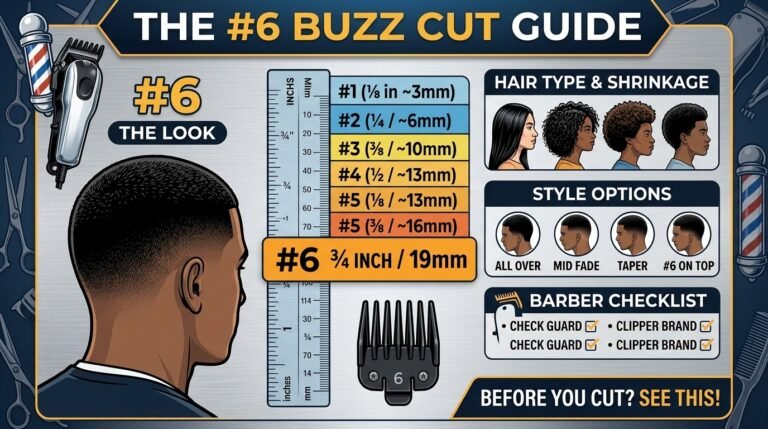
| Skin / no guard (0000–0.5) | Under 1mm | Shaved close to the scalp; used for skin fades and induction-style cuts |
| #1 | ~3mm | Very short; scalp clearly visible through the hair |
| #2 | ~6mm | Short with slightly more coverage; scalp still visible but less prominent |
| #3 | ~10mm | The upper edge of “short”; some natural texture starts to show |
| #4 | ~13mm | Borderline between a short buzz cut and a fuller buzz/crew length |
Related: 6 Guard Buzz Cut: Length, Look, and Everything to Know Before You Get One
What Actually Changes the Result
- Clipper brand and blade condition. Two clippers set to the same guard number can leave slightly different lengths.
- Barber technique. Multiple passes from different angles, or cutting against the grain, can leave hair a touch shorter than a single pass.
- Hair texture. Coarse or curly hair can look longer than straight hair at the same guard because of how it springs back after cutting.
- Side/top combination. Sides and top don’t need to match — many short buzz cuts use one guard on top and a shorter one (or a fade) on the sides.
If a specific look matters, bring a reference photo and ask which guard combination gets closest to it. A shared photo removes more guesswork than a guard number alone.
Very Short Buzz Cut Styles
At skin, #0, or #1 length, the scalp shows through clearly, and any bumps, marks, or hairline unevenness become part of the visible look. That’s not a flaw — it’s simply how close-cropped hair behaves.
- Maintenance is more frequent. With so little length to start, regrowth is noticeable within days, especially around the hairline and neck.
- Scalp care matters more. With minimal coverage, sun exposure and dryness affect the scalp directly — sunscreen or a hat is worth considering outdoors.
- Head shape becomes part of the visual, not a suitability issue — very short hair shows the natural shape of the head rather than concealing it.
- It’s the lowest-effort length day to day, even if it needs more frequent trims to stay looking fresh.
No natural head shape or feature makes this length “wrong” for someone. It’s a matter of personal comfort with a very exposed, minimal look.
Short Buzz Cut With Fade
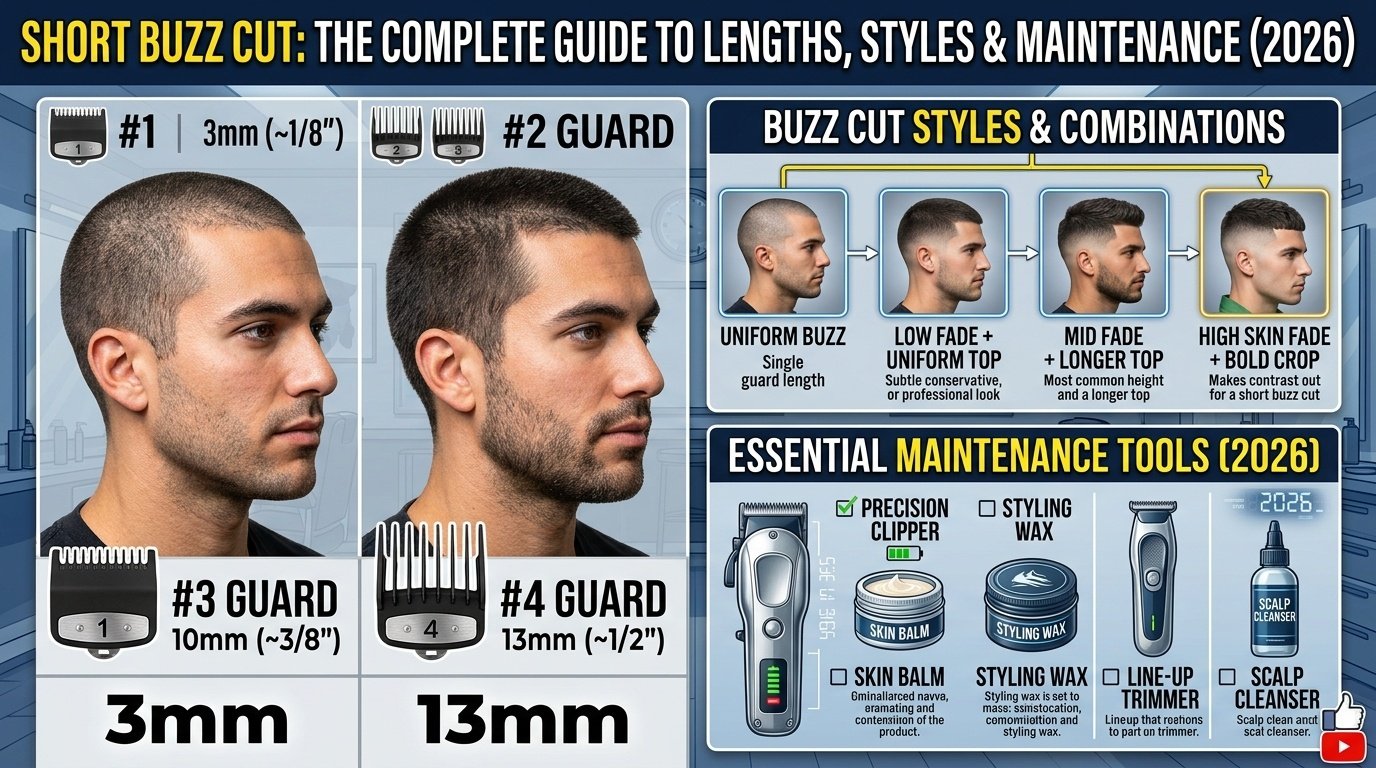
A fade adds a gradual length transition at the sides and back instead of one uniform length all over — it’s the most common way to add shape to a short buzz cut without adding styling effort.
Uniform short buzz cut: the same guard used all over. Clean and simple, no blending required.
Buzz cut with taper: a subtler fade — sides gradually shorten toward the neckline and ears, but the transition is soft rather than sharply blended, and usually doesn’t reach the skin.
Buzz cut with fade: a more defined transition, typically blended down to a shorter guard or the skin.
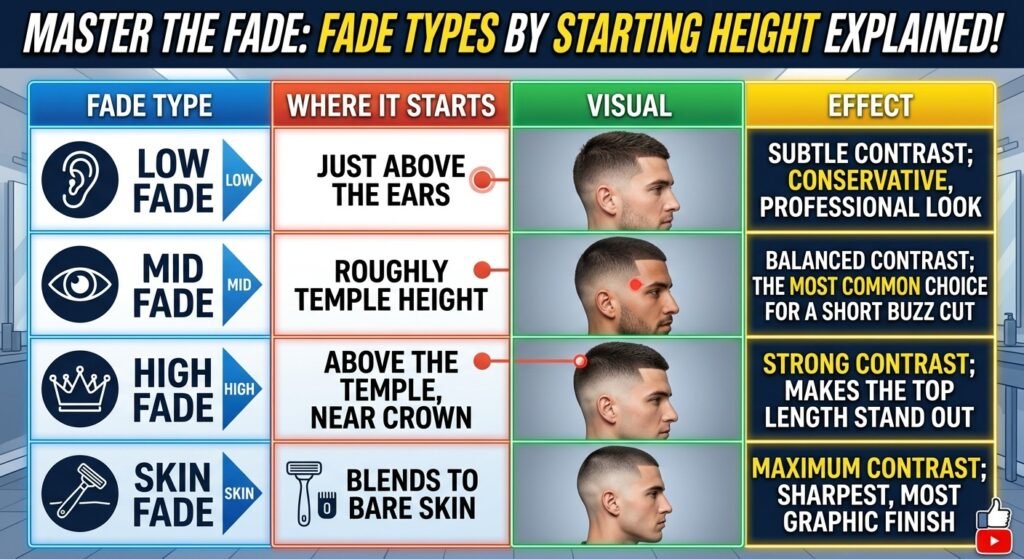
Fade Types by Starting Height
| Fade type | Where it starts | Effect |
|---|---|---|
| Low fade | Just above the ears | Subtle contrast; conservative, professional look |
| Mid fade | Roughly temple height | Balanced contrast; the most common choice for a short buzz cut |
| High fade | Above the temple, near the crown | Strong contrast; makes the top length stand out |
| Skin fade | Blends to bare skin | Maximum contrast; sharpest, most graphic finish |
The higher and closer to skin the fade, the more contrast it creates against the top — and the more often it needs a touch-up, since regrowth shows fastest right at the blend line.
Also Read: Long Buzz Cut Fade: The Complete Guide to Guards, Fades, and Styling
Short Military-Inspired Buzz Cut
The “military buzz cut” — very short sides and top, minimal length, no styling — reflects the practical, low-maintenance grooming standard associated with basic training, though actual regulations vary by country, branch, and unit, so no single haircut represents every military tradition.
What’s commonly called a military-inspired buzz cut today is a civilian style borrowed from that aesthetic: short length (often #1–#3), a clean uniform finish, and little to no fade contrast — though barbers now also offer versions with a fade added for a more modern look. Because the length is short throughout, it needs regular trims — usually every one to three weeks, depending on growth rate and target length.
Short Buzz Cut by Face Shape
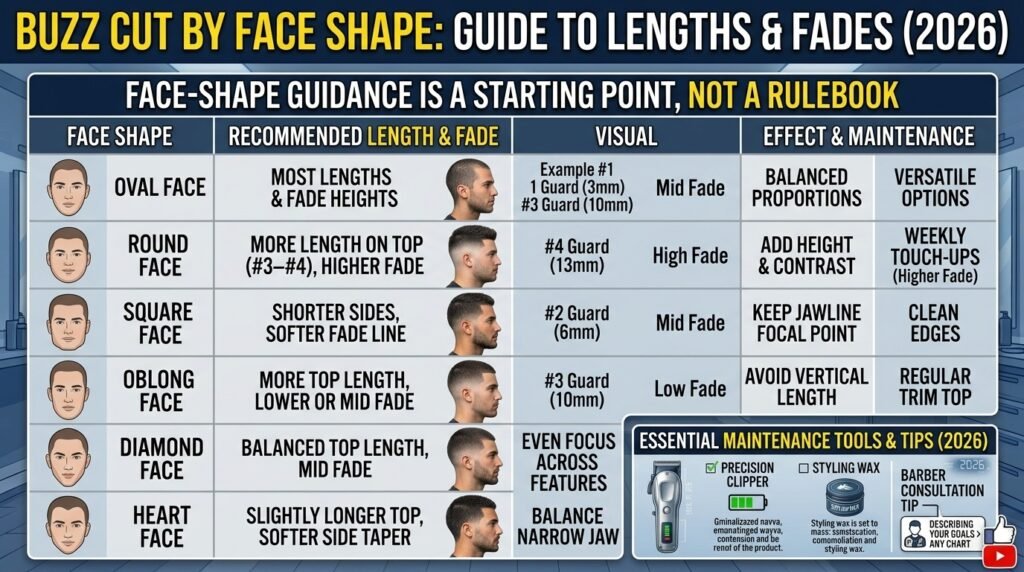
Face-shape guidance is a starting point, not a rulebook: because a buzz cut removes length, fade height and top length shift how facial proportions read, but personal preference outweighs any chart.
| Face shape | What tends to work | Why |
|---|---|---|
| Oval | Most lengths and fade heights | Balanced proportions suit a wide range of short lengths |
| Round | Slightly more length on top (#3–#4), higher fade | Added height and side contrast can create a longer visual line |
| Square | Shorter sides, slightly softer fade line | Keeps the jawline as the focal point without adding width |
| Oblong / rectangular | More top length, lower or mid fade | Avoids adding extra vertical length to an already longer face |
| Diamond | Balanced top length, mid fade | Keeps focus even across cheekbones and jaw |
| Heart | Slightly longer top, softer side taper | Balances a narrower jawline against a wider forehead |
These are general tendencies, not fixed rules. A shorter or longer length than the chart suggests can look just as good depending on hairline, head shape, and how the cut is blended — describing your face and goals to a barber remains more reliable than any chart alone.
Short Buzz Cut by Hair Type
A short length reveals natural hair texture more than almost any other haircut, so hair type changes both the look and the behavior of the same guard number.
- Straight hair: lies flat, showing the cleanest, most uniform line — guard lines and fade transitions are most visible here.
- Wavy hair: adds slight texture and movement even at short lengths; fade lines blend a touch more softly.
- Curly hair: springs back after cutting, so it often looks a little longer than the guard number suggests, keeping visible texture and volume on top.
- Coily hair: a similar spring-back effect, often with more visible density at the same guard — many barbers cut coily hair slightly shorter than the target guard to account for this.
- Thick/dense hair: holds more visible shape and can look fuller even at a low guard number.
- Fine hair: shows the scalp more readily at the same guard length compared to thicker hair.
- Thinning hair: a short buzz cut evens out the visual difference between thicker and thinner areas, since everything is the same short length — though it won’t add density that isn’t there.
None of this makes one hair type more or less “suited” to a short buzz cut. It changes how the same guard number looks and how quickly regrowth becomes noticeable.
Complete Guide: Short Buzz Cut: The Complete Guide to Lengths, Styles & Maintenance (2026)
Short Buzz Cut and Hairlines
Short hair doesn’t hide the hairline — it’s one of the most visible parts of this haircut, including natural variation like widow’s peaks or a hairline sitting slightly higher on one side. This is normal and common.
A receding or thinning hairline is also more visible at short lengths, simply because there’s no length left to soften the transition between hair and skin. A short buzz cut doesn’t hide a receding hairline and doesn’t reverse or treat hair loss — it presents the hairline as it currently is, cleanly and evenly. Barbers can sometimes soften the visual line with fade placement or slightly more length up front, but this is a styling adjustment, not a fix.
Short Buzz Cut With Beard
Facial hair changes the overall balance of a short buzz cut; there’s no requirement to have one.
- Clean-shaven: puts full focus on the haircut — the simplest combination.
- Light stubble: softens the transition between very short hair and bare skin.
- Short, groomed beard: a common pairing, especially with a fade — the beard fade and hair fade can be blended together.
- Fuller beard: adds visual weight to the lower face, balancing well with a shorter top and defined side fade.
Matching beard length loosely to hair length tends to read as more intentional than a large contrast between a very short cut and a long beard — a style preference, not a fixed rule.
Short Buzz Cut Style Ideas
Eight genuinely distinct variations, rather than dozens of near-identical ones:
- Classic uniform buzz cut — one guard length all over (commonly #2–#3), no fade, no taper. The simplest, lowest-maintenance version.
- Skin-close induction-style cut — guard #0–#1, or shaved with no guard. The shortest option.
- Buzz cut with low fade — short top, subtle fade starting just above the ears. Clean, conservative.
- Buzz cut with mid or high fade — visible contrast between top and sides for more shape.
- Buzz cut with taper — a soft, gradual side transition; less contrast than a fade.
- Textured short buzz cut — a slightly longer top (#3–#4) with natural texture left in, more visual interest than a fully uniform cut.
- Short buzz cut with a line-up — a crisp, defined hairline edge, usually paired with a fade.
- Short buzz cut with beard fade — hair fade and beard fade blended together for a connected finish.
Short Buzz Cut Pros and Cons
Advantages
- Minimal daily styling — often none at all
- Quick to wash and dry
- Reduces dependence on styling products
- Simple, predictable routine
- Works well for active lifestyles and hot climates
Worth considering
- Needs regular trims to keep the short length — regrowth is noticeable quickly
- Scalp features, marks, or an uneven hairline become more visible
- Hairline and hair density are on full display, without length to soften them
- More scalp is exposed to the sun, worth protecting
- Growing it back out takes time and patience through the in-between stages
Neither list is universal — some count the low-maintenance routine as the whole appeal; others find the exposure of a very short cut takes getting used to.
How Much Does a Short Buzz Cut Cost?
Pricing depends heavily on location and shop type, but a short buzz cut is typically one of the least expensive professional haircuts because it requires no scissor work and less time in the chair than most other styles.
- Basic barbershop buzz cut (no fade): usually the shop’s lowest-priced men’s cut, often 10–20 minutes in the chair.
- Buzz cut with a fade or line-up: typically priced slightly above a basic buzz cut, reflecting the extra blending time.
- DIY at home: a one-time clipper and guard set is the main cost, after which touch-ups are effectively free — the trade-off is more effort and a higher chance of unevenness, especially for fades.
Exact prices vary widely by region, shop tier, and barber experience, so it’s worth checking rates locally rather than assuming a fixed number.
How to Ask a Barber for a Short Buzz Cut
Being specific about seven details turns “just buzz it” into a predictable result:
- Top length — a guard number (“a #3 on top”) or a general feel (“as short as possible” vs. “a little length left”)
- Side length — same guard as the top, or shorter
- One length or blended — uniform cut, or a fade/taper
- Fade or taper, and where — low, mid, or high, if wanted
- Neckline — squared off or rounded/natural
- Line-up — a defined hairline edge, or a softer natural one
- How short you’re comfortable going — useful if unsure and open to the barber’s guidance
Example requests:
- “I’d like a short buzz cut, a #2 all over, no fade.”
- “Can I get a #3 on top with a low fade at the sides, and a natural neckline?”
- “I want it as short as possible — a skin fade on the sides and a #1 on top.”
Bring a reference photo if a specific look matters — guard numbers alone only communicate so much.
Complete Instruction: Buzz Cut Fade Haircut: The Complete Guide to Fade Levels, Guards & Barber-Ready Instructions
Common Short Buzz Cut Mistakes to Avoid
- Asking for “just a buzz cut” with no length specified. This leaves the exact result up to the barber’s default, which varies shop to shop.
- Going shortest-possible on the first try. Starting at a #3–#4 and going shorter next time is easier to adjust than the reverse.
- Skipping a reference photo for a specific look. Guard numbers and words like “short” mean different things to different people.
- Ignoring scalp sun protection at very short lengths. More scalp exposure means faster sun exposure.
- Waiting too long between fade touch-ups. A fade grows out visibly faster than the rest of the cut and starts looking uneven first.
- Cutting DIY fades without practice. Uniform lengths are forgiving at home; blended fades are not — mistakes here are the hardest to fix yourself.
DIY Short Buzz Cut Basics
What You’ll Need
- A clipper set with multiple guard attachments (commonly #0–#4 for short lengths)
- A smaller trimmer/edger for the neckline and hairline
- A mirror setup that lets you see the back and crown (handheld mirror plus wall mirror, or a helper)
- Good, even lighting
How to Do It
- Start with a longer guard than your target. You can always go shorter; you can’t add hair back.
- Check your work under bright, even lighting. Shadows hide unevenness that becomes obvious later.
- Move the clipper against the direction of hair growth in slow, overlapping passes.
- Use mirrors for the back and crown — the hardest areas to judge on your own.
- Clean the neckline last, once the main length is even, using the smaller trimmer for a crisp line.
- Don’t rush corrections. Fixing unevenness by going shorter in just one spot often creates a new uneven patch — even out the surrounding area instead.
Fades, tapers, and precise line-ups are considerably harder to do evenly on yourself. For those, a professional barber is usually worth it, even if you handle basic maintenance buzzes at home between visits.
Short Buzz Cut Maintenance
How often a short buzz cut needs attention depends on hair growth rate and target length, but general patterns hold:
- Very short lengths (#0–#1): every 1–2 weeks to stay looking freshly cut.
- Short-to-medium lengths (#2–#3): every 2–4 weeks.
- Fades and skin fades: touch-ups sooner than the rest of the cut, since regrowth shows fastest at the blend line.
Beyond trim frequency:
- Wash regularly — short hair shows product buildup and dryness more visibly than longer styles.
- Moisturize the scalp if it feels dry, particularly at very short lengths.
- Keep clippers and guards clean if maintaining the cut at home — buildup on the blades can cause uneven or pulling cuts.
- Touch up the neckline and edges between full cuts if they start looking overgrown.
There’s no single universal schedule — faster hair growth means more frequent trims than the ranges above; slower growth can stretch longer between visits.
Short Buzz Cut Grow-Out Guide
- Weeks 1–3: hair is still very short and mostly holds the buzzed shape; barely noticeable growth.
- Weeks 4–8: length becomes visible, especially on top; the cut starts looking less uniform and slightly shaggy at the edges.
- Weeks 8+: enough length builds up for basic styling or a shape-defining trim, depending on the target length.
A cleanup trim around weeks 4–6 — tidying the neckline and sides without touching the top length — makes the transition look more intentional. Many people use this stage as a bridge toward a crew cut or another short style. Growth rate varies significantly by person, so these are general timelines, not a fixed schedule.
Short Buzz Cut vs. Other Short Haircuts
| Style | Main difference | Typical maintenance | Styling needed |
|---|---|---|---|
| Short buzz cut | Very short, clipper-cut length throughout | Low to moderate | Minimal to none |
| Crew cut | More length and shape left on top | Moderate | Some, for texture on top |
| Fade | Defined, gradually blended side length | Moderate to high | Minimal |
| Taper | Softer, more gradual side/neck transition | Moderate | Minimal |
| Induction-style cut | Extremely short, uniform, close to skin | Frequent | Minimal to none |
Terminology varies between barbers and regions, so this is a general framework, not an industry-wide standard — confirm what a specific term means to your barber before the clippers start.
Short Buzz Cut for Men and Women
A short buzz cut isn’t limited to one gender — it’s shaped by length, fade choice, hair texture, and personal style, not a fixed rule about who can wear it. The building blocks are the same for anyone: choosing a guard length, deciding on a fade or taper, and factoring in face shape and hair type. What changes the finished look is personal preference — a soft taper with no fade for an understated result, a sharp skin fade, or added color, patterns, or texture on top for something bolder. There’s no version of the cut tied to gender; it comes down to length and finish.
This applies across ages too: teens often choose it for low-effort routines during sports or school, young adults frequently pair it with a fade or beard, and adults and older adults often favor the classic uniform version for its simplicity — there’s no required age for the style.
Personalizing Your Short Buzz Cut
Six factors determine the right version — not any single rule:
- Desired length — how short you’re comfortable going, from skin-close to a fuller #4.
- Face shape — a general guide for fade height and top length, not a requirement.
- Hair type — affects how a given guard number actually looks once cut.
- Hair density and hairline — influence how visible the scalp and hairline will be.
- Maintenance preference — shorter lengths and fades need more frequent upkeep than a longer, uniform buzz.
- Personal style — the deciding factor once the practical considerations are accounted for.
Example scenarios:
- Lowest possible maintenance, comfortable with scalp visibility: uniform #1–#2, no fade.
- Polished, professional look with contrast: #3 on top with a low fade.
- Curly hair, wants texture to show: #3–#4 on top, since curl pattern adds visible volume even at shorter guards.
- Easing into going very short: start at #3–#4 and go shorter next visit once comfortable.
Decision Guide
Choose a very short buzz cut if: you want the lowest possible styling effort, you’re comfortable with more scalp showing, and you want the cleanest possible finish.
Consider a slightly longer buzz cut if: you want more coverage and a softer look, you’re unsure about going extremely short, or you have curly/coily hair and want texture to show.
Consider a fade if: you want visual contrast between top and sides, and you like a shorter-sides, longer-top combination.
Consider a taper if: you want a subtler side transition than a fade and prefer a softer finish.
Short Buzz Cut FAQ
What is a short buzz cut? A haircut clipped to a short, uniform length with clippers, typically a #0–#3 guard, often with an optional fade or taper.
How short is a short buzz cut? Between skin-close and about 3/8 inch (10mm) — guards #0 through #3.
What number guard is best for a short buzz cut? There’s no single best guard: #1–#2 gives the shortest, most exposed look; #3 leaves slightly more coverage and texture.
Is a #1 buzz cut very short? Yes — roughly 3mm, short enough that the scalp is clearly visible.
Is a #2 buzz cut shorter than a #3? Yes — #2 is about 6mm, #3 is about 10mm.
Does a buzz cut suit a round face? It can. Slightly more length on top and a higher fade tend to add visual length, a common preference for round faces.
Can you get a short buzz cut with a fade? Yes — low, mid, high, and skin fades are all common pairings.
Is a short buzz cut good for thick hair? Yes. Thick hair holds visible shape well at short lengths and can look fuller even at lower guard numbers.
Is a buzz cut good for thinning hair? It evens out the visual contrast between thicker and thinner areas since everything is cut the same length, but it doesn’t add density.
Does a buzz cut make your hair look thicker? It can appear that way, since short hair stands more upright and shows less density contrast — though it doesn’t change actual hair volume.
How often should you maintain a short buzz cut? Every 1–2 weeks for very short lengths, every 2–4 weeks for slightly longer short buzz cuts; fades need touch-ups sooner.
How do you ask a barber for a short buzz cut? Specify a guard number for top and sides, say whether you want a fade or taper and where, and mention your preferred neckline.
Can women wear a short buzz cut? Yes — it’s shaped by guard length, fade choice, and personal style, not gender.
Can curly or coily hair work with a short buzz cut? Yes — curly and coily hair spring back slightly after cutting, so the same guard often looks fuller than on straight hair.
What is the difference between a buzz cut and a crew cut? A buzz cut is uniformly short all over; a crew cut leaves more length on top for texture or light styling.
What is the difference between a buzz cut and an induction cut? An induction cut is the shortest version — typically a #0 or #1 guard.
How long does it take for a buzz cut to grow back? Noticeable length usually builds up over 4–8 weeks, with enough for basic styling after about two months.
Is a short buzz cut easy to maintain? Day to day, yes — minimal styling required. It needs more frequent barber visits than longer cuts to keep the short length fresh.
How much does a short buzz cut cost? It’s typically one of the least expensive professional cuts, since it requires no scissor work; adding a fade usually costs slightly more.
About This Guide
This guide was compiled from standard clipper-guard conventions and common barbershop practice, cross-checked against current style trends, and written to avoid absolute claims about what suits any individual face, head shape, or hair type. For publication, adding a named review from a licensed barber or stylist would further strengthen its expertise signal.
Related: Long Buzz Cut Fade: The Complete Guide to Guards, Fades, and Styling
Final Thoughts
A short buzz cut is less about picking “a haircut” and more about choosing a specific combination — guard length, fade or no fade, and a neckline finish — that fits your upkeep tolerance and comfort with scalp visibility. The most reliable way to land on the right version is to describe your priorities clearly to a barber, or bring a photo, rather than asking for “a buzz cut” and hoping it matches what’s in your head.

Daniel Carter is the Senior Men’s Grooming Editor at FadeBuzzCut, where he specializes in fade buzz cuts, barbering techniques, men’s hairstyles, and evidence-based grooming advice. With more than 12 years of experience researching haircut trends, clipper techniques, face shape recommendations, and hair care, he creates in-depth guides that help readers confidently choose, maintain, and style modern buzz cuts.
Daniel works closely with experienced barbers, grooming professionals, and trusted industry resources to ensure every guide reflects current barbering standards and practical, real-world advice. His editorial approach combines expert research, clear explanations, and user-focused recommendations to make men’s grooming accessible for beginners and experienced enthusiasts alike.
At FadeBuzzCut.com, Daniel oversees editorial quality, content accuracy, and regular updates so readers receive reliable, up-to-date information on fade buzz cuts, beard combinations, hairstyle trends, clipper guard lengths, maintenance routines, and grooming products. Every article is written with a commitment to Experience, Expertise, Authoritativeness, and Trustworthiness (EEAT) while delivering helpful answers for both readers and AI-powered search experiences.
Whether you’re choosing your first fade buzz cut, comparing low, mid, or high fades, or looking for practical maintenance tips, Daniel’s goal is to provide trustworthy guidance that helps you achieve the best possible results.