12 Guard Buzz Cut: The Complete Length, Look, and Barber Guide
Guide verified against manufacturer specifications — last checked August 2026.
If you’ve seen “12 guard buzz cut” online and assumed it means an extra-close military-style cut, it’s actually the opposite: #12 is one of the longest clipper guards made, not the shortest. This guide explains exactly how long it is (with the length confirmed directly from Wahl’s own product specifications), what it looks like on different hair types, and how to request it without a miscommunication in the chair.
Key Takeaways
- A #12 guard is a long clipper attachment, not a short one — confirmed by Wahl at exactly 1.5 inches (1-1/2″, ~38 mm).
- Wahl sells #10 and #12 as a separate “Extra Long” guide comb set, distinct from its standard #1–#8 lineup — so not every clipper kit or barbershop has one on hand.
- Other major brands (Oster, Andis) don’t universally offer a numbered #12 guard the way Wahl does — the number is not a fixed industry-wide standard above #8.
- At 1.5″, a #12 cut shows visible texture and movement, not scalp — a very different look from a #1–#4 buzz cut.
- Because “buzz cut” is used loosely, always confirm the exact guard/length with your barber rather than relying on the number alone.
Quick Answer: What Is a 12 Guard Buzz Cut?
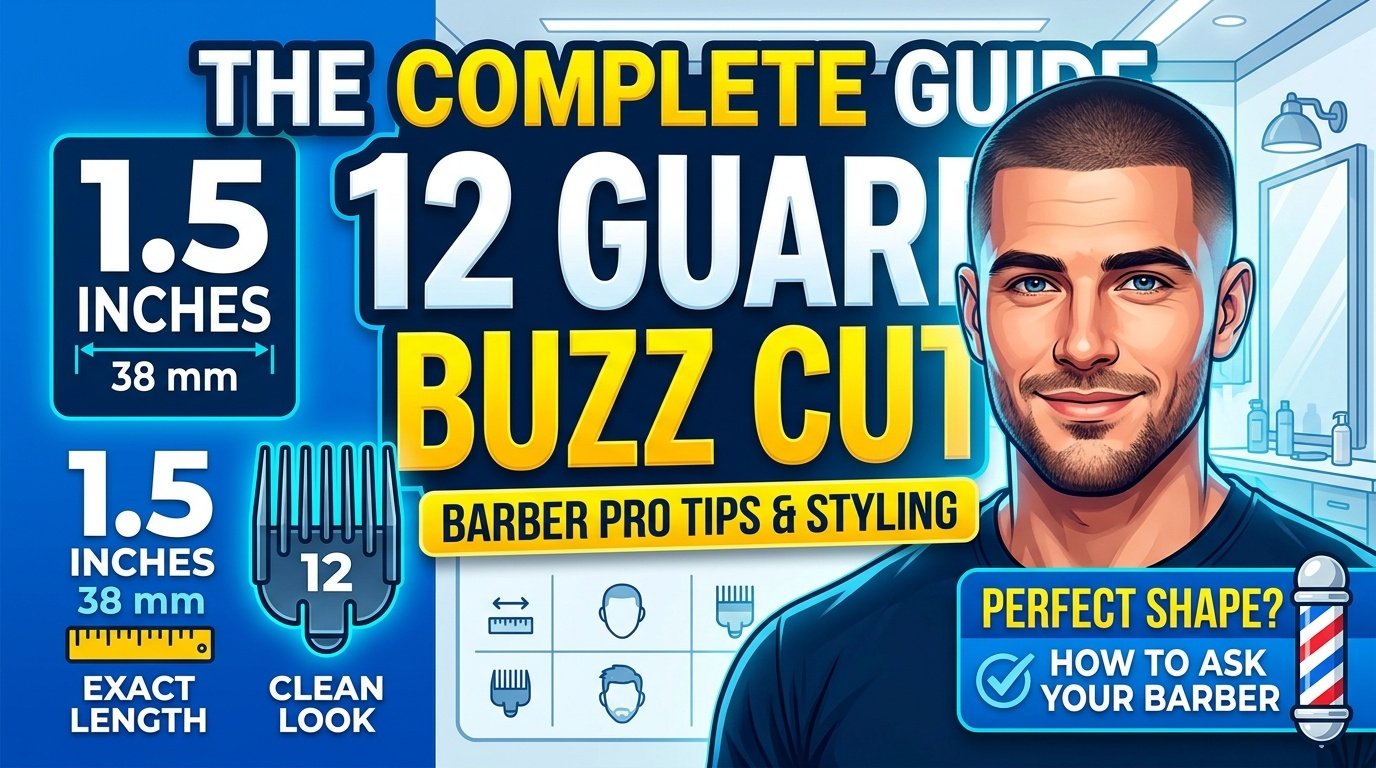
A 12 guard buzz cut is a clipper cut done with a #12 attachment guard — a long guide comb that, on Wahl’s system, leaves exactly 1.5 inches (about 38 mm) of hair. That’s roughly six times longer than a classic #2 buzz cut, so the result looks like a long, uniform clipper cut rather than a close-cropped buzz.
Quick Finder
| If you want to know… | Go to… |
|---|---|
| What a 12 guard buzz cut is | What Is a 12 Guard Buzz Cut? |
| How long #12 actually is (and the source) | How Long Is a 12 Guard Buzz Cut? |
| How many mm a #12 guard is | How Many mm Is a #12 Guard? |
| What #12 looks like | What Does a 12 Guard Buzz Cut Look Like? |
| Whether #12 counts as a “buzz cut” | Is #12 Really a Buzz Cut? |
| How it compares with #8 or #10 | 12 Guard vs Common Buzz Cut Guards |
| Whether it works with a fade or taper | Fades, Tapers, and Top-vs-Sides Combos |
| What to tell a barber | How to Ask a Barber |
| Whether you can cut it at home | DIY Guide |
| How to maintain it | Maintenance and Grow-Out |
| Common questions | FAQs |
What Is a 12 Guard Buzz Cut?
A clipper guard — also called a guide comb or attachment comb — is the plastic or metal comb that snaps onto a clipper blade and holds it a fixed distance from your scalp. The number stamped on the guard is shorthand for that distance, so a barber or a home user can dial in a length without measuring hair strand by strand.
“12 guard buzz cut” describes the result of running a #12 guard over the hair: a fully clipper-cut style, but at the long end of the guard range rather than the short end most people picture when they hear “buzz cut.” It is not a single, formally standardized haircut name the way “crew cut” is — it’s a practical, descriptive term for a length that can be worn several different ways: all one length, on top only, with a taper, or with a fade.
Three things get conflated and shouldn’t be:
| Term | What it actually means |
|---|---|
| Guard number | The label on the physical attachment comb (e.g., “#12”) |
| Cutting length | The approximate hair length left after that guard is used (1.5″ for Wahl’s #12) |
| Finished hairstyle | How the cut is actually shaped — uniform, tapered, faded — which #12 alone doesn’t determine |
How Long Is a 12 Guard Buzz Cut?
According to Wahl’s own product specifications, the #12 guide comb is listed at 1-1/2 inches (1.5″, approximately 38 mm). This isn’t a rough blog estimate — it’s the manufacturer’s stated cutting length, sold specifically as part of a “1-1/4″ (#10) & 1-1/2″ (#12) Long Hair Clipper Guide Comb Set,” marketed for cutting longer hair and fades.
That last detail matters: #10 and #12 are sold by Wahl as a separate “Extra Long” add-on set, not as part of its standard #1–#8 guide comb lineup. Wahl’s own guide to guard sizes describes #8 (1 inch) as “as long as it gets” within the standard set — #10 and #12 exist as a later, longer-length extension for people specifically wanting long clipper cuts and fade tops.
How Many mm Is a #12 Guard?
1.5 inches converts to approximately 38 mm (1 inch = 25.4 mm). Treat this as a close, manufacturer-backed approximation rather than an exact universal figure, because:
- Not every brand makes a numbered #12. Oster’s core guard lineup commonly tops out around #10; a numbered #12 is more of a Wahl-specific size than a cross-brand standard.
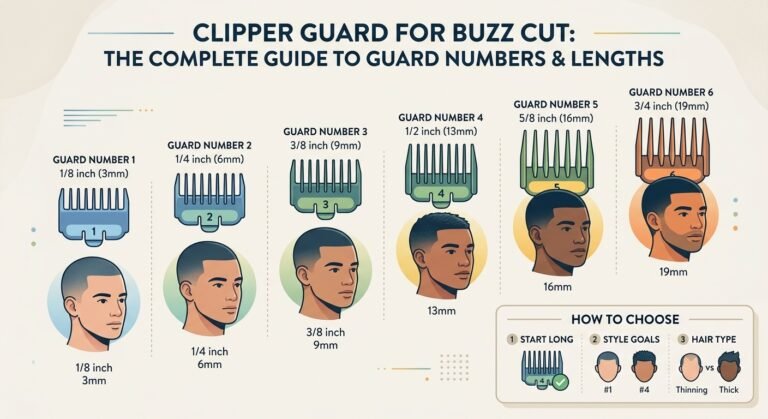
- The #1–#8 range follows a clean, consistent rule across most brands — the guard number roughly equals eighths of an inch (a #4 ≈ 4/8″, or ½”). That formula doesn’t extend cleanly past #8; #10 and #12 are closer to fixed “long” sizes than a continuation of the same math.
- Technique and hardware still move the result. Blade lever position, how flush the guard sits, hair growth direction, and whether the barber cuts with or against the grain can shift the visible outcome by a few millimeters either way.
- Hair texture changes the visible length. Straight hair shows close to the true 1.5″ length; curly and coily hair springs back after cutting, so the same guard can look noticeably shorter once it’s off the clipper.
If the exact length matters to you, ask your barber to confirm the specific guard or lever setting they’re using rather than relying on the number alone.
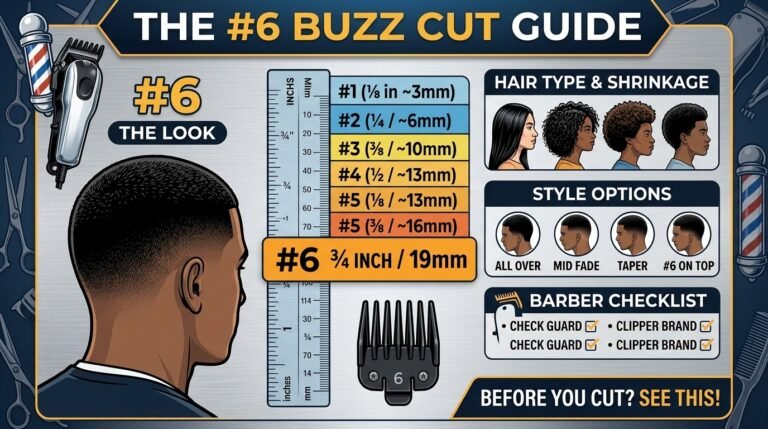
Related: 6 Guard Buzz Cut: Length, Look, and Everything to Know Before You Get One
Common Mix-Up: Guard Number vs. Blade Number
Some clipper systems (Oster and Andis detachable-blade clippers, for example) number their blades separately from their guards, and that numbering can run in the opposite direction — a higher blade number sometimes means a shorter cut, not a longer one. A “#12 blade” in that system is not the same thing as a “#12 guard.” This mix-up is one of the most common reasons a haircut comes out far shorter than expected — when in doubt, describe the length in inches or millimeters instead of quoting a number alone.
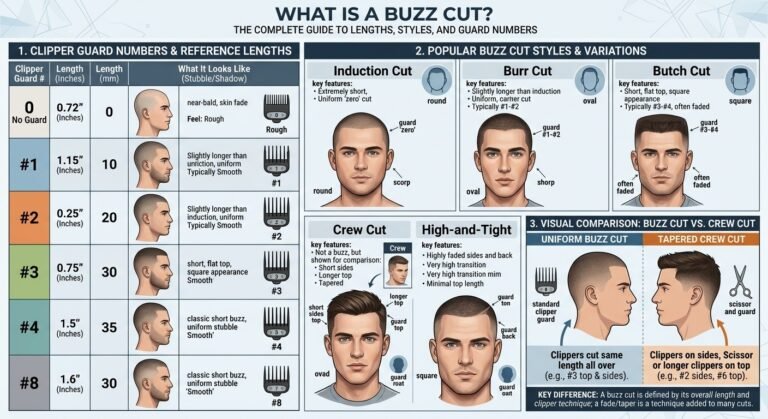
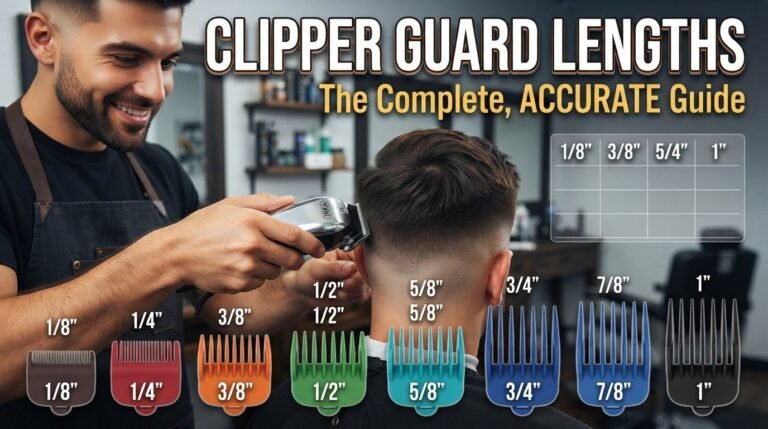
12 Guard vs Common Buzz Cut Guards
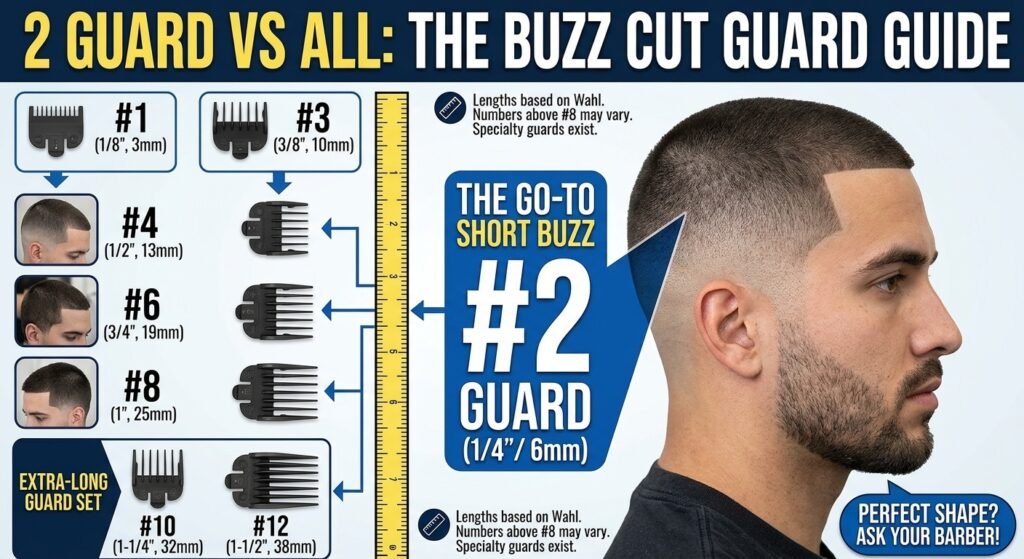
| Guard | Length | Visual result | Typical use |
|---|---|---|---|
| #1 | 1/8″ (3 mm) | Very close, scalp clearly visible | Classic tight buzz |
| #2 | 1/4″ (6 mm) | Short, slight shadow of hair | Common short buzz cut |
| #3 | 3/8″ (10 mm) | More visible hair, still close | Moderate buzz |
| #4 | 1/2″ (13 mm) | Noticeable coverage, soft texture shows | Longer buzz / crew-cut territory |
| #6 | 3/4″ (19 mm) | Clearly more hair, light styling possible | Longer clipper cut |
| #8 | 1″ (25 mm) | Full coverage, combable | Top of Wahl’s standard guard range |
| #10 | 1-1/4″ (32 mm) | Long clipper length, soft finish | Extra-long set; long clipper cuts, fade tops |
| #12 | 1-1/2″ (38 mm) | Longest widely available numbered guard | Extra-long set; long buzz / long clipper-style cuts |
Lengths above are based on Wahl’s published guide comb specifications; other brands’ numbering may vary, especially above #8.
Specialty and third-party guards beyond #12 exist (2″, 3″, or longer) for people wanting an even longer clipper-only length, but #12 is the longest guard included in most mainstream numbered sets.
What Does a 12 Guard Buzz Cut Look Like?
At 1.5 inches, hair cut with a #12 guard has real presence. The scalp isn’t visible the way it is with a #1 or #2 — instead you get a soft, uniform layer of hair with visible texture, some natural fall or lift depending on density, and enough length for hair to move rather than sit flat.
Compared with a #1–#4 buzz cut, a #12 result:
- Shows far less scalp and much less of the underlying head shape
- Retains more of the hair’s natural texture — waves, curls, or coils are clearly visible
- Has a softer, less severe silhouette
- Can be lightly styled with fingers or a small amount of product
Bottom line: the exact look still depends on the individual — dense, dark hair reads as fuller and more solid, while fine or curly hair produces a softer or visually shorter result even at the same 1.5″ guard length.
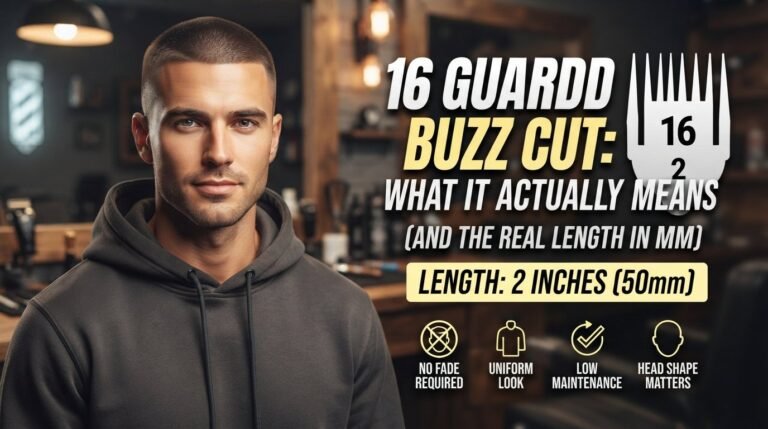
Related: 16 Guard Buzz Cut: What It Actually Means
Is a 12 Guard Buzz Cut Really a “Buzz Cut”?
Technically, yes. “Buzz cut” is normally used as an umbrella term for any hairstyle cut entirely (or almost entirely) with clippers, regardless of length — under that definition, a uniform #12 all-over cut qualifies just as much as a #1.
In everyday use, though, many people — and some barbers — reserve “buzz cut” for the shorter end of the range (roughly #1–#4), since that’s the image the phrase usually conjures. A long, textured #12 result can look and feel closer to a “long clipper cut” than the classic mental image of a buzz cut. Neither usage is wrong; if precision matters, state the guard number or approximate length rather than relying on “buzz cut” alone.
Who Might Prefer a 12 Guard Buzz Cut?
A #12 length tends to appeal to people who want short, low-maintenance hair without going as close as a traditional buzz; who like a uniform clipper finish but want more coverage; who are transitioning gradually into or out of a shorter buzz cut; or who want a longer top paired with shorter, faded, or tapered sides. None of this is a hard rule — suitability comes down mostly to personal preference, not a fixed formula.
Hair type and density
- Straight hair shows close to the true 1.5″ length and tends to lie fairly flat.
- Wavy hair shows more movement and less uniformity at the same guard length.
- Curly and coily hair looks shorter than the measured length due to natural shrinkage, and density can make the result look notably fuller.
- Thick or dense hair at #12 tends to look voluminous and can partly stand up from the scalp; a uniform cut also makes uneven density across the head more visible.
- Fine or thinning hair will still show more scalp in lower-density areas — a longer guard changes how existing hair is cut, not how much hair is actually growing.
Face shape and hairline
A longer, more textured length generally softens the visual effect of head shape compared with a very short buzz. Beyond that general tendency, there’s no single “correct” guard length for any face shape — it’s one factor among many, including personal style and how the sides are finished. A #12 length can also change how a receding hairline or widow’s peak reads visually, simply because there’s more hair covering the area — it does not hide, stop, or reverse hair loss; that’s a cosmetic effect of length, not a treatment.
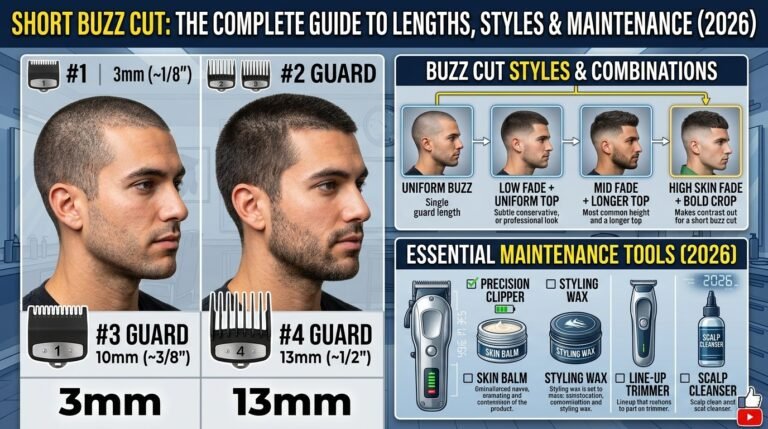
Related: Short Buzz Cut: The Complete Guide to Lengths, Styles & Maintenance (2026)
Fades, Tapers, and Top-vs-Sides Combos
A #12 guard describes a length, not a complete haircut, so it’s almost always paired with a decision about the rest of the head:
- #12 all over — the same guard used on top, sides, and back for a fully uniform result. Simplest to maintain, closest in spirit to a traditional buzz cut, just longer.
- #12 on top, shorter sides — the top stays at #12 while sides/back use a shorter guard, then get blended. This can start to resemble a longer crew cut depending on exactly how short the sides go.
- #12 with a taper — sides gradually shorten toward the hairline without a hard line; subtler than a fade.
- #12 with a fade (low, mid, or high) — sides cut progressively shorter, often down to skin, for stronger contrast against the longer top.
None of these combinations are formally standardized names — describe exactly what you want (guard number for the length you’re keeping, plus fade/taper/side-length preference) rather than assuming “#12 fade” means one universal look.
Related: Buzz Cut Fade Haircut: The Complete Guide to Fade Levels, Guards & Barber-Ready Instructions
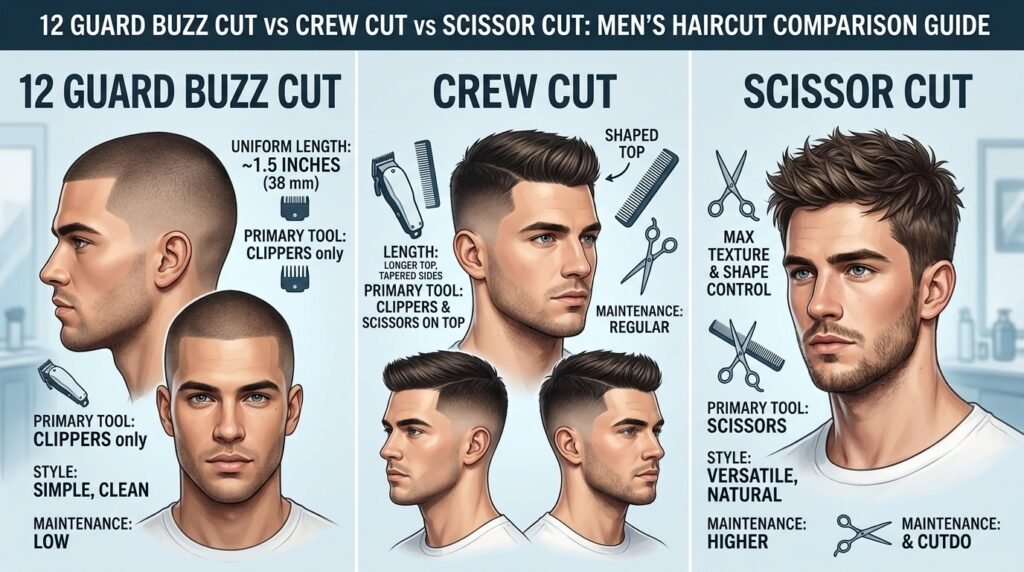
12 Guard Buzz Cut vs Crew Cut vs Scissor Cut
| 12 guard buzz cut | Crew cut | Scissor cut (short) | |
|---|---|---|---|
| Primary tool | Clippers | Clippers + scissors on top | Scissors, sometimes clippers on sides |
| Top length | Uniform ~1.5″ if used on top | Slightly longer, often shaped | Varies — most length control |
| Shape control | Minimal — mostly length | More shape, often a slight peak | Highest shape and texture control |
| Styling flexibility | Low to moderate | Moderate | Highest |
| Side treatment | Same guard, shorter guard, taper, or fade | Usually tapered or faded shorter | Usually blended or tapered |
| Maintenance | Simple if uniform; more if faded | Regular trims to keep the shape | More frequent shaping visits |
Bottom line: a #12 buzz cut is defined mainly by uniform clipper length, a crew cut adds intentional shaping on top, and a scissor cut trades clipper-line precision for texture and control.
Pros and Cons
Advantages: more coverage and softer texture than a #1–#4 buzz cut · minimal daily styling if kept uniform · simple to maintain versus intricately shaped cuts · retains natural texture and movement · works as a step into or out of a shorter buzz · pairs well with a taper or fade.
Trade-offs: doesn’t produce the classic close “shaved” look some people specifically want · a uniform length can make uneven density or directional growth more visible · looks noticeably different on dense vs. fine hair · a genuinely polished, shaped finish may still need some scissor work · #12 isn’t available in every clipper kit or shop, so confirm availability first.
How to Ask a Barber for a 12 Guard Buzz Cut
Before you sit down, know:
- Do you want #12 all over, or only on top?
- If top-only, how short do you want the sides and back?
- Fade, taper, or a straight blend between lengths?
- Should the neckline be squared off or left natural?
- Do you want the hairline edged?
- Do you have a reference photo (front, side, back)?
Example requests:
“I’d like a #12 guard all over — the same length on the top, sides, and back.”
“I want about a #12 on top, with the sides tapered down shorter and a clean neckline.”
Ask your barber to confirm the actual length their #12 (or nearest equivalent) produces on their specific clippers, since it can vary slightly by brand. Tip: screenshot the comparison table above and show it to your barber if you want to reference a specific guard number confidently.
12 Guard Buzz Cut DIY Guide
A uniform #12 all-over cut is one of the more forgiving styles to attempt at home, since there’s no fade line or shaping to get wrong:
- Confirm what length your specific #12 (or nearest equivalent) guard actually cuts to before starting.
- Make sure the guard is securely attached — a loose guard is the most common cause of uneven results.
- Start with clean, dry, detangled hair.
- Work systematically in sections rather than randomly.
- Go over each section in a couple of directions; cutting against the direction of growth generally gives more even results.
- Use a handheld mirror with a wall mirror to check the back and crown.
- Check behind the ears and around the nape carefully — the most commonly missed spots.
- Inspect the whole head under bright, even lighting before deciding you’re done.
- Only attempt neckline cleanup if you’re comfortable with it.
A single guard length is manageable solo. Fades, tapers, and precise shaping are much harder to do evenly on your own head and are usually worth a barber visit.
Maintenance and Grow-Out
A uniform #12 cut is relatively low-maintenance day to day since there’s no fade line to keep sharp. Basic upkeep: regular washing, normal scalp care, clean and oiled clippers if self-maintained, and neckline touch-ups as needed. A fade or taper paired with #12 will need more frequent attention than a plain uniform cut, since fades grow out visibly faster than they read.
There’s no universal trim schedule — frequency depends on your hair’s growth rate, how strictly you want to keep the exact length, and whether you’re maintaining a fade or taper. As hair grows out from #12, it doesn’t “expire”; it gets progressively longer and softer, gradually trending toward crew-cut territory before it needs a full cut or shape-up. Growth rates vary enough between individuals that a precise week-by-week timeline isn’t reliable — watch how the length and any fade line actually look rather than following a calendar.
Common Mistakes When Asking for a #12
| Mistake | Fix |
|---|---|
| Saying only “buzz cut” | Specify the guard number or approximate length |
| Assuming every barber’s #12 is identical | Ask them to confirm the length, especially at a new shop |
| Not specifying all-over vs. top-only | State the length you want on sides and back too |
| Requesting “a fade” without specifics | Say low, mid, or high, and whether it goes to skin |
| Skipping a reference photo | Bring front, side, and back images if the result matters |
| Confusing a guard number with a blade number | Describe the length in inches/mm if unsure which system applies |
What to Show Your Barber
A reference photo is especially useful for a longer clipper cut like #12, since there’s more room for interpretation than with a one-length short buzz. Bring images showing the front, both sides, the back, the top, and — if you want a fade or taper — a close-up of the side transition. The photo communicates the visual result; the guard number communicates the cutting method. No photo guarantees an identical outcome on different hair.
Style Ideas
| Version | Top | Sides | Overall effect |
|---|---|---|---|
| #12 all over | #12 | #12 | Uniform, soft long clipper cut |
| #12 with taper | #12 | Gradually shorter | Clean but subtle contrast |
| #12 with low fade | #12 | Shorter near the bottom only | Understated modern contrast |
| #12 with mid fade | #12 | More pronounced transition | Higher-contrast, barbered look |
| #12 top, shorter sides | #12 | Distinct shorter guard (e.g., #4–#6) | Longer-top clipper style, crew-cut adjacent |
Decision Guide
Choose #12 all over if you want one simple, consistent length, more coverage than a short buzz, and minimal styling effort.
Choose #12 with a taper if you want subtle side shaping while keeping the top relatively long.
Choose #12 with a fade if you want stronger contrast and a more deliberately barbered look.
Choose a shorter guard (#1–#4) if you specifically want the classic close, low-visibility buzz cut.
Consider a crew cut instead if you want more defined shape on top and more styling flexibility than a uniform clipper length offers.
FAQs
What is a 12 guard buzz cut? A clipper cut done with a #12 attachment guard, which on Wahl’s system leaves 1.5 inches (about 38 mm) of hair — much longer than a typical short buzz cut.
How long is a #12 guard haircut? 1.5 inches (1-1/2″), confirmed by Wahl’s own product specifications; this can vary slightly by clipper brand.
How many mm is a number 12 guard? Approximately 38 mm.
Is a number 12 buzz cut long? Yes — relative to the common #1–#4 range for a classic short buzz, #12 is long for a clipper-guard length.
Is #12 the longest buzz cut guard? It’s the longest guard in most standard numbered sets, though specialty or third-party guards can go longer.
What does a #12 buzz cut look like? A soft, uniform layer of hair with visible texture and movement — much more coverage than a short buzz.
Is a #12 guard the same on every clipper? Not necessarily. Not every brand offers a #12, and exact lengths can vary slightly between manufacturers.
Is a #12 buzz cut considered a buzz cut? Technically yes, under the broad definition of any clipper-only cut, though some people reserve “buzz cut” for shorter lengths.
Is a #12 buzz cut longer than a #8? Yes. #8 is 1 inch (25 mm); #12 is 1.5 inches (38 mm).
What is the difference between a #10 and #12 guard? A quarter inch: #10 is 1-1/4″ (32 mm) and #12 is 1-1/2″ (38 mm) — both sold by Wahl as part of the same “Extra Long” comb set.
Can you get a fade with a #12 buzz cut? Yes — #12 sets the top length while the sides are gradually shortened for the fade.
Can you get a taper with a #12 buzz cut? Yes, a taper works the same way as a fade but with a more gradual transition.
Can a barber use #12 all over? Yes — a single, uniform pass across the whole head is one of the most common ways to wear this length.
Is a #12 buzz cut good for thick hair? It can work well, showing off thick hair’s volume and texture, though very dense hair may look fuller than expected.
Is a #12 buzz cut good for thinning hair? It offers more coverage than a very short buzz but won’t hide significant thinning and doesn’t affect actual hair density.
Can curly hair be cut with a #12 guard? Yes, though curl shrinkage means the visible length typically looks shorter than the measured 1.5″.
How do I ask a barber for a #12 buzz cut? Specify the guard number, whether it’s all over or top-only, side length preference, and fade/taper choice.
Can I do a #12 buzz cut at home? A uniform all-over #12 is one of the more forgiving DIY options; fades and precise shaping are harder to do solo.
How often should you maintain a #12 buzz cut? No universal schedule — it depends on growth rate and whether you’re maintaining a fade, which grows out visibly faster.
How long does a #12 buzz cut take to grow out? No fixed timeline; the cut gradually loses its crisp, uniform look and starts resembling a longer short hairstyle.
Is a #12 buzz cut the same as a crew cut? Not exactly — #12 is a length, while a crew cut is a shaped style with more graduation on top.
Sourcing Note
Guard-length figures for #1–#12 in this guide are drawn from Wahl USA’s published product specifications for its standard #1–8 guide comb set and its separate #10/#12 “Extra Long” guide comb set. Brand-comparison notes (Oster, Andis) reflect each brand’s publicly listed guard ranges at the time of writing. Because manufacturers periodically update product lines, readers planning a specific cut should confirm current specs with their barber or the clipper manufacturer directly.
Conclusion
“12 guard buzz cut” describes a specific length — 1.5 inches, confirmed directly by Wahl — rather than one fixed, universally standardized haircut. It sits at the long end of the clipper-guard spectrum, sold by Wahl as part of a dedicated “Extra Long” set rather than its base #1–#8 lineup, and gives noticeably more coverage and texture than a short buzz cut. Whether it works for you comes down to how you want it finished: uniform, tapered, or paired with a fade. The most reliable way to get the result you want is to be specific with your barber about the guard number, the side treatment, and — if exact length matters — the confirmed measurement rather than the number alone.

Daniel Carter is the Senior Men’s Grooming Editor at FadeBuzzCut, where he specializes in fade buzz cuts, barbering techniques, men’s hairstyles, and evidence-based grooming advice. With more than 12 years of experience researching haircut trends, clipper techniques, face shape recommendations, and hair care, he creates in-depth guides that help readers confidently choose, maintain, and style modern buzz cuts.
Daniel works closely with experienced barbers, grooming professionals, and trusted industry resources to ensure every guide reflects current barbering standards and practical, real-world advice. His editorial approach combines expert research, clear explanations, and user-focused recommendations to make men’s grooming accessible for beginners and experienced enthusiasts alike.
At FadeBuzzCut.com, Daniel oversees editorial quality, content accuracy, and regular updates so readers receive reliable, up-to-date information on fade buzz cuts, beard combinations, hairstyle trends, clipper guard lengths, maintenance routines, and grooming products. Every article is written with a commitment to Experience, Expertise, Authoritativeness, and Trustworthiness (EEAT) while delivering helpful answers for both readers and AI-powered search experiences.
Whether you’re choosing your first fade buzz cut, comparing low, mid, or high fades, or looking for practical maintenance tips, Daniel’s goal is to provide trustworthy guidance that helps you achieve the best possible results.