Clipper Guard for Buzz Cut: The Complete Guide to Guard Numbers, Lengths, and How to Choose
Last updated: August 2026
A buzz cut’s final look comes down to five things working together: the guard number, the clipper blade underneath it, your hair’s texture and density, and the barber’s technique. Change any one of them and the same “guard number” can produce a different haircut. This guide untangles all five, starting with the guard itself.
TL;DR: What Clipper Guard Should You Use for a Buzz Cut?
There’s no single correct guard — a buzz cut spans a range, not one length. Guards #1–#4 produce the classic short, close-cropped buzz. Guards #5–#8 create a fuller, longer clipper-cut look. Past #8, the result starts to read as a long buzz or crew cut rather than a traditional close buzz. Guard numbers are consistent within most brands but not perfectly across them, so treat the number as a strong starting point, not a lab-grade measurement.
Jump to What You Need
| If you want to know… | Go to… |
|---|---|
| What a clipper guard actually is | What Is a Clipper Guard? |
| Guard vs. blade, explained | Clipper Guard vs. Clipper Blade |
| Exact lengths, #1 through #12 | Buzz Cut Guard Length Chart |
| Whether Wahl, Andis, and Oster match | Do Guard Sizes Match Across Brands? |
| What #1–#3 look like | Short Buzz Cut Guards |
| What #2–#4 look like | Classic Buzz Cut Guards |
| What #5–#12 look like | Medium and Long Buzz Cut Guards |
| How to pick a length | Choosing Your Guard |
| How hair type changes the result | How Hair Type Changes the Result |
| Guards for fades and tapers | Guards for Fades and Tapers |
| How to talk to a barber | What to Tell Your Barber |
| Cutting your own buzz cut | Cutting a Buzz Cut at Home |
| Common questions | FAQs |
What Is a Clipper Guard?
A clipper guard — also called a guide comb or attachment comb — is a plastic or metal comb-shaped piece that snaps onto the clipper blade. It holds the blade a fixed distance from your scalp, so instead of cutting hair down to the blade’s edge, the clippers leave behind whatever length the guard allows.
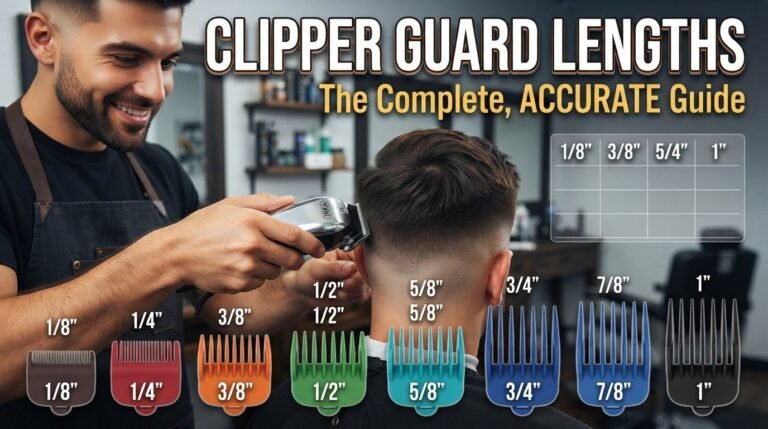
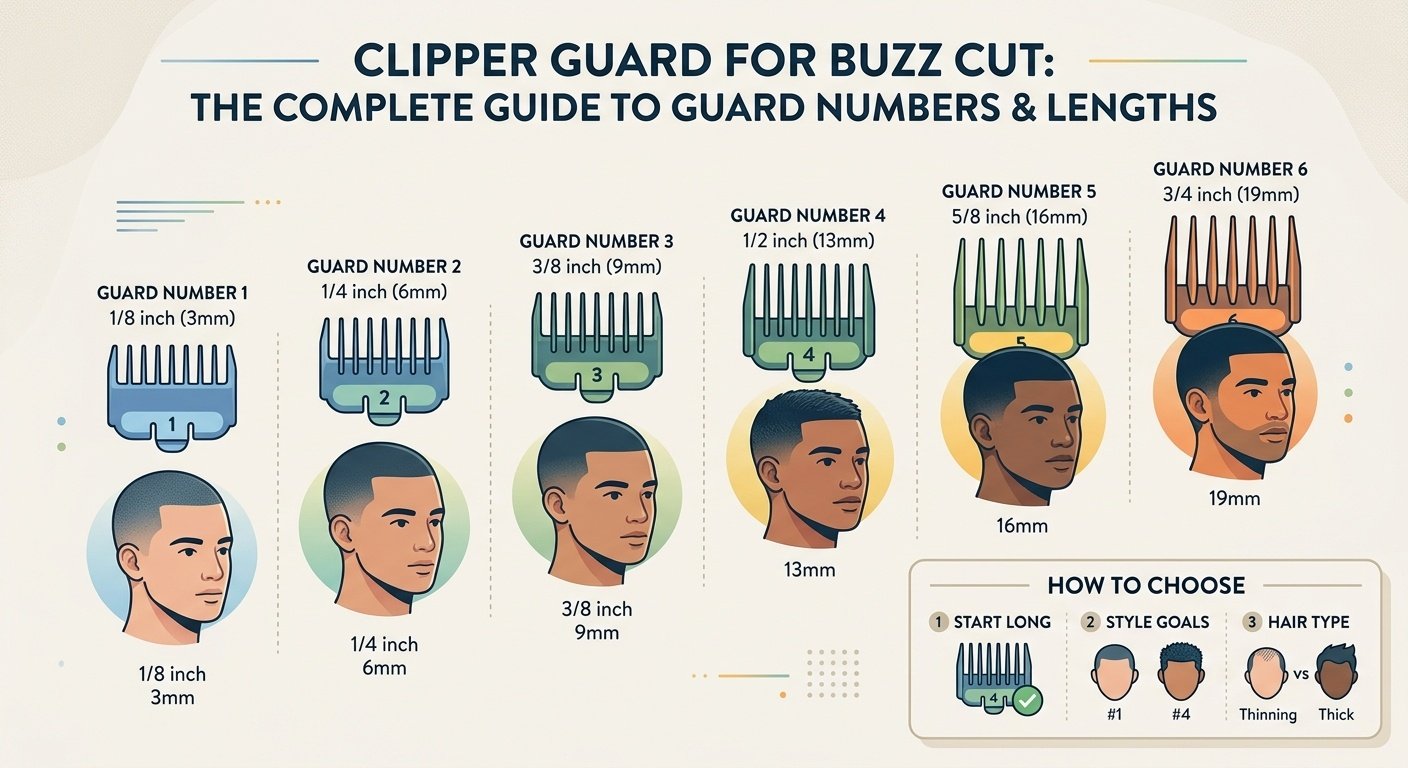
Guards are numbered as shorthand for length. On most brands, the number roughly tracks eighths of an inch: a #1 leaves about 1/8″, a #4 leaves about 1/2″. Higher numbers leave more hair; lower numbers leave less.
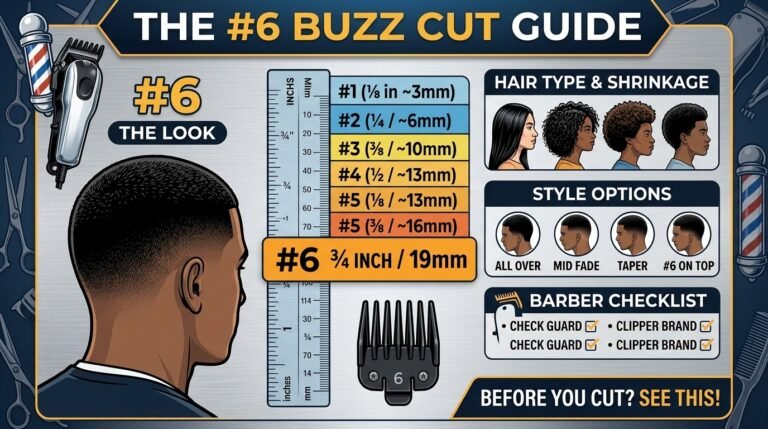
Related: 6 Guard Buzz Cut: Length, Look, and Everything to Know Before You Get One
Why the guard isn’t the whole story
- It sets a starting point, not the finished result. Blade angle, number of passes, cutting direction, and the barber’s technique all shape what you actually end up with.
- Numbering isn’t identical across brands. Wahl, Andis, and BaByliss PRO largely share the same eighths-of-an-inch convention. Oster’s professional detachable-blade clippers work on a different logic entirely — full comparison below.
- The lever adjustment can shift the outcome. Many clippers have a taper lever that moves the blade slightly closer to or farther from the guard, adding or subtracting a millimeter or two from the “official” length.
Clipper Guard vs. Clipper Blade
Short answer: a guard is the removable comb attachment; a blade is the cutting mechanism underneath it. They’re often used interchangeably in conversation, which causes real confusion at the barber chair.
The guard is what most people mean when they say “guard number” — the comb piece that clips on and off.
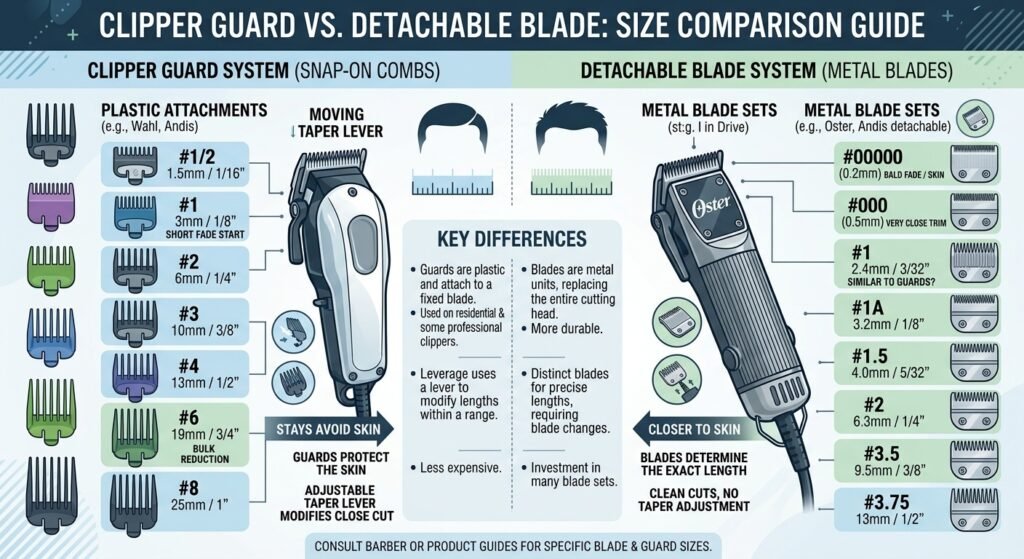
The blade is the mechanism that actually cuts. On clippers with a taper lever, adjusting the lever changes the blade’s cutting length directly, with no guard involved. On professional detachable-blade clippers — Oster’s Classic 76 is the best-known example — barbers swap entire numbered blades instead of snapping combs onto one fixed blade, and that blade-numbering system runs on its own scale.
Why it matters: a “#1” on a comb-guard system and a “#1” blade on a detachable-blade system are not the same length. Two barbers can both say “give you a one” and mean two different results. If precision matters — for a fade especially — ask which system is in use, or describe the length in addition to the number.
Complete Guide: 12 Guard Buzz Cut: The Complete Length, Look, and Barber Guide
How Buzz Cut Guard Numbers Work
In short: smaller number = shorter hair, larger number = longer hair. That rule holds almost everywhere, but four things keep it from being an exact science:
- Numbering isn’t universal. Wahl, Andis, and BaByliss PRO track closely with each other. Oster’s detachable blades run on a separate, largely reversed scale.
- Half sizes exist because the early jumps are big. Going from #1 to #2 is close to doubling the length — which is why #0.5 and #1.5 guards exist, mainly for smoothing fade transitions.
- The lever changes the math. The same guard can leave a slightly different length depending on where the taper lever sits.
- Technique changes the visual result. Cutting direction, number of passes, and dry vs. damp hair all affect how a given guard looks once you’re done.
Treat the guard number as a dependable starting point, not a promise that identical numbers always mean identical millimeters everywhere.
Related: 16 Guard Buzz Cut: What It Actually Means (And the Real Length in mm)
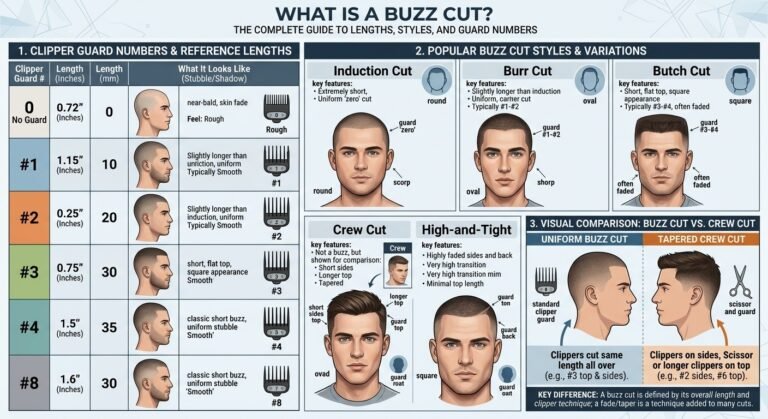
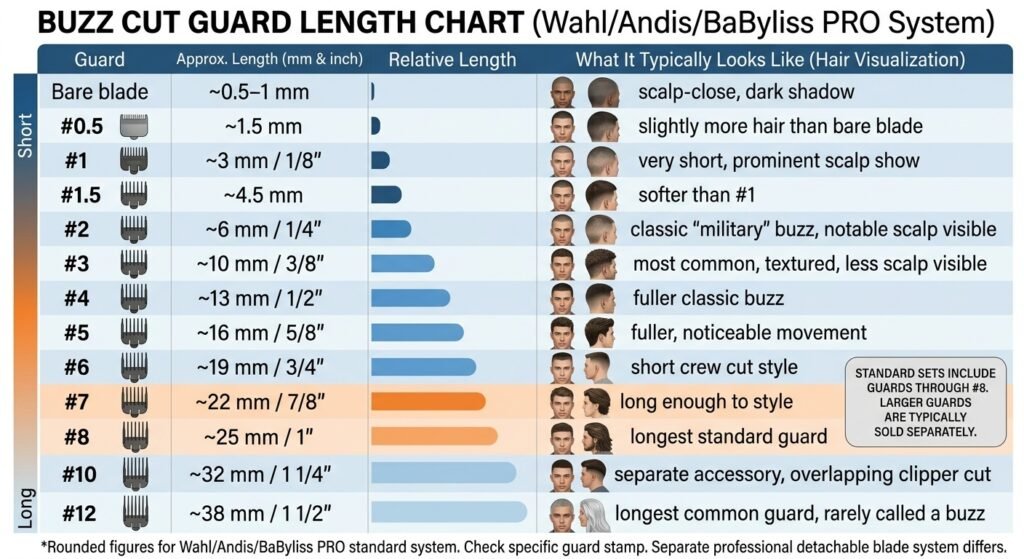
Buzz Cut Guard Length Chart
In short: #1 is about 3 mm, each step up adds roughly another 1/8 inch, and #8 (about 25 mm / 1″) is the longest guard included in most standard sets.
This chart uses the eighths-of-an-inch convention shared by Wahl, Andis, and BaByliss PRO — the system behind most home clippers and barbershop guard sets.
| Guard | Approx. length | Relative length | What it typically looks like |
|---|---|---|---|
| No guard / bare blade | ~0.5–1 mm | Very short | Dark shadow close to the skin — not fully bald |
| #0.5 | ~1.5 mm | Very short | Slightly more than a bare blade; common at the base of a skin fade |
| #1 | ~3 mm (1/8″) | Very short | Scalp clearly visible; the closest common buzz length |
| #1.5 | ~4.5 mm | Very short–short | Softer than #1; used mainly for blending |
| #2 | ~6 mm (1/4″) | Short | The classic “military” buzz — noticeable scalp show, especially on lighter or thinner hair |
| #3 | ~10 mm (3/8″) | Short | The most commonly requested buzz length; visible texture, less scalp show than #2 |
| #4 | ~13 mm (1/2″) | Short–medium | Fuller classic buzz; can be lightly brushed |
| #5 | ~16 mm (5/8″) | Medium | Noticeably fuller, with some movement |
| #6 | ~19 mm (3/4″) | Medium | Starts to resemble a short crew cut more than a tight buzz |
| #7 | ~22 mm (7/8″) | Medium–long | Enough length to comb or style with product |
| #8 | ~25 mm (1″) | Long | Longest guard in most standard sets |
| #10 | ~32 mm (1 1/4″) | Long | Usually sold separately; overlaps with a long clipper cut |
| #12 | ~38 mm (1 1/2″) | Longest common guard | Mainly available on Wahl-compatible sets; rarely called a “buzz” |
Accuracy footnote: These are rounded, commonly cited figures for the standard comb-guard convention (Wahl/Andis/BaByliss PRO). Individual guards can differ by a fraction of a millimeter between brands, and Oster’s professional detachable-blade system uses different numbering entirely (see the comparison below). Guards past #8 are typically separate accessories rather than included in a standard set. When precision matters, check the number stamped on your specific guard.
Related: Clipper Guard Lengths: The Complete, Accurate Guide
Do Guard Sizes Match Across Brands?
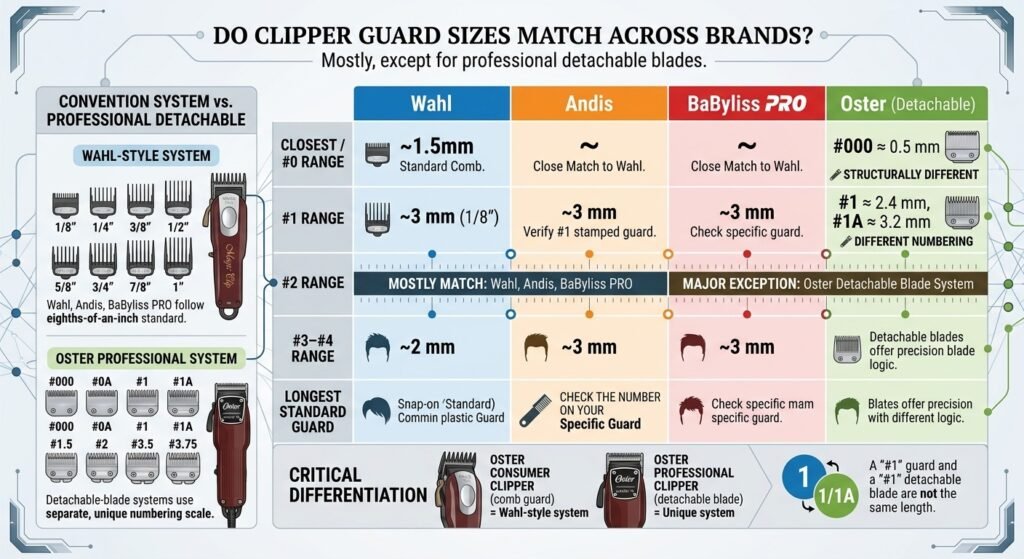
Short answer: mostly, with one major exception. Wahl, Andis, and BaByliss PRO’s snap-on comb guards follow the same eighths-of-an-inch logic and land close to each other at every number. Oster’s professional detachable-blade clippers — not Oster’s simpler comb-guard models — use a structurally different system.
| Length category | Wahl (comb guard) | Andis (comb guard) | BaByliss PRO (comb guard) | Oster detachable blade (e.g., Classic 76) |
|---|---|---|---|---|
| Closest / #0 range | ~1.5 mm | Runs close to Wahl at this range | Runs close to Wahl at this range | #000 ≈ 0.5 mm |
| #1 | ~3 mm (1/8″) | Close to Wahl’s #1 — confirm on the guard itself, as sources vary here | Close to Wahl’s #1 | #1 ≈ 2.4 mm; #1A ≈ 3.2 mm |
| #2 | ~6 mm (1/4″) | Close to Wahl’s #2 | Close to Wahl’s #2 | #2 ≈ 6 mm |
| #3–#4 | ~10–13 mm | Close to Wahl, confirm on guard | Close to Wahl | #3.5 ≈ 10 mm (no direct #4 equivalent) |
| Longest standard guard | #8 ≈ 25 mm (1″) | Around 25 mm; some sets top out shorter | Standard sets often stop nearer 19 mm (3/4″) | Not applicable — detachable-blade systems use a separate comb attachment for longer lengths |
Important nuance: Oster also sells consumer clippers with simple snap-on comb guards, and those generally follow the same Wahl-style convention. It’s specifically Oster’s professional detachable-blade clippers, like the Classic 76, that run on the different numbering system described above. If you’re not sure which type you have, check whether the clipper uses a single fixed blade with snap-on combs (Wahl-style) or interchangeable numbered blades (Oster Classic-style).
Short Buzz Cut Guards (No Guard–#1–#3)
This is the range most people picture when they hear “buzz cut.”
- No guard / bare blade: the closest clipper cut possible without switching to a razor or foil shaver — a dark shadow, not smooth skin.
- #1: shows a good amount of scalp, especially under bright light or on lighter hair colors. About as close as most people go without going fully bald.
- #2–#3: the most commonly requested “clean buzz” range. Scalp visibility drops noticeably from #1 to #3, and texture starts to show.
Low-maintenance and even-growing, but also the range where scalp shape, hairline irregularities, and density differences are most visible — there’s very little length to hide behind.
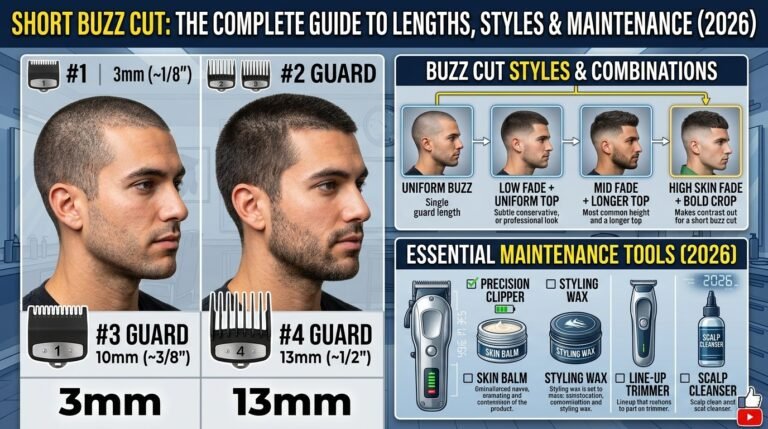
Also Read: Short Buzz Cut: The Complete Guide to Lengths, Styles & Maintenance (2026
Classic Buzz Cut Guards (#2–#4)
If someone says “give me a buzz cut” with no other detail, this is the range a barber usually defaults to — it reads as a deliberate haircut rather than a shave or a longer clipper cut.
- #2: close, classic buzz with clear scalp visibility on most hair types.
- #3: commonly cited as the single most requested buzz length — a clean look with noticeably less scalp show than #2.
- #4: the upper edge of “classic buzz” territory. Enough length for visible texture; depending on density, it can start to look more like a short crop than a tight buzz.
The visual jump between adjacent numbers here (say, #2 vs. #3) is often bigger than the millimeter difference suggests, because scalp visibility drops fastest at the shortest lengths.
Related: Hair Clipper Guard Sizes: The Complete, Accurate Guide
Medium and Long Buzz Cut Guards (#5–#12+)
Past #4, “buzz cut” becomes a looser term — barbers and clients start calling these lengths a fuller buzz, a clipper cut, or a crew cut depending on styling.
- #5–#6: enough hair for visible movement and light styling, while still cut uniformly.
- #7–#8: usually the longest guards in a standard set. Many people can comb or lightly style at this length; it starts overlapping with what some call a “long buzz cut.”
- #10–#12: typically sold separately, less commonly used for a traditional buzz look, and more associated with an all-over “clipper cut” that stays short without being tight.
There’s no industry-agreed cutoff for where “buzz cut” stops applying — that line is about styling convention, not a technical spec.
Choosing Your Guard: A Decision Framework
Want the closest possible look? No guard or a #1 — the most scalp show, the least room for error.
Want the recognizable classic buzz cut? #2–#4 is the most commonly chosen range and reads clearly as a buzz rather than a shave or a crop.
Want more coverage or a softer look? #5–#8 gives a fuller result with visible texture.
Want a long buzz / clipper-cut style? #8 and above (where your clipper system supports it) gives length you can style while staying uniform.
Not sure at all? Start longer than you think you want. It’s a one-way decision — a barber or a second pass can always remove more length, but cut hair can’t be put back. Starting at a #4 and reassessing is far more forgiving than starting at a #1 and hoping.
How Hair Type Changes the Result
In short: measured length and perceived length are not the same thing, and hair type is the biggest reason why.
Texture:
- Straight hair tracks the guard length fairly directly.
- Wavy hair keeps some visible movement even at shorter lengths.
- Curly hair often looks shorter than the actual cut length, because curl pattern pulls the strand upward.
- Coily hair can show significant shrinkage — the same guard can look noticeably shorter than on straighter hair.
Density: Denser hair looks fuller at a given guard length; finer hair can look thinner at the identical measured length. Neither the guard nor the clipper changes how much hair you have — only how long each strand is left.
Scalp visibility: Shorter guards, lower density, and high contrast between hair color and skin tone tend to show more scalp. Longer guards, denser hair, and lower contrast tend to show less — though lighting and growth direction affect this too.
Hairline: Shorter lengths make natural hairline shape more visible — a widow’s peak, natural asymmetry, a receding hairline. A guard choice changes how much length is there to soften that shape visually; it doesn’t change the hairline itself.
Buzz Cut Guards for Fades and Tapers
A guard number describes the main length — it says nothing on its own about how the sides or back are handled.
Fades blend the main length down to very short (or skin) at the sides and back, using a sequence of progressively shorter guards plus blade and lever adjustments to smooth the transitions.
Illustrative example only — not a universal formula: someone with a #6 on top might see a barber work down through #4, #2, #1, and the bare blade to build a low, mid, or high fade. The exact sequence depends entirely on the barber’s technique, your hair, and how gradual you want the blend.
Tapers are a subtler, more localized version — generally limited to temples, sideburns, and the neckline rather than a dramatic transition up the sides. “Number six all over with a taper” gets a softer, less contrasted finish than “number six all over with a fade.”
Terminology worth knowing:
- “#4 all over” means that length applies broadly across top, sides, and back — though edges, the neckline, and the area around the ears are often still refined afterward.
- “#6 on top” says nothing about the sides. Without more detail, a barber may leave them matching, tapered, or faded — so specify separately.
Guard Number Comparisons
#1 vs. #2: Proportionally the biggest jump on the chart — nearly double the length. #1 shows significantly more scalp; #2 already reads as a deliberate, clean buzz.
#2 vs. #3: #3 softens #2’s closeness with more coverage and texture while still looking like a tight, classic buzz.
#3 vs. #4: #4 shows meaningfully more texture and length, and depending on density can start to look less like a “buzz” and more like a short crop.
#4 vs. #6: #6 is substantially fuller — enough length for visible movement, which #4 generally can’t offer.
#6 vs. #8: #8 pushes further into “clipper cut” territory — still uniform and low-effort, but closer to a short conventional haircut than a stereotypical buzz.
#8 vs. #10/#12: These longer guards are rarely used for anything called a “buzz cut” — closer to an all-over short clipper cut for people who want length uniformity without true closeness.
A Guard Number Isn’t a Haircut Name
Short answer: a guard number is a cutting-length instruction, not a description of a finished hairstyle.
A #4 could mean #4 used uniformly all over, #4 on top with shorter or tapered sides, #4 with a fade to skin, or #4 with a taper limited to the edges. The same is true for every other guard number. Saying “I want a four” tells a barber how much length to leave in a given pass — not the shape of the finished cut. That’s exactly why barber communication needs more than a number.
What to Tell Your Barber
| Instead of saying… | Say… |
|---|---|
| “Give me a buzz.” | “I want a #X guard all over.” |
| “Make it short.” | “I want approximately this guard length” (name a number or show a photo). |
| “Give me a fade.” | “I want this length on top with a low / mid / high fade.” |
| “Keep it clean.” | Specify the neckline and sideburn preference directly. |
Cover these five points, and a barber has what they need:
- Guard number — and flag if you’re unsure of the exact measurement.
- All-over vs. top-only — should the sides match, or differ?
- Side treatment — same length, tapered, or faded, and how high.
- Neckline and sideburns — natural, squared off, or rounded.
- Reference photo, if you have one.
Example requests:
“I want a #4 guard all over.” “I want a #6 on top with tapered sides — nothing dramatic, just cleaner at the edges.” “I want a #3 buzz all over, but leave the neckline natural, not shaved.” “I want a #4 on top with a low fade on the sides.”
If a barber asks follow-up questions after you give a number, that’s normal — they’re clarifying shape, not questioning your choice. Reference photos help more than a number alone: the number communicates intended length, a photo communicates the overall look. A clear side or three-quarter view is especially useful when a fade or taper is involved, since it shows the transition a front-facing photo can’t.
Cutting a Buzz Cut at Home
A uniform, all-over buzz cut is one of the more forgiving DIY haircuts — no blending, no fade, no precision lineup, which is where most home-haircut risk lives.
Before you start
- Confirm the guard is the length you want and that it’s compatible with your specific clipper model.
- Make sure it clicks in securely — a loose guard can shift mid-cut.
- Start with clean, dry, detangled hair.
While cutting
- Work in good lighting, with a second mirror for the back of your head.
- Make slow, systematic passes against the direction of hair growth for the most even result.
- Check behind the ears and around the crown — the most commonly missed spots.
- Inspect from multiple angles as you go, not just at the end.
If something looks uneven Don’t drop to a shorter guard immediately. Growth direction — especially at the crown — can make hair look uneven even when the length is actually consistent. Finish a full first pass before deciding anything needs correcting.
After cutting Check the result in good light, clean up the neckline only if you’re comfortable, and clean hair out of the clippers and guard so they cut evenly next time.
This gets you a solid uniform buzz. Fades, tapers, and precise lineups take real skill — leaving those to a barber, even if you handle the basic buzz yourself, isn’t a failure of nerve.
Maintenance and Grow-Out
Maintenance: shorter guards make regrowth noticeable faster, since a couple of millimeters is a large percentage change at that length. Longer guards tolerate more growth before the look shifts. There’s no single correct trim schedule — it depends on growth rate, how sharp you want the look to stay, and whether a fade or taper is involved (fades generally need more frequent upkeep, since the blended transition grows out unevenly).
Grow-out: a short guard (#1–#2) shows length before it shows much texture. A medium guard (#4–#6) starts showing visible movement and light styling potential within a few weeks for most people. Longer guards transition into a short conventional hairstyle fastest. Exact timelines vary too much by individual growth rate to promise a number of weeks.
Common Mistakes
| Mistake | Fix |
|---|---|
| Picking a guard without knowing roughly how long it is | Check the length chart first |
| Assuming every brand’s guards measure the same | Confirm your specific brand — see the brand comparison |
| Confusing a guard number with a blade number | Remember: comb guards and detachable blades are different systems |
| Saying only “buzz cut” with no length | Always give (or ask for) a specific guard number |
| Forgetting to specify all-over vs. top-only | State the side treatment separately |
| Requesting “a fade” with no transition height | Specify low, mid, high, or skin — or bring a photo |
| Ignoring your own hair texture and density | The same guard looks different on different hair — see how hair type changes the result |
| Starting too short when unsure | Go longer first — it’s easy to go shorter next time, impossible to undo a too-close cut |
| Treating a guard number as a full haircut description | Pair it with side, neckline, and fade/taper details |
Quick Decision Table
| Your goal | Starting guard range |
|---|---|
| Extremely close buzz | No guard–#1 |
| Classic short buzz | #2–#4 |
| Fuller buzz cut | #5–#8 |
| Long buzz / clipper cut | #8+ (where the clipper system supports it) |
| Unsure about going short | Start longer, reassess after |
| Buzz cut with a fade | Choose top length and fade height separately |
| Buzz cut with a taper | Choose main length and edge treatment separately |
These are practical starting points, not fixed rules — hair type, clipper brand, and personal preference still apply.
FAQs
What guard should I use for a buzz cut?
It depends on how close you want the result. #1–#2 is the closest look, #2–#4 is the classic buzz range, and #5–#8 gives a fuller, longer clipper-cut result. There’s no single best guard for everyone.
What is the most common buzz cut guard?
#2 and #3 are the lengths most often associated with a “classic” buzz cut, though this varies by personal preference and hair type.
How long is a #4 guard?
Roughly 13 mm (about 1/2 inch) on the standard Wahl/Andis/BaByliss system. Individual guards can vary slightly by brand.
How long is a #6 guard?
Roughly 19 mm (about 3/4 inch) on the standard system.
How long is a #8 guard?
Roughly 25 mm (1 inch) — typically the longest guard included in a standard set.
Do clipper guard sizes vary by brand?
Yes, though less than most people assume. Wahl, Andis, and BaByliss PRO’s comb guards generally follow the same eighths-of-an-inch pattern. Oster’s professional detachable-blade clippers use an entirely different numbering system — see the brand comparison table.
Is a clipper guard the same as a clipper blade?
No. A guard is the removable comb attachment that sets cutting length; the blade is the cutting mechanism itself. Detachable-blade clippers swap blades directly, and that numbering system works differently from comb guards.
Can I use one guard all over?
Yes — a single guard used all over is one of the simplest, most beginner-friendly buzz cut approaches. Edges, the neckline, and the area around the ears are often still cleaned up separately afterward.
What guard should I use for a buzz cut fade?
Choose your main (usually top) length first, then let the fade blend down through progressively shorter guards toward the sides and back. There’s no universal guard sequence — it depends on the barber’s technique and how gradual you want the fade.
What guard should a beginner use for a buzz cut?
Starting with a longer guard, like a #4, is common for a first buzz cut — it’s easy to go shorter afterward but impossible to add length back once it’s cut.
Can I cut a buzz cut at home with clippers?
Yes — a uniform, all-over buzz cut is one of the more forgiving DIY haircuts. Fades, tapers, and precise lineups are considerably harder to do well without experience.
Does a shorter guard show more scalp?
Generally yes, especially with lower hair density or high contrast between hair and skin tone — though lighting and growth direction also play a role.
Does a longer guard make hair look thicker?
A longer guard leaves more length, which can make hair appear fuller, but it doesn’t change your actual hair density.
Conclusion
Guard numbers follow a simple pattern — smaller number, shorter hair; larger number, longer hair — but the exact result depends on your clipper brand, your hair’s texture and density, and how the guard is used: all over, top-only, with a fade, or with a taper. #1–#4 covers the classic short buzz range, #5–#8 gives a fuller look, and anything beyond that moves past what most people picture as a “buzz.”
If you’re still unsure, tell your barber the guard length you’re considering and show a reference photo of the overall look. Between the two, they have what they need to get it right — and if you’re cutting at home, start longer than you think, then reassess.

Daniel Carter is the Senior Men’s Grooming Editor at FadeBuzzCut, where he specializes in fade buzz cuts, barbering techniques, men’s hairstyles, and evidence-based grooming advice. With more than 12 years of experience researching haircut trends, clipper techniques, face shape recommendations, and hair care, he creates in-depth guides that help readers confidently choose, maintain, and style modern buzz cuts.
Daniel works closely with experienced barbers, grooming professionals, and trusted industry resources to ensure every guide reflects current barbering standards and practical, real-world advice. His editorial approach combines expert research, clear explanations, and user-focused recommendations to make men’s grooming accessible for beginners and experienced enthusiasts alike.
At FadeBuzzCut.com, Daniel oversees editorial quality, content accuracy, and regular updates so readers receive reliable, up-to-date information on fade buzz cuts, beard combinations, hairstyle trends, clipper guard lengths, maintenance routines, and grooming products. Every article is written with a commitment to Experience, Expertise, Authoritativeness, and Trustworthiness (EEAT) while delivering helpful answers for both readers and AI-powered search experiences.
Whether you’re choosing your first fade buzz cut, comparing low, mid, or high fades, or looking for practical maintenance tips, Daniel’s goal is to provide trustworthy guidance that helps you achieve the best possible results.