Clipper Guard Lengths: The Complete, Accurate Guide
Quick answer
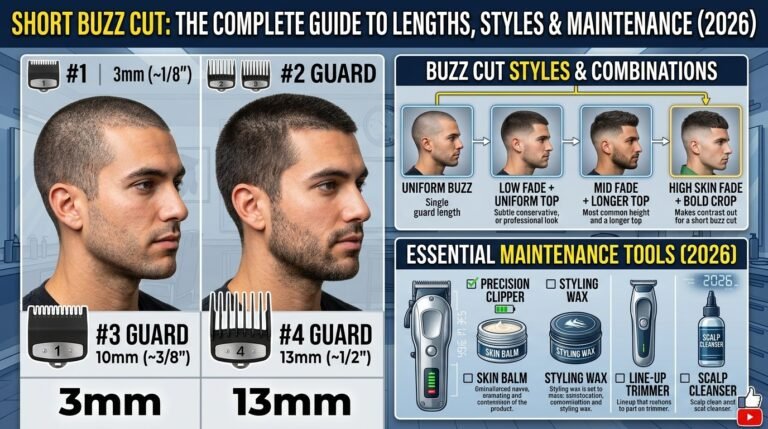
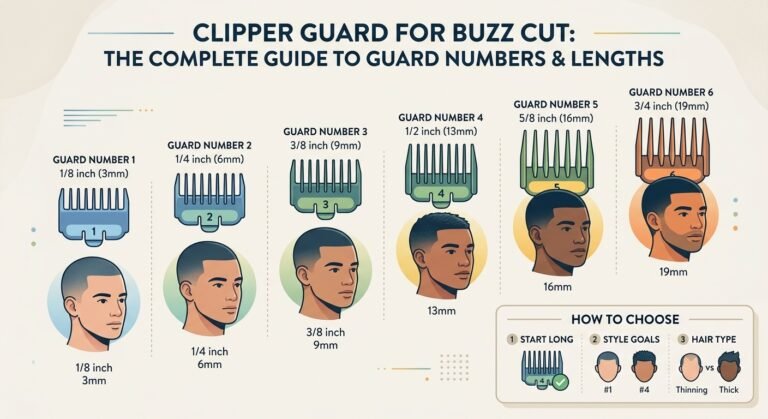
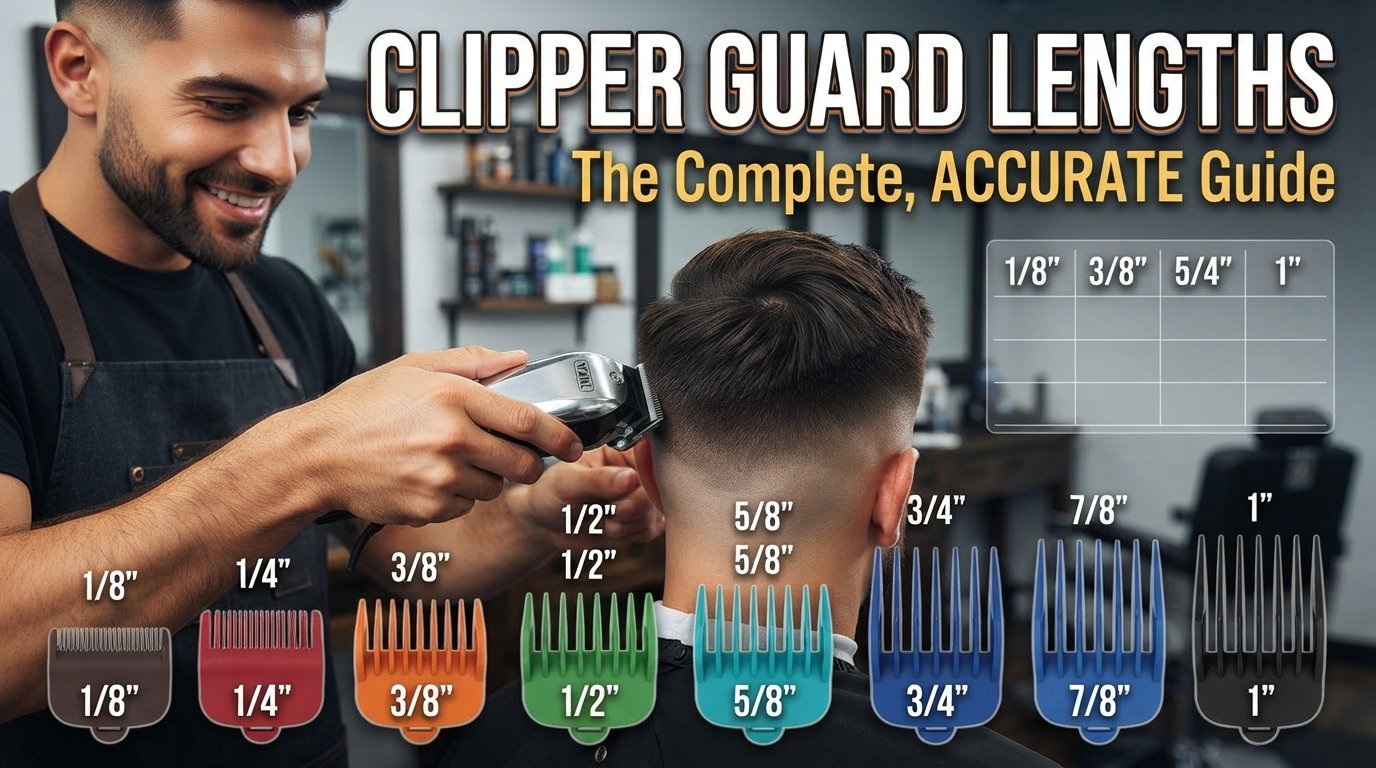
Clipper guards are numbered 0 through 8 (occasionally higher), and each number roughly corresponds to that many eighths of an inch of hair left behind — a #1 leaves about ⅛” (3mm), a #4 about ½” (13mm). The exact millimeter length varies slightly by brand, and guard number isn’t the same thing as blade setting or lever position. The rest of this guide covers what that means in practice.
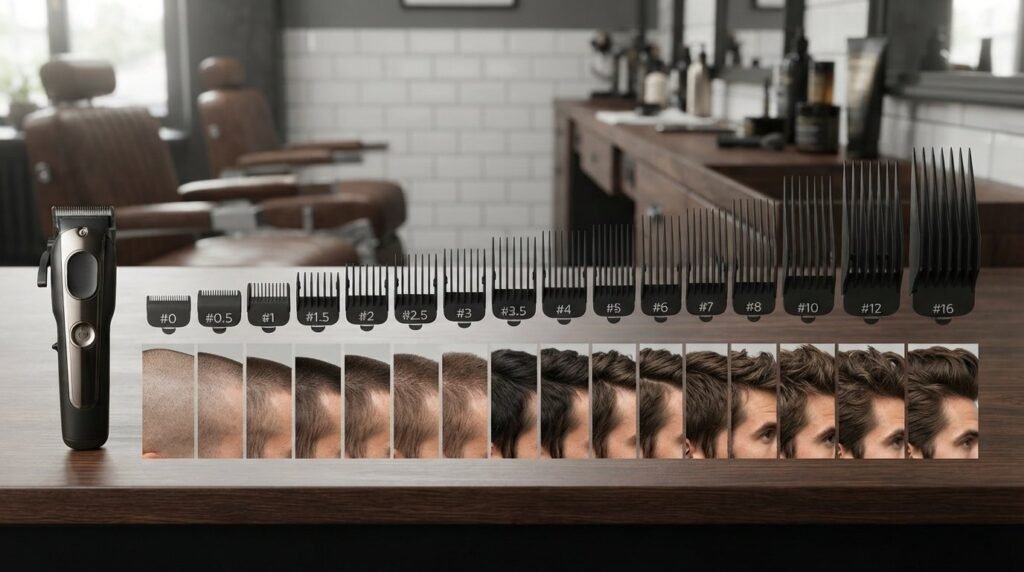
Quick clipper guard length chart
| Guard | Approx. Length | Approx. mm | General Appearance | Common Use |
|---|---|---|---|---|
| No guard (bare blade) | ~1/32″ or less | ~0.4–0.8mm | Skin-close, near-shaved look | Skin fades, bald fades |
| #0 / #0.5 | 1/16″ | ~1.5mm | Very close, scalp clearly visible | Very short buzz, fade base |
| #1 | 1/8″ | ~3mm | Scalp still visible through hair | Short buzz, fade/taper blending |
| #1.5 | ~3/16″ | ~4–5mm | Between #1 and #2, blending step | Fade blending |
| #2 | 1/4″ | ~6mm | Scalp visible in bright light, texture starts | Classic short buzz, sides on a fade |
| #2.5 | ~5/16″ | ~7–8mm | Between #2 and #3 | Fade blending |
| #3 | 3/8″ | ~9–10mm | Scalp mostly covered, visible texture | Medium buzz, crew cut |
| #3.5 | ~7/16″ | ~11mm | Between #3 and #4 | Blending |
| #4 | 1/2″ | ~12–13mm | Full coverage, some texture/curl visible | Conservative “longer” clipper cut |
| #5 | 5/8″ | ~15–16mm | Noticeable bulk, hair starts to move | Longer buzz, brush cut |
| #6 | 3/4″ | ~19mm | Visible length and texture | Top length on tapers/fades |
| #7 | 7/8″ | ~22mm | Approaching a full inch | Less common; longer clipper cuts |
| #8 | 1″ | ~25mm | A full inch of length | Long clipper cut, thick hair |
| #10 | 1 1/4″ | ~32mm | Long, scissor-like length | Long clipper cuts, textured tops |
| #12 | 1 1/2″ | ~38mm | Long, needs product to hold shape | Long tops, thick/curly hair |
| #16 | 2″ | ~51mm | Very long for a clipper attachment | Uncommon; specialty/extended sets |
Two things to keep in mind while reading this chart:
- The mm figures are approximate conversions, not exact manufacturer specs. Guard numbers were built around eighths of an inch, so the metric equivalents round differently by brand — a #3 shows up as 9mm on some charts and 10mm on others, and both are correct roundings of the same 9.525mm.
- Guards past #8 aren’t standardized the way #0–#8 are. They’re common on Wahl-compatible attachment sets but not universal, and sizing conventions vary more at this range.
What clipper guard lengths actually mean
A clipper guard (also called an attachment comb or guide comb) snaps onto the clipper blade and holds it a fixed distance from the scalp — that distance is the guard length, and it determines how much hair remains after a pass.
The number on the guard is a size label, not a unit of measurement. The convention that stuck across the industry is: guard number ≈ number of eighths of an inch. A #1 guard ≈ 1 × ⅛” = ⅛”. A #4 guard ≈ 4 × ⅛” = ½”. That’s why higher numbers leave more hair — each step adds another eighth of an inch.
This convention is consistent enough that “a number 2” means roughly the same thing on most clippers. But it is an approximation, which is why guard number, actual cutting length, blade setting, and lever position are worth separating out clearly.
Guard number vs. actual cutting length vs. blade vs. lever
These four terms get used interchangeably in casual conversation, and that’s the source of most confusion around clipper guard lengths.
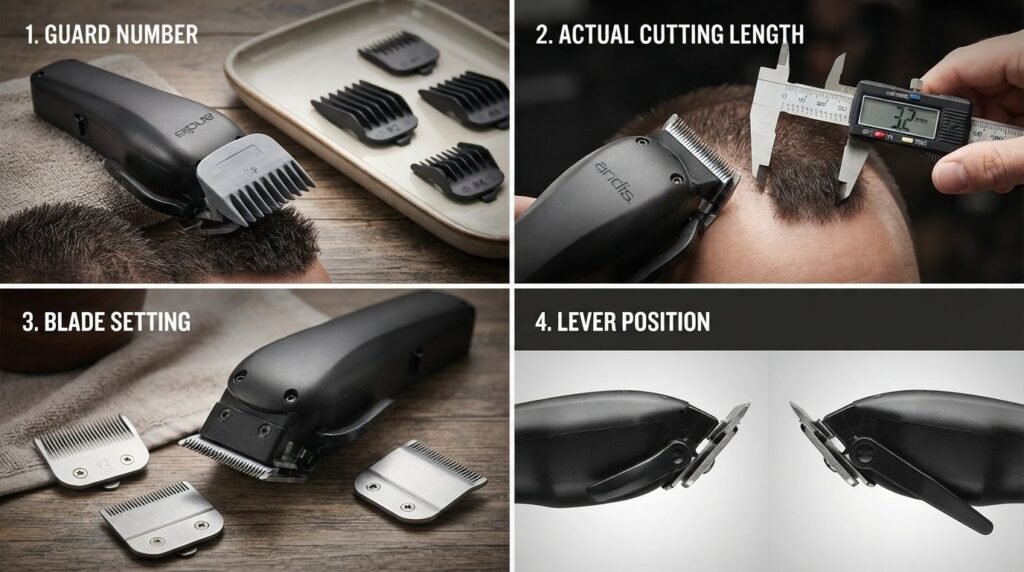
Guard number is the label printed on the attachment (0, 1, 2, 3…). It’s shorthand, not a certified measurement.
Actual cutting length is the real, physical distance the guard holds the blade away from the scalp — what you’d measure with calipers, expressed in mm or inches. It’s what determines what you see in the mirror, and it’s the number to use if you need precision: “6mm on the sides,” not just “a #2.”
Blade setting refers to the clipper’s own cutting blade, separate from any guard. Detachable-blade clippers come with blades sized similarly to guards — a 000 or 0000 blade cuts extremely close to the skin (well under 1mm, used for skin fades), while a size 1 blade cuts closer to ⅛”. A guard is placed over a blade to extend that length further, and a guard’s stated length assumes it’s paired with the blade it was designed for. Put the same guard on a different blade size, and the resulting length shifts.
Lever position applies to clippers with an adjustable blade — a small lever, common on both home and barber clippers. Sliding it from closed to open moves the blade slightly, adding a small extra range of cutting length without changing the guard. That’s one reason two haircuts done with “the same guard” can still come out subtly different.
Practical example: two clippers both marked with a #2 guard can produce visibly different results if one’s lever is set to open and the other’s is closed, or if the guards were built for different blade sizes. Neither is wrong — the guard number just isn’t the complete specification.
Clipper guard lengths in mm — why the numbers aren’t identical everywhere
A few reasons the same guard number shows different mm values depending on the source:
- Rounding. ⅛” is 3.175mm, usually rounded to 3mm. But ⅜” (9.525mm) gets rounded to 9mm by some brands and 10mm by others — both are defensible roundings of the same physical size.
- Material thickness. A metal-clip guard and a solid plastic guard of the “same” size can differ by a fraction of a millimeter because the guard’s own material adds depth.
- Brand-specific systems. Wahl, Andis, and Oster are the three most common professional brands. Their standard #1–#8 guards land close to each other, but they aren’t guaranteed to be identical or interchangeable — especially in specialty or longer guards (10, 12, 14+), which function more as an aftermarket accessory convention than a strict industry standard.
- The bare blade isn’t zero. Without any guard, a clipper still leaves a small amount of stubble rather than cutting to bare skin — commonly under a millimeter, depending on the blade. That’s the real floor, and it’s shorter than even a #0 guard.
Treat guard-number-to-mm charts, including the one above, as reliable approximations for everyday decisions. If you need an exact result — matching a fade line, a specific set length, or a previous haircut precisely — communicate the millimeter measurement itself rather than the guard number alone.
Related:
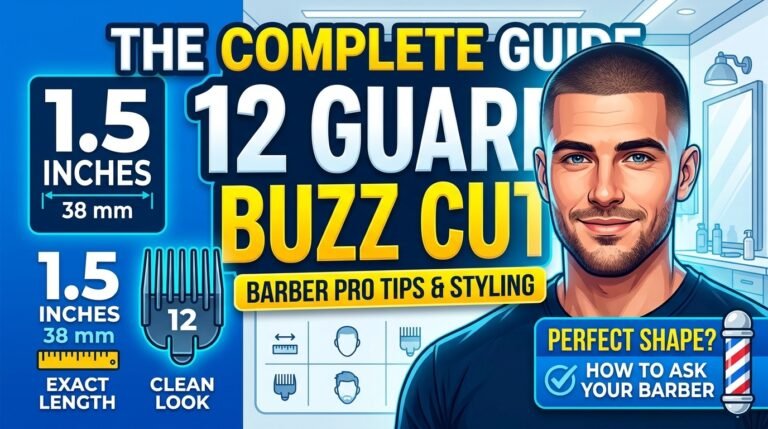
12 Guard Buzz Cut: The Complete Length, Look, and Barber Guide
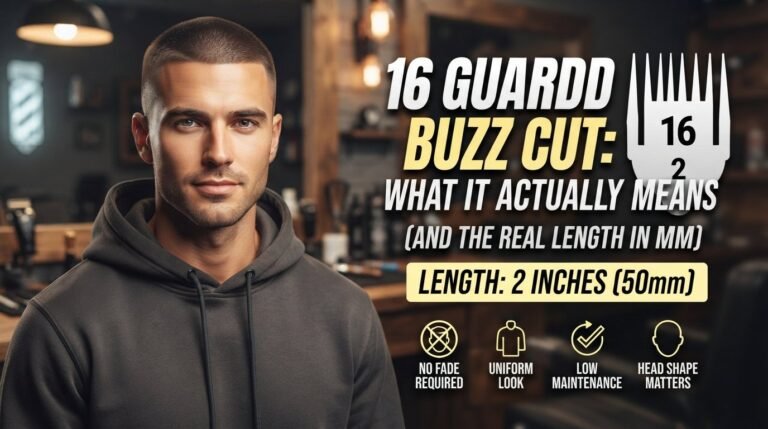
16 Guard Buzz Cut: What It Actually Means (And the Real Length in mm)
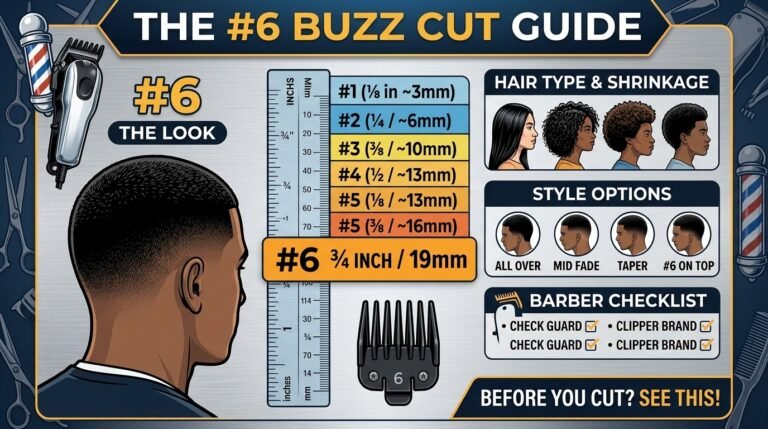
6 Guard Buzz Cut: Length, Look, and Everything to Know Before You Get One
What each clipper guard length looks like
Very short (bare blade – #1, roughly 0–3mm)
Scalp is clearly visible underneath the hair, especially at certain angles, with little to no texture or movement. This range covers skin fades and the closest section of most fades — a #0 is the shortest standard guard at about 1.5mm; a #1 at about 3mm is one of the most requested sizes for a defined buzz cut, with the scalp still showing through.
Short (#1.5 – #3, roughly 4–10mm)
Scalp is still visible in bright light, but coverage increases noticeably through this range, and texture — waves, curls — starts to show as a small pattern rather than lying flat. A #2 (about 6mm) is arguably the single most popular guard length: short but with visible hair rather than a shaved look, common on the sides of a fade and as a full buzz-cut length on its own. A #3 (about 9–10mm) is a step fuller, with reduced scalp show-through, often used for a slightly longer buzz or an upper step in a fade.
Medium (#3.5 – #5, roughly 11–16mm)
Scalp visibility drops off significantly; hair reads as “short hair” rather than “buzzed,” and natural growth direction becomes more visible. A #4 (about 12–13mm) is the most common “longer but still low-maintenance” length — full coverage, visible texture, minimal scalp show, and a frequent choice for people moving away from very short cuts. A #5 (about 15–16mm) adds real bulk and some styling movement, more often used as a top length than an all-over cut.
Longer clipper lengths (#6 and up, roughly 19mm+)
Hair has visible movement, some styling potential, and noticeably more bulk — particularly on thicker or curlier hair, where the same setting reads shorter due to curl contraction. #6–#8 (about 19–25mm) are less common as a full head length and more often the longest guard in a starter set, or a choice for thick/curly hair. #10 and #12 (about 32–38mm) move past what most people mean by “clipper guard length” in casual conversation and into scissor-cut territory — long, low-maintenance length, with availability depending on the specific clipper and guard system.
How long before a guard length grows out?
Hair grows at roughly half an inch (about 1.25cm) per month on average, though the exact rate varies by person. That means a #2 (about 6mm) can be creeping toward #3 territory (about 9–10mm) within four to six weeks — which is part of why shorter guard lengths generally need more frequent maintenance than longer ones: the same amount of regrowth is proportionally more noticeable on a #1 than on a #6.
Clipper guard lengths by haircut type
Buzz cuts
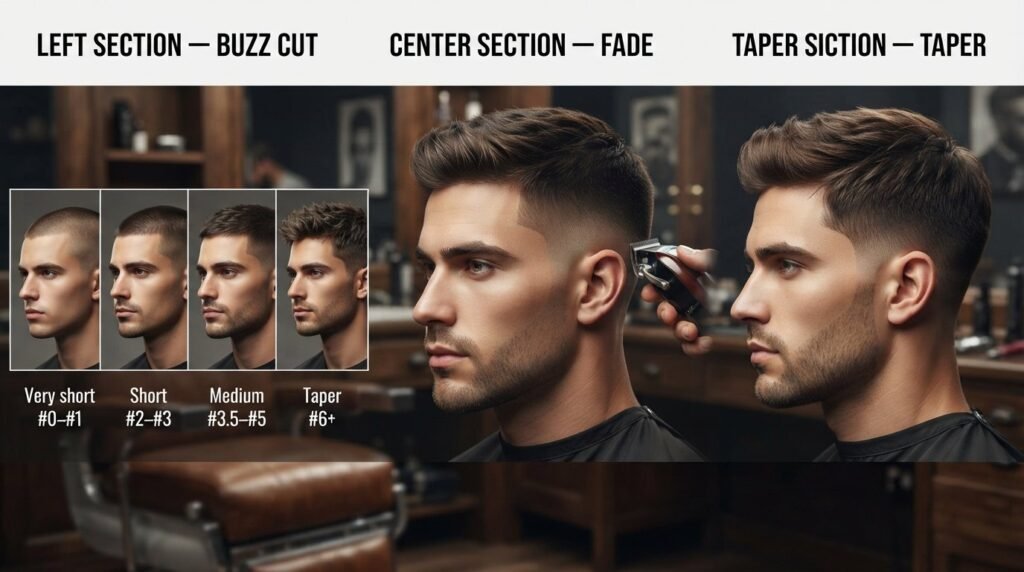
A buzz cut is a uniform clipper length over the whole head (sometimes with a slightly shorter perimeter), so the guard choice is essentially the haircut.
- Very short (#0–#1): maximum scalp visibility, most defined head shape, lowest length overall, but needs touching up most often since regrowth shows fastest.
- Short (#2–#3): the classic buzz range — visible hair with the scalp still reading through in good light.
- Medium (#3.5–#5): fuller look, less scalp visibility, more forgiving of an uneven hairline or head shape, slower to look grown-out.
- Long / longer clipper cut (#6+): reads more like short hair than a traditional buzz, with visible texture and movement.
No single length is “the” buzz-cut length — it depends on how much scalp visibility you want and how often you’re willing to redo it.
Related: What Is a Buzz Cut? The Complete Guide to Lengths, Styles, and Guard Numbers
Fades
A fade is not one guard length — it’s a progression of lengths blended into each other, from very short at the bottom to longer toward the top. Confusing “a fade” with “a guard number” is one of the most common misunderstandings around this topic.
A typical progression moves through:
- Shortest zone (nape/perimeter): bare blade or #0/#1
- Intermediate zone: #1.5–#2.5, sometimes fine-tuned further with the lever
- Upper transition: #3–#4 or higher, depending on the intended top length
- Blending: guard changes are smoothed together with overlapping passes, lever adjustments, and often scissor-over-comb work — this is what makes the transition look gradual instead of stepped.
The guard lengths set the boundaries; the blending technique creates the fade effect between them.
Related: Buzz Cut Fade Haircut: The Complete Guide to Fade Levels, Guards & Barber-Ready Instructions
Tapers
A taper is more localized than a fade: a gradual shortening applied around the temples, sideburns, and neckline, while the rest of the head stays a single longer length rather than transitioning all the way down. A taper typically doesn’t go as short at its lowest point as a fade does, and the blend zone is narrower — concentrated at the hairline rather than climbing the whole side of the head. The guard lengths used are the same building blocks as a fade; the difference is how much of the head is affected and how low the shortest point goes.
Guard length comparisons
The comparisons below reflect the ones people most often need to decide between — #1 through #5 cover the bulk of everyday decisions; the higher pairs are included for completeness but are less commonly searched.
| Comparison | Approx. difference | What actually changes |
|---|---|---|
| #1 vs #2 | ~3mm | A meaningful jump at short lengths — #2 shows noticeably more coverage and less scalp than #1. |
| #2 vs #3 | ~3–4mm | #3 starts to look like “short hair” rather than a buzz; texture becomes visible. |
| #3 vs #4 | ~2–3mm | #4 is the common cutoff between low-maintenance-short and buzz-cut territory. |
| #4 vs #5 | ~3mm | #5 adds visible bulk and styling movement; less common as a full-head length. |
| #6 vs #8 | ~6mm | #8 is a full inch and reads as genuinely longer hair rather than a clipper-length cut. |
| #8 vs #10 | ~7mm | #10 moves into long, low-maintenance-length territory beyond typical clipper-guard use. |
| #10 vs #12 | ~6mm | The difference shows mainly in styling versatility rather than perceived shortness. |
Why the same guard length can look different on different hair
The same cutting length doesn’t produce an identical visual result on everyone, because of how hair grows and sits:
- Straight hair shows length most literally — what the guard cuts is close to what you see.
- Wavy hair adds slight visual bulk, making a length look a touch longer than the same setting on straight hair.
- Curly hair contracts as it dries — a guard leaving 13mm of hair can read several millimeters shorter once the curl pattern springs back.
- Coily hair contracts the most; a length that reads as a substantial buzz on straight hair can look extremely close on tightly coiled hair.
- Thick or dense hair reads fuller at every length, since more strands occupy the same area.
- Fine or low-density hair shows more scalp at a given length than thicker hair, even with an identical guard.
Cutting length and visual result are related but not identical. If you’re matching a photo or a previous haircut, factor in your own hair’s texture and density, not just the number someone else used.
What shorter lengths reveal: scalp, hairline, and head shape
Shorter guard lengths naturally show more of what’s underneath the hair — the scalp itself, the natural hairline shape, the crown, the temples, and the general contour of the head (the curve of the crown, the flatness or roundness of the back). This is a visual effect of cutting length, not a treatment: a shorter guard doesn’t cause hair loss, and it doesn’t disguise thinning areas — if anything, shorter lengths tend to make thinning more visible, since there’s less hair volume to cover the scalp. If scalp, hairline, or head-shape visibility is a concern, it’s worth raising directly with a barber before a cut, since it affects which length range makes sense.
For face shape specifically, there’s no reliable formula like “round face → #3.” What actually affects how a haircut interacts with face shape is the combination of length, taper, fade placement, hairline shape, neckline, and beard styling — not the guard number in isolation.
Choosing and communicating your length
How to choose the right guard length
Work through these rather than picking a number cold:
- How short do you want to look — think “scalp visible” vs. “hair visible,” not a guard number.
- How much scalp visibility are you comfortable with — this narrows you to a range fast.
- One uniform length, or a fade/taper — a uniform length is a single guard decision; a fade or taper is a progression.
- What’s your hair texture — curly or coily hair may need a longer guard than expected, due to contraction.
- What’s your hair density — thicker hair reads fuller at every length; thinner hair shows more scalp at the same setting.
- Cutting your own hair or going to a barber — at home, prioritize guards you’re confident fit securely; with a barber, describe the result you want rather than just a number.
There’s no universally “best” guard — the right one matches the visual result you want, given your hair and your maintenance tolerance.
How to tell your barber what you want
A guard number alone is often incomplete: “give me a number 4” doesn’t say whether that’s the whole head, just the top, or the sides too, and it assumes the barber’s #4 matches what you’re picturing. More complete ways to communicate:
- State the number and where it applies: “a #4 on top, #2 on the sides.”
- Give a measurement when precision matters: “about 13mm on top” removes any ambiguity from rounding.
- Describe the structure, not just a length: uniform, tapered, faded, and how you want the neckline and hairline handled.
- Bring a reference photo — it communicates the overall visual result (proportions, blend style, hairline shape) in a way a single number can’t.
- Name the technique if you know it: fade, taper, buzz, scissor-over-comb.
A photo communicates appearance. A measurement communicates length. A guard number communicates useful but approximate shorthand.
If a specific number produces a different result than expected — different clipper brand, different blade, different lever setting — the more reliable fix is describing the result you want (a measurement, or “about this much shorter than it is now”) rather than insisting on the exact number, since guard systems aren’t universally interchangeable.
Using clipper guards
Checking compatibility
Before assuming any guard fits any clipper:
- Identify your clipper model — guards are typically built for a specific blade width and attachment mechanism.
- Check manufacturer compatibility — a guard sold as “fits Wahl” won’t necessarily fit an Andis or Oster clipper, or vice versa.
- Confirm the guard type matches your blade — standard guards fit standard-width blades; wide or detachable specialty blades usually need their own guard sets.
- Remember a guard’s stated length assumes it’s paired with its intended blade.
- Never force a guard that doesn’t click or snap securely into place — a loose guard can shift mid-cut and produce an uneven result, or come off entirely.
Using guards at home
- Confirm the guard is fully seated before starting — a half-attached guard is the most common cause of an accidental short spot.
- Double-check which length you’ve attached, especially with sets where the numbers are small and easy to misread.
- Make slow, consistent passes, moving against the direction of hair growth for the most even result.
- Check multiple growth directions, particularly around the crown, where hair often grows in a spiral and can leave uneven patches if cut from only one angle.
- Use mirrors — front, back, handheld — to check the neckline, behind the ears, and the crown.
- Work in good, even lighting so you can catch uneven spots as you go, not after.
- Clean the clipper and guard afterward — hair buildup affects both blade performance and guard fit over time.
Common mistakes
| Mistake | Why it happens | How to fix it |
|---|---|---|
| Assuming guard numbers are universal | Charts present fixed values without noting brand variation | Treat numbers as approximate; use mm for anything precise |
| Confusing guard number with mm | The two get used interchangeably in casual speech | Number is shorthand; mm is the actual measurement |
| Confusing the guard with the blade | Both are physical clipper parts near the cutting edge | Guard sits over the blade and adds length; blade size is separate |
| Confusing guard length with lever position | Both affect final length independently | Lever fine-tunes within a guard; it doesn’t replace guard choice |
| Using an incompatible guard | Guards look similar across brands but aren’t universal | Check compatibility before attaching, and never force a fit |
| Assuming one guard “creates” a fade | Fades are described by a guard range, which sounds like one setting | A fade is a blended progression of multiple guards, not one |
| Ignoring hair texture | Charts describe length, not appearance | Account for curl contraction when picking a length for curly/coily hair |
| Ignoring density | Same logic as texture | Expect thinner hair to show more scalp at the same guard |
| Giving only a guard number to a barber | It feels specific enough | Add where it applies, a measurement, or a reference photo |
| Assuming the same length looks identical on everyone | Charts imply one visual outcome | Expect variation based on your own hair’s texture and density |
Troubleshooting
The guard left more or less hair than expected. Check whether it was fully seated — a partially attached guard can sit closer to or farther from the blade than intended — and confirm you used the number you meant to.
The guard doesn’t fit the clipper. Don’t force it. Check the guard’s stated compatibility against your specific clipper model before trying a different brand’s guard.
The haircut looks uneven. Usually a growth-direction issue — go back over the area from a different angle, particularly around the crown and neckline.
Scalp is more visible than expected. Often a density or lighting effect rather than a wrong guard — the same length shows differently depending on hair thickness and how the light hits it.
Curly hair looks shorter than the guard number suggests. That’s curl contraction, not a mistake. Sizing up a guard from what you’d use on straight hair often gets closer to the intended result.
You wanted one uniform length but got a fade or taper. Communicate explicitly next time: “uniform length, no blending” is the clearest phrasing.
Your clipper doesn’t have the length you need. Longer guards (#10+) especially aren’t included in every set — check whether they’re sold separately for your model before settling for the closest one you already own.
FAQ
What are clipper guard lengths? They’re the fixed cutting lengths produced by numbered attachment combs on a clipper. Each number is shorthand based on eighths of an inch (a #1 ≈ ⅛”, a #4 ≈ ½”), not a certified millimeter measurement — the exact length can vary slightly by brand.
Does a higher guard number always mean longer hair? Within one brand’s standard guard set, yes — each number up adds roughly another eighth of an inch. Across different brands or guard systems, the relationship holds loosely but isn’t guaranteed to be exact.
How many mm is a number 1 guard? Approximately 3mm (⅛”), though manufacturers round slightly differently.
How many mm is a number 2 guard? Approximately 6mm (¼”).
How many mm is a number 3 guard? Approximately 9–10mm (⅜”) — one of the sizes where rounding differs most between sources.
How many mm is a number 4 guard? Approximately 12–13mm (½”).
What is the shortest clipper guard? A #0 guard, around 1.5mm. Going without any guard leaves an even shorter length, typically under 1mm, depending on the blade.
What is the longest common clipper guard? Within a typical consumer set, #8 (about 1″/25mm). Extended sets go up to #10, #12, or occasionally higher, but these aren’t in most standard kits and vary more by manufacturer.
Are clipper guard lengths universal across brands? Approximately, not exactly. The #0–#8 range is consistent enough for everyday use, but exact mm figures, half-sizes, and anything above #8 vary more by brand.
Can you use guards from a different brand? Sometimes, if the attachment mechanism and blade width match — but it’s not guaranteed, and a loose-fitting guard is a real consistency and safety issue. Check compatibility first.
What guard length is best for a buzz cut? There’s no single best length — #1–#2 gives a very short, defined buzz; #3–#5 gives a fuller look with less scalp visibility. It depends on how much scalp you want to show and how often you want to maintain it.
What guard lengths are used for fades? A fade isn’t one guard — it’s a progression, typically starting at bare blade or #0–#1 at the shortest point and blending up through several guards to whatever length is wanted at the top.
Why does the same guard look different on different hair? Curly and coily hair contracts as it dries, making a given cutting length look shorter than on straight hair; hair density also changes how much scalp shows through at any given length.
How long does a clipper guard length last before it needs a trim? Hair grows roughly half an inch (about 1.25cm) a month on average. Shorter guards show that regrowth proportionally faster than longer ones, so very short lengths typically need touch-ups every two to three weeks, while medium and longer lengths can usually go longer between cuts.

Daniel Carter is the Senior Men’s Grooming Editor at FadeBuzzCut, where he specializes in fade buzz cuts, barbering techniques, men’s hairstyles, and evidence-based grooming advice. With more than 12 years of experience researching haircut trends, clipper techniques, face shape recommendations, and hair care, he creates in-depth guides that help readers confidently choose, maintain, and style modern buzz cuts.
Daniel works closely with experienced barbers, grooming professionals, and trusted industry resources to ensure every guide reflects current barbering standards and practical, real-world advice. His editorial approach combines expert research, clear explanations, and user-focused recommendations to make men’s grooming accessible for beginners and experienced enthusiasts alike.
At FadeBuzzCut.com, Daniel oversees editorial quality, content accuracy, and regular updates so readers receive reliable, up-to-date information on fade buzz cuts, beard combinations, hairstyle trends, clipper guard lengths, maintenance routines, and grooming products. Every article is written with a commitment to Experience, Expertise, Authoritativeness, and Trustworthiness (EEAT) while delivering helpful answers for both readers and AI-powered search experiences.
Whether you’re choosing your first fade buzz cut, comparing low, mid, or high fades, or looking for practical maintenance tips, Daniel’s goal is to provide trustworthy guidance that helps you achieve the best possible results.