Hair Clipper Guard Sizes: The Complete, Accurate Guide
Quick Answer
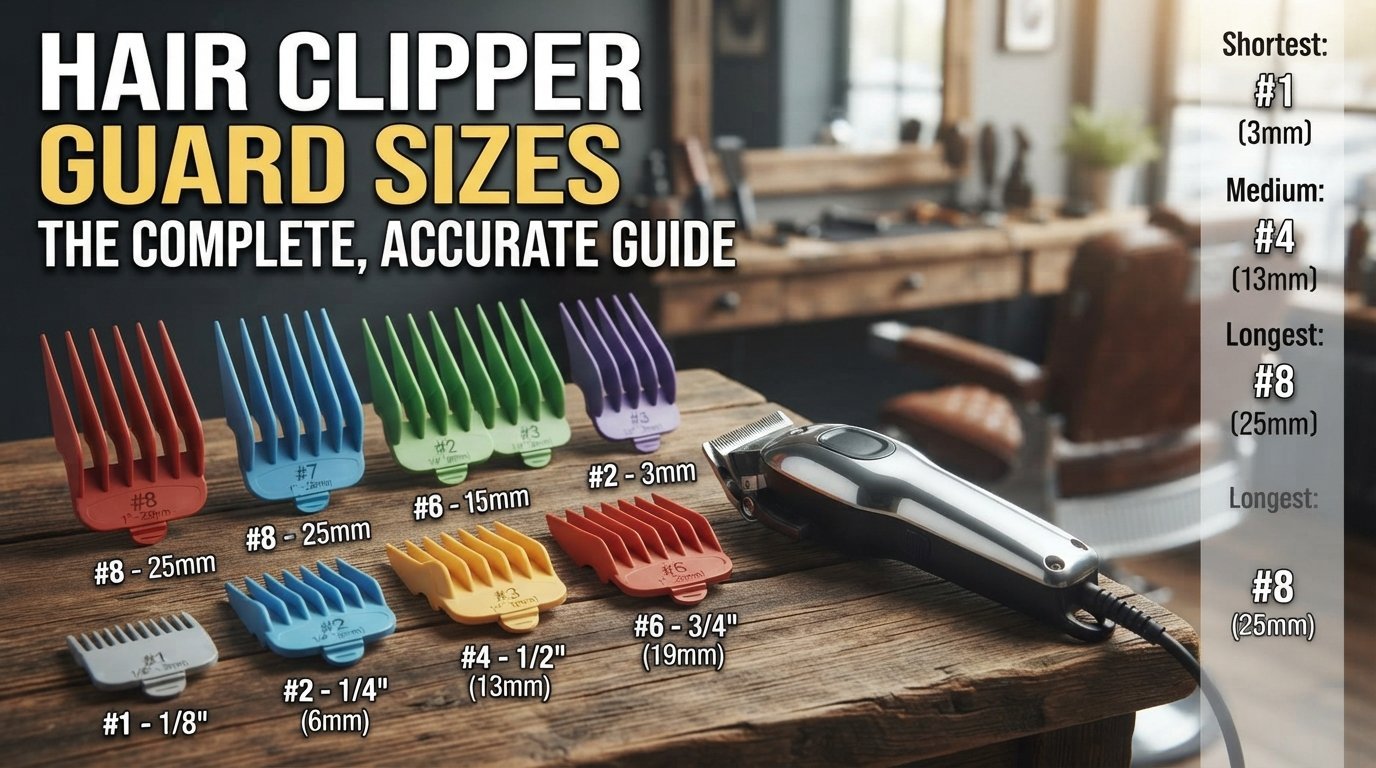
A clipper guard is a numbered attachment that snaps onto a clipper blade and controls how much hair is left after a pass. Higher numbers generally leave more hair; lower numbers cut closer. A #1 leaves around 1/8 inch (3mm); an #8, the longest guard in most standard kits, leaves around 1 inch (25mm).
The number is a label, not a measurement. It’s close to a round fraction of an inch on most kits, which is why people treat it as exact — but guard numbers aren’t fully standardized across brands, and even within one brand, different product lines can use different numbering logic. If you need an exact result, think in millimeters. If a rough length is fine, the number alone works.
Quick-Reference Guard Size Chart
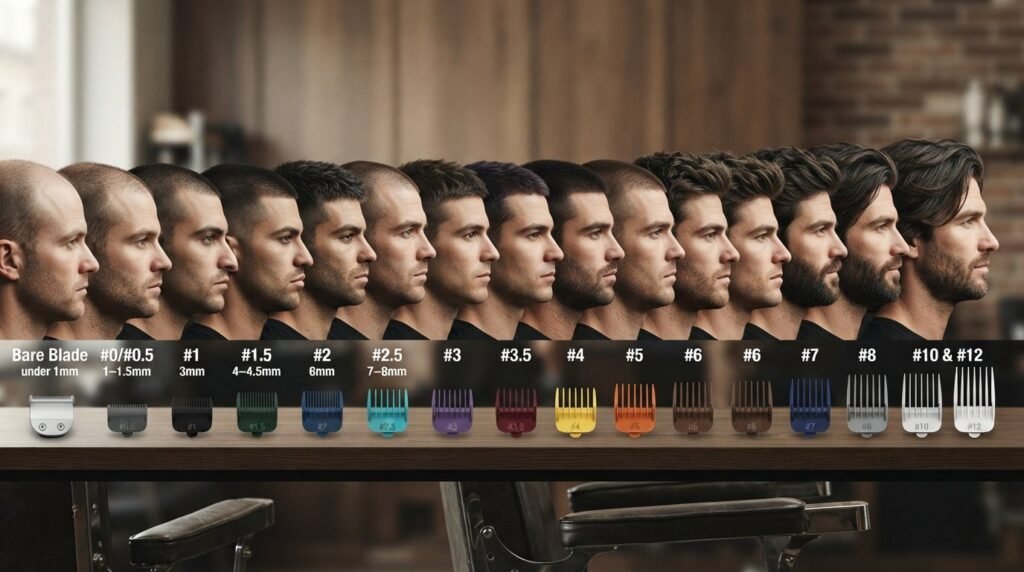
This is the progression used by most standard 8-guard kits, based on Wahl’s guide-comb sizing — the most common reference point in the U.S. market.
| Guard | Approx. Length | Approx. Inches | Typical Use |
|---|---|---|---|
| Bare blade (no guard) | Under 1mm | — | Skin-close fade base, closest possible cut |
| #0 / #0.5 | 1–1.5mm | 1/16″ | Skin-fade blending step |
| #1 | 3mm | 1/8″ | Very short buzz; fade/taper starting point |
| #1.5 | 4–4.5mm | 3/16″ | Blending between #1 and #2 |
| #2 | 6mm | 1/4″ | Classic short buzz; common on the sides of a fade |
| #2.5 | 7–8mm | 5/16″ | Blending step |
| #3 | 9.5–10mm | 3/8″ | Popular all-purpose short length |
| #3.5 | 11mm | 7/16″ | Blending step |
| #4 | 13mm | 1/2″ | Common length for tops; texture starts to show |
| #5 | 16mm | 5/8″ | Longer buzz with visible movement |
| #6 | 19mm | 3/4″ | Longer clipper cut |
| #7 | 22mm | 7/8″ | Long clipper cut |
| #8 | 25mm | 1″ | Longest guard in most standard 8-piece kits |
| #10 | ~32mm | 1 1/4″ | Extended-length accessory, sold separately |
| #12 | ~38mm | 1 1/2″ | Extended-length accessory, sold separately |
Half-sizes and anything past #8 aren’t included in most starter kits — they’re accessory purchases, and not every clipper model supports them. Check your clipper’s compatible attachment list before assuming a size is available for it.
What Is a Clipper Guard, Exactly?
A clipper guard (also called an attachment comb or guide comb) is a plastic or metal comb that clips over a clipper’s moving blade. Its teeth hold hair away from the blade at a fixed distance, so the clipper only cuts what extends past the guard rather than cutting down to the bare blade edge. That’s what makes guards the basis of even, repeatable cuts — every pass over a section of hair leaves roughly the same length.
Wahl’s standard guide combs, for example, are branded “Secure-Fit” attachments, engineered specifically to click firmly onto the company’s blades and reduce snagging. That kind of brand-specific engineering is exactly why a guard made for one clipper doesn’t automatically fit another cleanly — more on that in the compatibility section below.
Guard vs. Blade vs. Lever: Three Different Things
These three terms get used almost interchangeably, but they control length in different ways:
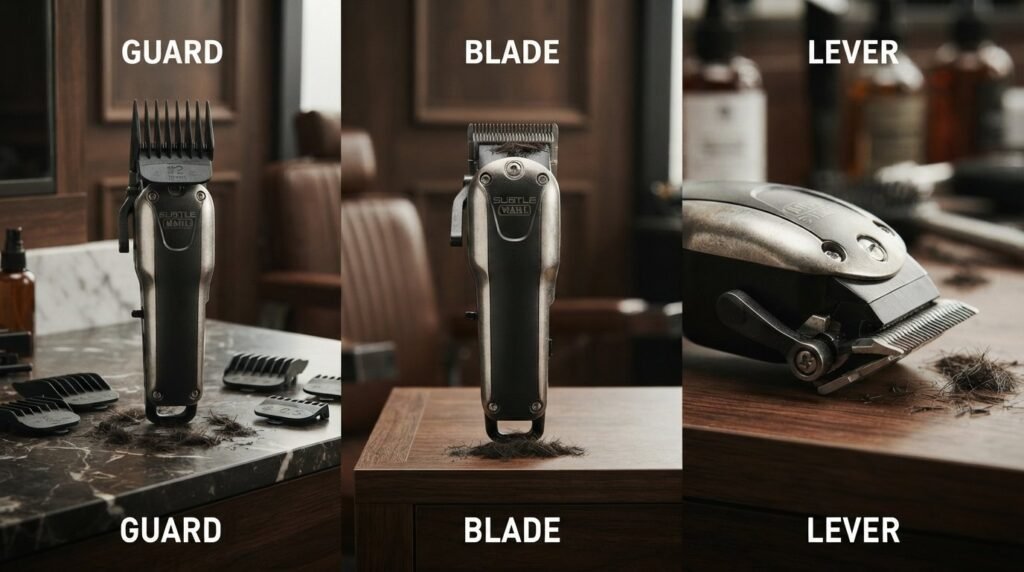
- The guard sets length in fixed steps — swap the attachment, get a new length.
- The blade is the clipper’s actual cutting mechanism. Some blades are adjustable or detachable and can cut extremely close on their own, with no guard attached at all — this is how skin fades and bald fades are done.
- The lever (or taper lever) is a small switch on the side of many clippers that shifts the moving blade slightly closer to or further from a fixed position, adding roughly 0.5–1mm of length without changing the guard. It’s a fine-tuning tool, not a substitute for a guard.
Knowing which one you’re adjusting matters: “my guard didn’t change but the cut looks longer” is almost always a lever issue, not a guard issue.
Why Guard Numbers Aren’t Fully Standardized
The core rule — higher number, more hair left — holds within a single product line. The number looking like a clean fraction of an inch (a “#4″ landing near 1/2”) is what makes people assume the system is exact and universal. It isn’t, for two reasons:
Across brands, a #2 from one manufacturer is close to, but not guaranteed to match, a #2 from another.
Within one brand’s own lineup. Wahl’s standard 1–8 guide combs run on an ascending scale — #1 shortest, #8 longest. But Wahl’s separate “5-in-1” accessory line, sold as color-coded guards (red, purple, blue, orange, yellow) for its adjustable/5-in-1 clippers, uses different numbering: some of its lower numbers correspond to longer lengths than its higher numbers do. Two product lines from the same company, two different rules for what a number means.
The practical takeaway: use the number for a quick, casual request (“give me a two on the sides”). Use millimeters when you need to match a previous cut exactly, blend a fade, or communicate with a barber using a different clipper system than the one you’re used to.
The Guard-by-Guard Breakdown
Each entry below covers length, typical appearance, and common use — useful as a standalone reference for any single guard size.
Bare Blade / #0–#0.5 (Skin to ~1.5mm)
The closest cut available without a guard. Scalp is clearly visible through the hair at nearly every angle. Used as the base of a skin fade or the tightest blending step — rarely worn as a full head length on its own.
#1 (≈3mm)
A classic tight buzz. Scalp shows through under most lighting. The most common starting point for fades and tapers, since it gives barbers the shortest fixed reference length to blend upward from.
#2 (≈6mm)
Still a short buzz, but with visibly more coverage than a #1. Scalp shows through less obviously, and faint texture (waves or curls) starts to register.
#3 (≈9.5–10mm)
Often the “safe middle” length for a first-time clipper cut — enough hair to read as a deliberate short style rather than a shave-down, with minimal scalp show-through on most hair densities.
#4 (≈13mm)
Hair has enough length to move slightly and be pushed around with fingers. Curl and wave pattern become clearly visible. A common choice for the top of a fade, or as an all-over low-maintenance length.
#5–#6 (≈16–19mm)
The shift from “buzz cut” into “longer clipper crop.” Hair shows real movement and can be lightly styled.
#7–#8 (≈22–25mm)
The longest guards in most standard kits. Results read more like a short scissor cut than a buzz, with enough length for basic styling.
#10–#12 (≈32–38mm)
Not included in basic sets — sold as separate accessories for clipper cuts that need more length retained, or for maintaining textured and curly styles where a standard #8 would still cut too short.
Related: Clipper Guard for Buzz Cut: The Complete Guide to Guard Numbers, Lengths, and How to Choose
Why the Same Guard Can Look Different on Different Heads
Cutting length and visual length aren’t the same thing. A guard sets a physical measurement, but what you actually see afterward depends on:
- Texture and curl pattern. Straight hair lies flat and shows close to its true cut length. Wavy and curly hair springs back after cutting, so a 10mm cut can visually read shorter than 10mm of straight hair. Coily hair contracts the most of any texture.
- Density. Thick, dense hair reads fuller at a given length because more hair is standing per square inch. Fine or low-density hair shows more scalp at the same length.
- Growth direction. Swirls at the crown or hairline can catch light unevenly even when every strand is technically the same length.
- Scalp/hair contrast. Dark hair on a lighter scalp (or vice versa) makes scalp show-through far more visible at short lengths than low-contrast combinations.
The practical rule: a guard number tells you the cut, not the look. Two people getting an identical #2 all over can walk away with visibly different haircuts.
Related: 16 Guard Buzz Cut: What It Actually Means (And the Real Length in mm)
Clipper Guard Sizes for Buzz Cuts
“Buzz cut” isn’t one specific length — it’s a range, usually grouped like this:
- Very short buzz — bare blade through #1 (up to ~3mm). Maximum scalp visibility, lowest maintenance, most noticeable hairline.
- Short buzz — #2–#3 (~6–10mm). The most common “classic buzz” range, balancing scalp coverage with a still-very-short profile.
- Medium/longer buzz — #4–#5 (~13–16mm). Visible texture and slight movement; still low-maintenance.
- Long clipper cut — #6 and up (19mm+). Reads more like a uniform short haircut than a traditional buzz.
Coarser or curlier hair often looks fuller at a given guard than straight hair does — worth factoring in before choosing a length based on a reference photo of someone with different texture.
Related: 6 Guard Buzz Cut: Length, Look, and Everything to Know Before You Get One
Clipper Guard Sizes for Fades
A fade isn’t one guard — it’s a progression of guards blended together, built from three tools working in combination:
- A starting point, often bare blade or a low guard (#0.5–#1), at the lowest part of the hairline.
- Progressively longer guards moving up the head (#1 → #2 → #3), each blended into the one below it.
- The taper lever, used during blending passes to fine-tune length in small increments without switching guards. Some barbers also use clipper-over-comb technique — cutting with the bare blade against a comb — for the smoothest transitions.
The guards set the major length steps; the lever and technique create the gradient between them. Two fades using identical guards can still look completely different depending on how well those transitions are blended.
Clipper Guard Sizes for Tapers
A taper works on the same principle as a fade — shorter length graduating into longer — but confined to a specific zone rather than the whole side and back:
- Temple taper — blends shorter length around the temple into surrounding hair.
- Neckline taper — softens the hairline at the back of the neck instead of leaving a hard line.
- Sideburn taper — blends sideburn length into the fade or surrounding length.
Tapers typically use a narrower guard range (often just one step, like #1 into #2) than a full fade, since the goal is a soft transition in one area rather than a gradient across the whole head.
Guard Size Comparisons
| Comparison | Length Difference | What Changes |
|---|---|---|
| #1 vs #2 | ~3mm | #2 softens scalp show-through slightly versus #1’s tighter buzz |
| #2 vs #3 | ~3–4mm | #3 is often where a cut stops reading as “very short” |
| #3 vs #4 | ~3mm | #4 starts showing curl/wave pattern clearly |
| #4 vs #5 | ~3mm | #5 feels like a longer crop rather than a buzz |
| #6 vs #8 | ~6mm | #8 reads as a short haircut, not a buzz, with more styling flexibility |
| #8 vs #10/#12 | ~7–13mm | Mainly relevant for textured or curly styles needing more retained length |
How Hair Type Changes the Result
- Straight hair — cut length and visual length match most closely; charts and reference photos (usually shot on straight or slightly wavy hair) hold up best here.
- Wavy hair — mild spring-back after cutting; a guard can look marginally shorter than its stated length once it settles.
- Curly hair — noticeable contraction; a length that reads as a clear clipper cut on straight hair can look tighter and shorter on curly hair.
- Coily hair — the most contraction of any texture; guard numbers are the least reliable predictor of final visual length.
- Thick/dense hair — reads fuller at any given length; less scalp show-through at short guards.
- Fine/low-density hair — more scalp visibility at the same guard length.
No texture is better suited to clippers in general — the point is that identical guard numbers won’t produce identical-looking results across textures, so photo references are a starting point, not a guarantee.
Scalp, Hairline & Head Shape
Shorter guards reveal more scalp, hairline shape, and the natural contours of the head — the crown, the flat or rounded back (occipital area), the temples — simply because there’s less hair standing between scalp and eye. This is a visual effect of length, not a treatment: no guard changes hair density or growth, only how much of what’s already there is left standing.
If scalp visibility at specific spots (crown, temples, hairline) is a concern, that’s a reason to keep those areas slightly longer rather than expecting a particular guard number to conceal anything. The same logic applies to head shape — very short hair exposes more of the underlying silhouette, which is better addressed by adjusting length and the surrounding taper or fade than by any single “best guard for your face shape” rule.
How to Choose the Right Guard Size
Work through these questions rather than picking a number in isolation:
- How much scalp visibility are you comfortable with? More → lower guard; less → higher guard.
- Uniform cut, or fade/taper? A uniform cut needs one guard; a fade needs a planned progression plus lever work.
- Which area — top, sides, back? These often use different guards within one haircut.
- What’s your hair density and texture? Curlier or denser hair can often go a step shorter and still show similar coverage.
- Matching an existing haircut? Think in millimeters if you know them — guard numbers can drift between clippers.
- Cutting it yourself, or getting it done? At home, start with a longer guard; you can always go shorter.
- Do you need an exact length? Specify millimeters, not just a guard number.
- Does your clipper actually support the guard you want? Confirm before buying accessory guards.
There’s no universally “best” guard — the right one depends on the answers above.
Related: 12 Guard Buzz Cut: The Complete Length, Look, and Barber Guide
How to Tell Your Barber What You Want
“Give me a number 3” communicates a rough length but leaves a lot unspecified. A fuller request usually covers:
- Guard number or millimeters for the main length (millimeters for precision).
- Different lengths for top vs. sides, if you want contrast — e.g., “#4 on top, #2 on the sides.”
- Fade or taper, and roughly how high you want it to start.
- Neckline and hairline preference — natural, squared off, or rounded.
- A reference photo, which communicates overall look — texture, styling, proportions — in a way a number alone can’t.
The number and the photo do different jobs: the number sets cutting length, the photo shows the result you’re picturing. Bringing both cuts down on miscommunication.
Guard Compatibility
Guards aren’t universal hardware. Whether one fits a given clipper depends on:
- Clipper brand and model — manufacturers design guards to snap onto their own blade shape.
- Attachment mechanism — some clippers use a simple snap-on comb; others use adjustable or detachable blade systems with their own accessory line.
- Standard vs. specialty lines — a brand’s adjustable “5-in-1”-style clippers often have a dedicated guard set that doesn’t interchange with that same brand’s standard 1–8 guide combs.
Compatibility checklist:
- Identify your exact clipper model.
- Check the manufacturer’s listed compatible attachments for that model.
- Confirm whether the guard you want is a standard or specialty size.
- Confirm the actual cutting length in millimeters, not just the printed number.
- Don’t force a guard that doesn’t snap on cleanly — a loose fit can shift mid-cut and cut unevenly.
Can You Mix Guards From Different Brands?
Generally, not reliably. Fit depends on the exact shape of the blade and the guard’s attachment clips, which differ by manufacturer and often by product line within one manufacturer. Generic “universal fit” guard sets exist and often work on a range of common blade shapes, but that’s a “usually fits most” claim, not a guarantee — and even a good physical fit doesn’t guarantee the printed number matches your main brand’s length exactly. If precision matters, use guards made for your specific clipper.
Using Clipper Guards at Home
- Confirm the guard is compatible with your clipper before starting.
- Verify the actual length you’re getting, not just the printed number, the first time you use a new guard.
- Attach it securely — a guard that isn’t fully snapped in place can slip during a pass.
- Start conservative. You can always go shorter; you can’t add hair back.
- Check both with and against the direction of hair growth on a small section first if you’re new to this — results often look more even going against the grain, but this varies by clipper and hair type.
- Check the crown and back of the head with a mirror (or a second mirror held up behind you) — the areas most often missed.
- Check behind the ears and the neckline carefully — easy spots to cut unevenly.
- Go slowly around the hairline; mistakes here are the most visible.
- Clean the clipper and guard afterward — remove hair and oil the blade per the manufacturer’s instructions.
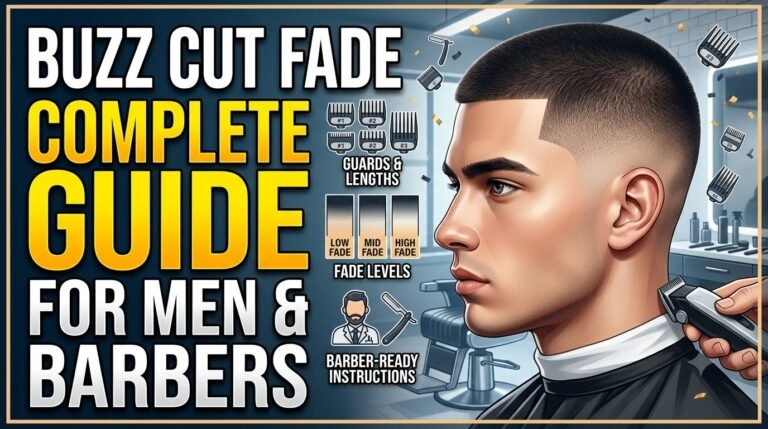
Related: Buzz Cut Fade Haircut: The Complete Guide to Fade Levels, Guards & Barber-Ready Instructions
Common Mistakes
| Mistake | Why It Happens | How to Avoid It |
|---|---|---|
| Assuming every brand’s numbers match | Most kits use a similar 1–8 scale, so it looks standardized | Check millimeters when precision matters |
| Confusing guard number with millimeters | The number is close to a round fraction, so it’s treated as exact | Treat the number as a label, not a measurement |
| Confusing a guard with the blade or lever | All three affect length, through different mechanisms | Know which one you’re actually adjusting |
| Assuming one guard creates a whole fade | Fades are usually described by their end result, not their steps | Plan a progression of guards plus lever work |
| Ignoring texture and density | Charts and photos are usually shown on one hair type | Expect a texture-based visual difference from the “official” length |
| Not specifying top vs. sides | “Give me a number 2” doesn’t say where | State each area’s length separately |
| Requesting a number with no description of the result | Barbers can’t read intent from a number alone | Bring a reference photo alongside the requested length |
| Using an incompatible guard | Guards can look like they fit without seating fully | Confirm compatibility, and make sure it clicks fully into place |
| Grabbing the wrong guard by mistake | Guards can look similar at a glance, especially in low light | Double-check the printed number before attaching |
| Skipping the crown and back of the head | Hard to see without a mirror | Use a handheld mirror against a wall mirror, or ask for help |
Troubleshooting
The guard seems shorter than expected. Confirm it’s the correct guard and fully seated; curlier or denser hair can also visually read shorter than the stated length.
The guard doesn’t fit. Stop — don’t force it. Confirm the guard is designed for your exact clipper model; a loose or partially-seated guard can slip and cut too short.
The haircut looks uneven. Usually a blending issue, not a guard-size issue — check whether transitions were smoothed with a lever or comb technique rather than left as hard lines.
More scalp is visible than expected. Typically a density/texture effect at short lengths, not a malfunction; a slightly longer guard next time will show less scalp.
Curly hair looks shorter than the guard number suggests. Expected curl contraction — choose a guard a size longer than you would for straight hair if you want a similar visual result.
The sides came out too short. Confirm which guard was actually used, and check whether the taper lever was left in the “open” (shorter) position.
A single length turned into an accidental fade. Usually a lever or blade-angle inconsistency across passes, not a guard swap — check technique and lever position.
My clipper doesn’t offer the guard I need. Check the manufacturer’s accessory line for longer or half-size guards sold separately, or convert to the closest available length in millimeters.
FAQ
What are hair clipper guard sizes? Numbered attachments that clip onto a clipper blade to control how much hair is left after cutting — generally from #0/#0.5 (closest) to #8 (longest in most standard kits), with longer specialty guards sold separately.
What do the numbers on clipper guards mean? Each number is a label for a specific cutting length assigned by the manufacturer. Higher numbers generally mean more hair left; lower numbers mean a closer cut. The number itself isn’t a precise measurement.
Does a higher guard number mean longer hair? Yes, generally, within one manufacturer’s standard guide-comb line. It’s not a universal rule across every product line — some specialty guard sets use different numbering logic.
What is the shortest clipper guard? A bare blade or #0/#0.5 guard, typically under 1.5mm.
What does a 0.5 guard mean? A half-size guard between the bare blade and a #1, used mainly as a blending step in skin fades rather than as a full head length.
What is the longest common clipper guard? Most standard 8-piece kits top out at #8 (around 25mm/1 inch); #10 and #12 are sold as separate accessories for longer lengths.
What is a #10 or #12 guard used for? Maintaining longer clipper cuts, or cutting curly/textured styles that need more length retained than a standard kit’s #8 provides. They’re not included in most basic sets.
How many mm is a number 1 / 2 / 3 / 4 guard? On most standard kits: #1 ≈ 3mm, #2 ≈ 6mm, #3 ≈ 9.5–10mm, #4 ≈ 13mm. See the full chart above for the complete scale.
Are clipper guards universal? No — fit and exact length vary by clipper brand and model, and a single brand can use different numbering systems across different product lines.
What guard should I use for a buzz cut? Depends on desired scalp visibility: #1–#2 for a very short or short buzz, #3–#5 for a longer buzz with more coverage and texture.
What guard should I use for a fade? A fade uses a progression of guards, not a single one — usually starting near bare blade and stepping up, blended with the taper lever.
Can I use guards from another brand on my clipper? Usually not reliably — attachment shape and blade dimensions differ by brand and model, so cross-brand guards can fit loosely or cut a slightly different length than expected.
What is the difference between a guard and a blade? A guard is a removable attachment that sets length by holding hair away from the blade. The blade is the clipper’s actual cutting mechanism, and some blades are adjustable or detachable for very close cuts with no guard at all.
What is the difference between a guard and a lever setting? A guard sets the main cutting length in fixed steps. A taper lever fine-tunes length in small increments (often under 1mm) without changing the guard — mainly used for blending.
Should I tell my barber the guard number or the millimeters? Millimeters for precision or when matching a previous cut exactly; the guard number is fine for a general request, ideally paired with a reference photo.
Conclusion
Guard numbers are useful shorthand, but shorthand for a length that varies by manufacturer, by product line, and even by hair texture on the same head. Knowing the approximate millimeter value behind each number — and treating a guard, a blade setting, and a lever adjustment as three separate things — is what actually makes a haircut request accurate, whether you’re briefing a barber or running the clippers yourself.

Daniel Carter is the Senior Men’s Grooming Editor at FadeBuzzCut, where he specializes in fade buzz cuts, barbering techniques, men’s hairstyles, and evidence-based grooming advice. With more than 12 years of experience researching haircut trends, clipper techniques, face shape recommendations, and hair care, he creates in-depth guides that help readers confidently choose, maintain, and style modern buzz cuts.
Daniel works closely with experienced barbers, grooming professionals, and trusted industry resources to ensure every guide reflects current barbering standards and practical, real-world advice. His editorial approach combines expert research, clear explanations, and user-focused recommendations to make men’s grooming accessible for beginners and experienced enthusiasts alike.
At FadeBuzzCut.com, Daniel oversees editorial quality, content accuracy, and regular updates so readers receive reliable, up-to-date information on fade buzz cuts, beard combinations, hairstyle trends, clipper guard lengths, maintenance routines, and grooming products. Every article is written with a commitment to Experience, Expertise, Authoritativeness, and Trustworthiness (EEAT) while delivering helpful answers for both readers and AI-powered search experiences.
Whether you’re choosing your first fade buzz cut, comparing low, mid, or high fades, or looking for practical maintenance tips, Daniel’s goal is to provide trustworthy guidance that helps you achieve the best possible results.