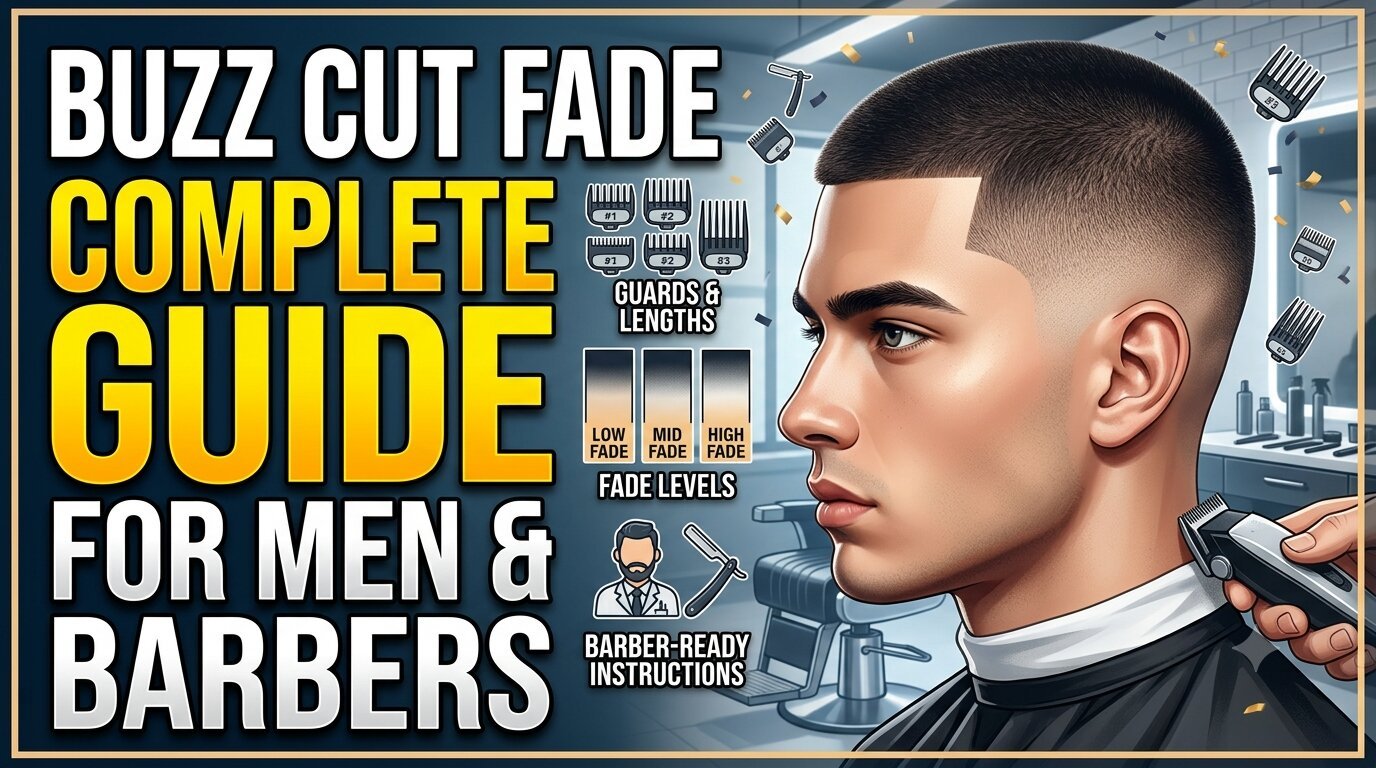
Buzz Cut Fade Haircut: The Complete Guide to Fade Levels, Guards & Barber-Ready Instructions
Last updated: August 2026
A buzzcut fade haircut pairs a uniform, clipper-cut top with sides that gradually shorten toward the hairline or skin. Most men walk into the barbershop without a plan for either variable — how short on top, how high the fade starts — and leave with a haircut that doesn’t match what they pictured. This guide breaks the buzz cut fade into its actual components so you can ask for exactly what you want.
Quick Answer: What Is a Buzz Cut Fade?
A buzz cut fade combines an even, clipper-cut top with sides and back that gradually shorten toward the skin or a low guard length. The fade can start low, mid, or high on the head, and the top can range from skin-close to a longer, textured buzz — changing either variable shifts the look from subtle to sharp.
| Style | Best For |
|---|---|
| Low fade buzz cut | Subtle, classic appearance |
| Mid fade buzz cut | Balanced modern look |
| High fade buzz cut | Strong, sharp contrast |
| Skin fade buzz cut | Maximum contrast |
| Taper fade buzz cut | Conservative finish |
| Buzz cut + beard | Strong masculine contrast |
Buzz Cut Fade Finder
| If you want… | Consider |
|---|---|
| The least noticeable grow-out | Low fade + #2 or #3 on top |
| A workplace-safe modern look | Mid fade + #2 on top |
| Maximum visual contrast | Skin fade + #1 or shorter on top |
| A softer, less aggressive transition | Taper instead of a full fade |
| A style that pairs well with a beard | Low or mid fade, blended at the sideburn |
| The lowest possible upkeep | Traditional buzz with a light taper, no hard fade line |
Buzz Cut vs. Buzz Cut Fade vs. High-and-Tight
These three get confused often enough to define side by side:
| Term | What Makes It Different |
|---|---|
| Traditional buzz cut | One clipper guard across the entire head — no length variation, no fade line |
| Buzz cut fade (buzzcut fade) | Uniform buzzed top, but the sides shorten in stages down to a low guard or skin |
| Crew cut | Slightly longer than a buzz on top (often blended or tapered by scissor), with shorter sides |
| High-and-tight | A specific military-derived style: sides skin-faded very high, with a small amount of length left on top |
A high-and-tight is technically one type of high fade buzz cut — not a synonym for the whole category. Low and mid fade buzz cuts have no military association at all.
Related: What Is a Buzz Cut? The Complete Guide to Lengths, Styles, and Guard Numbers
Buzz Cut Guard Lengths Explained
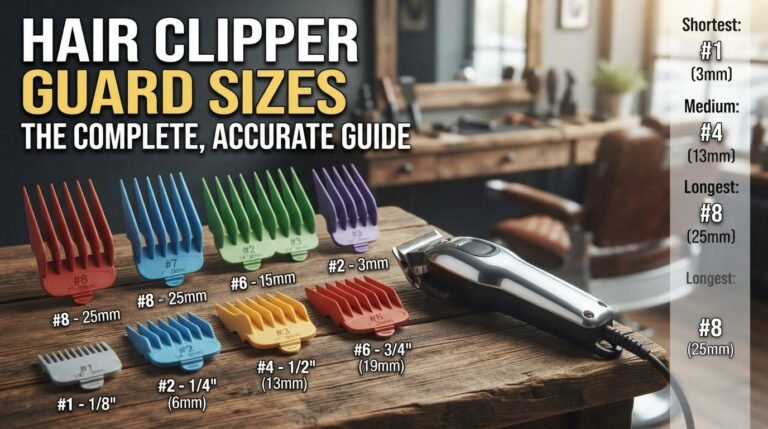
Clipper guards run #0–#8, though most buzz cut fades stay within #0–#6. Exact length varies slightly by clipper brand and technique — treat the figures below as the standard reference point, not a laser-measured constant.
| Guard | Length | Visual Effect | Maintenance | Who Tends to Choose It |
|---|---|---|---|---|
| #0 / skin | 0.5mm or bare blade | Scalp visible, sharpest possible contrast | High | Fully shaved looks or maximum fade contrast |
| #1 | 3mm | Very short, faint shadow of hair | High | A close buzz with minimal styling |
| #2 | 6mm | Classic buzz length, some texture visible | Moderate–high | The most common all-purpose top length |
| #3 | 10mm | Slightly softer, more coverage | Moderate | A buzz look without going too close |
| #4 | 13mm | Visible texture, some styling possible | Moderate | A buzz that can still be brushed or textured |
| #5 | 16mm | Noticeably longer, more top coverage | Lower–moderate | Blending a fuller top with a stronger fade |
| #6 | 19mm | Longest common “buzz,” approaching a crop | Lower | More length to work with while sides stay short |
A shorter top guard makes the fade underneath more visible, since less length competes with it. A longer top guard (#4–#6) shifts visual weight onto the top and softens the overall contrast.
Complete Guide: 6 Guard Buzz Cut: Length, Look, and Everything to Know Before You Get One
Buzz Cut Fade Levels Explained
The fade level is where the shortening starts on the side of the head — a separate decision from top length.
Low Fade Buzz Cut
Starts just above the ear, close to the hairline. Most of the side stays at a longer, uniform length, so from a distance it can read as a tidy buzz rather than an obvious fade. It suits conservative grooming standards and grows out with the least visible change, since only a small area is shortened to the skin.
Mid Fade Buzz Cut
Starts around temple height. This creates a clearer gradient than a low fade without the drama of a high fade — the reason it’s often described as the most balanced option. It needs slightly more frequent maintenance than a low fade, since more of the head is taken down short.
High Fade Buzz Cut
Starts near the top of the head, close to where the buzzed top begins. A larger portion of the side and back goes short, producing the strongest contrast against the top length. Because more area is faded, it needs more frequent touch-ups to avoid looking overgrown.
Skin Fade Buzz Cut
Takes the bottom of the fade to bare skin rather than a short guard. “Skin fade” describes the finish, not the starting height — it can be paired with a low, mid, or high fade. It produces the sharpest possible contrast but also grows out the fastest visually, since new growth against bare skin is more noticeable than new growth against a short guard.
Taper Fade Buzz Cut
Shortens hair only at the perimeter — ears, neckline, sideburns — without a long, graduated blend up the side. A taper keeps more length and a softer transition than a true fade, which is why it reads as the more conservative option. If you want a barely-there change from a plain buzz with no visible fade line, ask for a taper, not a fade.
Related: Short Buzz Cut: The Complete Guide to Lengths, Styles & Maintenance (2026)
Combining Top Length and Fade Height
The finished look depends on three variables together: top length, fade height, and fade finish (skin vs. guard-length).
| Combination | General Effect |
|---|---|
| #1 top + low fade | Subtle, close-cropped, minimal contrast |
| #2 top + low fade | Classic buzz with a clean, understated perimeter |
| #2 top + mid fade | Balanced contrast — the most common everyday combination |
| #3 top + mid fade | Softer top with a clear but not extreme fade |
| #3 top + high fade | Visible contrast while keeping some length on top |
| #4 top + mid fade | Textured top with a moderate fade underneath |
| #4 top + taper | Low-contrast, easy-to-maintain combination |
| #5–#6 top + low fade | Flexibility on top with only a subtle fade accent |
Raising the fade height or lowering the top guard both increase contrast; the reverse softens it.
Popular Buzz Cut Fade Variations
| Style | Fade Level | Top Length | Best Suited For | Maintenance | Tell Your Barber |
|---|---|---|---|---|---|
| Classic buzz fade | Low | #2–#3 | Everyday, low-drama styling | Low–moderate | “Low fade, #2 on top, keep it simple” |
| Buzz with line-up | Low–mid | #2–#3 | A sharper edge without a strong fade | Moderate | “Line up the front hairline, keep the fade subtle” |
| Buzz with hard part | Mid | #2–#4 | A styling detail beyond the fade itself | Moderate–high | “Add a hard part on the [left/right] side” |
| Buzz with beard fade | Low–mid | #2–#3 | Cohesion with a full or short beard | Moderate | “Blend the beard into the fade at the sideburn” |
| Buzz with taper | Taper | #3–#5 | Conservative workplaces, subtle preference | Low–moderate | “A taper, not a full fade — keep it soft” |
| Textured buzz top | Low–mid | #4–#6 | Thicker or wavy hair, more styling | Moderate | “Leave more length on top, fade the sides only” |
| Skin fade buzz | High | #1–#2 | The boldest version of the cut | Higher | “Skin fade on the sides, [guard] on top” |
| Short buzz fade | Low | #1–#2 | Active lifestyles, minimal effort | Low | “Short all over with a low fade” |
| Buzz for receding hairline | Low–mid | #2–#3 | Even length reduces hairline contrast | Moderate | “Keep it even, don’t overshape the hairline” |
Buzz Cut Fade for Different Face Shapes
Face shape can inform proportion choices — it doesn’t restrict anyone to one option. Personal preference, hairline, and hair texture matter just as much.
Oval
Proportions are already balanced, so most fade heights (#1–#5 top) work without a strong reason to avoid any of them — this shape has the most room to experiment.
Round
A slightly longer top (#3–#4) with a low or mid fade adds visual height, rather than the uniform shortness of a very tight buzz, which can emphasize width.
Square
Short, structured sides tend to complement an already-defined jawline instead of competing with it.
Oblong / Rectangular
Very short sides combined with extra height on top can stretch the face visually. A lower top guard and a more moderate fade help keep the silhouette from elongating further.
Diamond
Diamond faces are widest at the cheekbones — keeping some width at the temple, rather than fading extremely high, tends to sit in better proportion with the jaw.
Heart
Heart shapes are often widest at the forehead. A slightly longer top and a lower or moderate fade shift visual weight downward instead of emphasizing the forehead further.
Buzz Cut Fade for Different Hair Types
- Straight hair shows the fade transition clearly, with no natural texture to blur the line.
- Wavy hair softens the transition slightly compared to straight hair at the same settings.
- Curly hair affects how the top visually connects to the fade — curl pattern can make the crown read shorter or longer than the guard alone suggests.
- Coily hair often creates especially strong definition at short lengths due to density and pattern.
- Thick hair fills back in faster, so upkeep may need to happen sooner to keep the fade sharp.
- Fine hair reveals more scalp at very short guard lengths than denser hair does.
- Dense hair can make a longer top guard look fuller and can make fade lines fill in faster.
- Thinning hair — a shorter, more uniform length can make density differences less visually obvious for some people; results vary by distribution.
Buzz Cut Fade for Different Hairlines
Receding hairline: Keeping the sides and top closer in length reduces the contrast between the hairline and the rest of the head, which can make a receding line less visually prominent for some people. A very high, sharp fade can do the opposite by drawing the eye directly to it.
Widow’s peak: A short buzz doesn’t hide a widow’s peak — it can make the shape more visible with less length to soften it. Some men lean into this rather than disguise it.
Uneven hairline: A barber can preserve the natural line or clean it up slightly for symmetry — worth stating a preference directly, since barbers default differently.
Thinning crown: Shorter, uniform lengths can make density differences less noticeable for some people, depending on how much thinning is present.
Patchy density: A very short, even length can sometimes reduce the visual gap between denser and sparser areas.
This is styling guidance, not medical advice — no haircut stops, slows, or reverses hair loss.
Buzz Cut Fade With a Beard
- Clean-shaven + buzz fade: Puts full focus on the sharpness of the fade line.
- Light stubble + buzz fade: Softens the jawline while keeping the haircut as the focal point.
- Short beard + buzz fade: Commonly blended at the sideburn for a continuous look.
- Full beard + buzz fade: A slightly longer top or lower fade can balance the added width and length of a full beard.
- Beard fade blended into haircut: The sideburn is faded to connect beard density smoothly into the haircut, avoiding a hard line at the join.
A higher fade against a fuller beard creates a strong visual break; a lower fade blends the two more seamlessly.
Military-Inspired vs. Modern Buzz Fades
Military buzz cuts and induction-style cuts prioritize uniformity with one guard length across the whole head. The high-and-tight — very short or skin-faded sides with slightly more length on top — grew out of that tradition into a recognizable style of its own. Not every buzz fade is a military cut: a low fade with a longer, textured top has far more in common with contemporary barbering than with regulation grooming.
Modern barbers customize the look through fade placement, hairline shape, edge-up detailing, beard blending, extra top length for texture, and design details like a hard part. High-contrast design details aren’t automatically appropriate for every workplace — worth weighing before requesting anything elaborate.
Choosing by Workplace or Lifestyle
Match the fade height and design detail to your environment before the appointment, not during it.
| Priority | Suggested Direction |
|---|---|
| Conservative workplace | Low fade or taper, #3–#4 on top |
| Modern professional | Mid fade, #2–#3 on top |
| Bold, styling-focused | High fade or skin fade |
| Active / low-maintenance lifestyle | Short buzz (#1–#2), simple low fade |
| Creative environment | Line-up or subtle design detail where appropriate |
How to Ask Your Barber for a Buzz Cut Fade
“A #2 on top with a mid fade” gets a far more predictable result than “give me a buzz fade.” Specificity is the entire trick to this haircut.
General script:
“I want a [low/mid/high] fade on the sides and back, with about a [guard number] on top. Keep the transition clean and natural, and [line up / don’t line up] the hairline.”
Style-specific scripts:
- Low fade: “Low fade on the sides, staying close to the hairline. #3 on top, nothing too dramatic.”
- High fade: “High fade — take it up near the top of my head — with a #1 or #2 on top for contrast.”
- Skin fade: “Skin fade at the bottom, blending up to a #2 on top. I want it sharp.”
- Taper: “A taper, not a full fade — just clean up the sides and neckline, keep most of the length.”
- Buzz with beard: “Fade the sides into a mid fade and blend it into my beard at the sideburn.”
- Receding hairline: “Keep the sides and top close in length and don’t overshape the hairline — I’d rather it look natural.”
Clarify before the clippers start: Fade height · top guard number · skin fade or guard-length finish · hairline (line up or natural) · temple treatment · sideburn length · neckline shape · beard connection · top texture or finish.
Bring more than one photo. A single angle rarely communicates exact length or fade placement. A front, side, back, and close-up top-length photo together give a barber a far clearer target — and describing what you like about the reference (the contrast, the texture, the hairline) matters more than expecting an identical result, since hair type and head shape change the outcome.
Buzz Cut Fade Maintenance
Grow-out timeline: Sharpest for the first several days, softening gradually over the following week or two as hair grows in evenly, with the fade line becoming progressively less defined after that. These are general patterns — growth rate, texture, and how short the fade was cut all affect the timeline.
Refresh frequency: Many people return every two to three weeks. A low fade generally holds its shape longer between visits than a high or skin fade, since less of the head was taken down short.
Between-visit care: Keep the neckline and edges tidy, wash according to your scalp’s needs, and use sunscreen or a hat on exposed scalp during extended sun exposure — very short hair and skin fades leave more scalp uncovered than longer styles. If the beard is blended into the fade, trim it on a similar schedule so the connection stays clean.
Grow-out effect: As the cut grows, the fade line softens, the sides gain density, contrast decreases, and the neckline loses definition. This is more forgiving on a low fade or taper and more noticeable on a skin fade, where new growth against previously bare skin stands out quickly.
Across seasons: Short length is generally easier to manage in summer heat and humidity. In winter, more scalp is exposed to cold, particularly with a skin fade — worth factoring into hat habits. The cut works year-round; grooming and scalp care are what adjust seasonally.
Cost, Timing & What to Expect
Pricing and appointment length vary significantly by region, shop tier, and barber experience, so treat these as general ranges rather than fixed figures.
| Factor | General Range |
|---|---|
| Basic buzz cut fade | Often comparable to a standard men’s haircut price at a given shop |
| Added detailing (line-up, beard blend, hard part) | Typically a modest add-on over the base price |
| Appointment length | Roughly 20–40 minutes for cut plus fade blending |
| Walk-in vs. appointment | Both are common; busier shops may favor booking ahead |
The fade itself — not the buzzed top — is usually what adds time to the appointment, since blending multiple lengths cleanly takes longer than running one guard over the whole head.
Can You Do a Buzz Cut Fade at Home?
| Task | Difficulty |
|---|---|
| Buzzing the top evenly | Relatively easy |
| Maintaining one clipper length | Relatively easy |
| Creating a low fade | Moderate |
| Creating a mid fade | Moderate–high |
| Creating a skin fade | High |
| Blending around the temples | High |
| Creating a clean hairline line-up | Moderate–high |
Buzzing the top with a single guard is manageable with a mirror and a steady hand. Fading relies on guard control, blending between multiple lengths, and symmetry that’s hard to judge on your own head — a skin fade especially requires precision that’s difficult without training. Maintaining an already-cut buzz length between visits is realistic at home; creating or recreating a clean fade is better left to a barber, particularly on the first attempt.
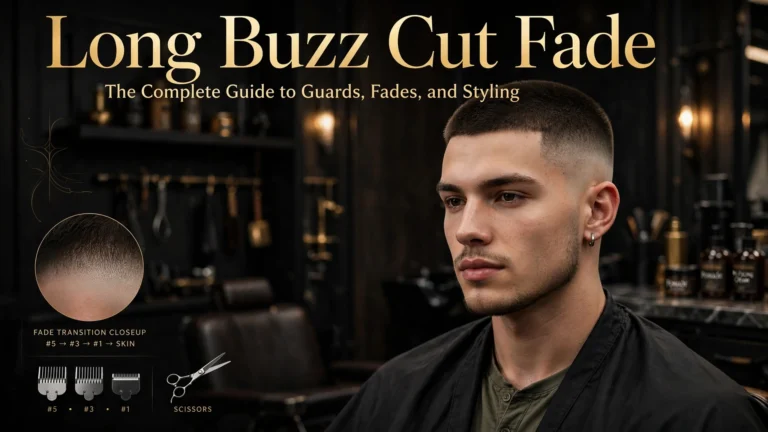
Related: Long Buzz Cut Fade: The Complete Guide to Guards, Fades, and Styling
Common Buzz Fade Mistakes to Avoid
- Starting with too high a fade — a low fade is easier to build on than a high or skin fade is to undo.
- Vague length requests — “short” means different things to different barbers; a guard number doesn’t.
- Confusing a taper with a fade — these produce visibly different results.
- Ignoring the natural hairline — decide in advance whether to preserve or clean it up.
- Working from one reference photo only — texture and head shape change how the same cut looks.
- Forgetting beard proportions — a fade chosen without the beard in mind can look disconnected.
- Attempting an advanced fade at home without experience — skin fades and high fades are difficult to self-execute cleanly.
- Ignoring workplace norms — high-contrast designs aren’t universally appropriate.
- Underestimating refresh frequency — a sharp fade needs more frequent visits than most people expect.
Frequently Asked Questions
What is a buzz cut fade haircut? A buzz cut fade is a buzz cut where the sides and back are gradually shortened toward the hairline — from a longer guard down to a shorter one or bare skin — while the top keeps a uniform, clipper-cut length.
What fade looks best with a buzz cut? There’s no single best option: low fades suit a subtle, classic look; mid fades balance contrast and versatility; high or skin fades create the boldest effect. The right choice depends on desired contrast, workplace, and maintenance tolerance.
Is a buzz cut fade low maintenance? It depends on fade height. A low fade or taper is relatively low maintenance. A high or skin fade needs more frequent trims to stay sharp.
What guard should I use for a buzz cut? Common choices run #1 (very close) to #4 (visible texture). A #2 or #3 is the most frequent starting point.
How long does a buzz fade last? The sharpest look typically holds for about a week, with the fade line softening gradually over the following weeks. Many people return every two to three weeks for a refresh.
Is a buzz cut good for a receding hairline? It can make a receding hairline less visually obvious for some people, since overall length is closer to uniform — it doesn’t change or treat the hairline itself.
Does a buzz cut make thinning hair look better? For some people, a very short, uniform length reduces the contrast between denser and thinner areas. Results vary by how the thinning is distributed.
Should I get a low, mid, or high fade with a buzz cut? Low fades are the most conservative, mid fades offer balanced contrast, and high fades create the strongest visual effect. The decision comes down to how much contrast and maintenance you want.
What’s the difference between a buzz cut fade and a high-and-tight? A high-and-tight is a specific style — sides skin-faded very high, minimal length on top. A buzz cut fade is the broader category, covering low, mid, and high fade options at varying top lengths.
Can I do a buzz fade at home? Buzzing the top evenly is realistic at home. A clean, blended fade — especially a skin fade — is significantly harder to self-execute and is generally better handled by a barber, particularly the first time.
How often should a buzz fade be refreshed? Many people return every two to three weeks, though this varies with hair growth rate and desired sharpness. Low fades typically go longer between visits than high or skin fades.
What should I tell my barber? State the fade height (low, mid, high), the top guard number, whether you want a skin fade or guard-length finish, and how you want the hairline and neckline handled. “Mid fade, #2 on top” gives far more direction than “buzz fade.”
Glossary
- Fade — a gradual, graduated shortening of hair up the side of the head, from longer to shorter (or skin).
- Taper — a gradual shortening limited to the perimeter (ears, neckline, sideburns), without a long blend up the side.
- Blend — the technique of smoothly connecting two different lengths with no visible line.
- Guard — a plastic attachment on clippers that sets a fixed cutting length, numbered #0–#8.
- Skin fade — a fade that finishes at bare skin rather than a short guard length.
- Line-up (edge-up) — sharply defining the hairline, typically at the forehead and temples.
- High-and-tight — a military-derived style with a very high, often skin-level fade and minimal top length.
Save This Before Your Next Appointment
The fastest way to get a predictable result is to walk in with a specific request instead of a general one. Screenshot the barber script for your target fade level from this guide, or bookmark this page so it’s ready the next time you sit down in the chair.

Daniel Carter is the Senior Men’s Grooming Editor at FadeBuzzCut, where he specializes in fade buzz cuts, barbering techniques, men’s hairstyles, and evidence-based grooming advice. With more than 12 years of experience researching haircut trends, clipper techniques, face shape recommendations, and hair care, he creates in-depth guides that help readers confidently choose, maintain, and style modern buzz cuts.
Daniel works closely with experienced barbers, grooming professionals, and trusted industry resources to ensure every guide reflects current barbering standards and practical, real-world advice. His editorial approach combines expert research, clear explanations, and user-focused recommendations to make men’s grooming accessible for beginners and experienced enthusiasts alike.
At FadeBuzzCut.com, Daniel oversees editorial quality, content accuracy, and regular updates so readers receive reliable, up-to-date information on fade buzz cuts, beard combinations, hairstyle trends, clipper guard lengths, maintenance routines, and grooming products. Every article is written with a commitment to Experience, Expertise, Authoritativeness, and Trustworthiness (EEAT) while delivering helpful answers for both readers and AI-powered search experiences.
Whether you’re choosing your first fade buzz cut, comparing low, mid, or high fades, or looking for practical maintenance tips, Daniel’s goal is to provide trustworthy guidance that helps you achieve the best possible results.