What Is a Buzz Cut? The Complete Guide to Lengths, Styles, and Guard Numbers
Last updated: August 2026 · Fact-checked against Wahl USA’s official guide-comb specifications, Merriam-Webster, and documented haircut terminology.
A buzz cut is one of the easiest haircuts to picture and one of the most misunderstood in the details. Most people know it as “very short hair cut with clippers” — but that hides real nuance: guard numbers, fades, tapers, and several named variations that all sit under the same term. This guide defines exactly what a buzz cut is, how it’s cut, what every length and style looks like, and how to ask for one with precision.
Key Takeaways
- A buzz cut is a short hairstyle cut mainly with electric clippers, ranging from skin-close to about half an inch, either uniform or graduated with a fade or taper.
- Clipper guard numbers are standardized in spacing (roughly every 1/8 inch) but not identical in exact millimeters across brands — a #2 leaves about 6mm, but always check the number printed on the guard itself.
- Dictionaries define “buzz cut” as a synonym of “crew cut,” but barbers and stylists distinguish them: a buzz cut is short everywhere, while a crew cut keeps meaningfully more length on top.
- “Induction cut” and “burr cut” both describe extremely short, uniform buzz-cut variations historically tied to military basic training.
- A buzz cut does not change hair density, reverse thinning, or affect regrowth — it only changes visible length.
Quick Finder
| If you want to know… | Go to… |
|---|---|
| What a buzz cut actually is | Definition |
| Buzz cut vs. the dictionary definition | Buzz Cut vs Crew Cut: The Dictionary Says They’re the Same |
| How short it is | Buzz Cut Lengths and Guard Numbers |
| Different types | Types of Buzz Cuts |
| How a fade changes it | Buzz Cut With a Fade |
| Whether it may suit you | Who Can Wear a Buzz Cut? |
| What to tell a barber | How to Ask a Barber for a Buzz Cut |
| How to maintain it | Buzz Cut Maintenance |
| Common questions | FAQs |
What Is a Buzz Cut?
A buzz cut is a short hairstyle created mainly with electric clippers, cutting hair close to the scalp instead of shaping it with scissors. The name comes from the buzzing sound clippers make while running through hair.
Clippers are fitted with a snap-on guard (also called a guide comb) that sets how much hair is left behind, or used bare-bladed for the closest possible finish. This is the core mechanical difference between a buzz cut and most other haircuts: instead of scissor work shaping length strand by strand, the clippers pass over each section at a fixed setting, leaving hair at a consistent length.
Length varies within the category. Some buzz cuts use one guard length everywhere for a fully uniform finish. Others pair a shorter setting on the sides with more length on top, or add a fade or taper for a graduated transition instead of one flat length. “Buzz cut” is best understood as a category of short, clipper-based hairstyles — not one exact haircut with a single fixed length.
Buzz Cut vs Crew Cut: The Dictionary Says They’re the Same
Here’s a genuinely useful nuance most guides skip: Merriam-Webster’s dictionary defines “buzz cut” simply as a synonym for “crew cut.”<sup>[1]</sup> In everyday and historical usage, the two terms have overlapped.
In modern barbering practice, though, they’re usually treated as distinct: a buzz cut keeps hair short and clipper-cut everywhere, including the top, while a crew cut keeps noticeably more length and shape on top with short, clipper-cut sides. If you want the barbershop distinction rather than the dictionary one, use the comparison table in the vs. similar haircuts section below.
What Does a Buzz Cut Look Like?
Visually, a buzz cut is defined by four consistent traits:
- Short overall length — hair sits close to the scalp, typically between skin-close and about half an inch.
- Visible scalp, more so at shorter guard lengths, less so at longer ones.
- A clipped, textured finish — less layered than a scissor cut, more uniform.
- Uniform or graduated shape — flat and even in a classic buzz cut, or shorter at the sides with a visible transition in a faded or tapered version.
How Is a Buzz Cut Cut?
- Deciding the length — client and barber agree on a guard number (or a no-guard “skin” finish) for the sides, back, and top.
- Attaching the guard — a plastic guide comb clips onto the blade to set a consistent length, or the barber works with the bare blade for the closest finish.
- Cutting the main sections — typically starting at the back and sides, moving with or against hair growth depending on the look.
- Checking for consistency — a second pass, often against the grain, catches uneven patches.
- Blending a fade or taper, if requested — shorter guards near the hairline blend upward into the longer length using overlapping passes.
- Cleaning the neckline and edges — defined with a trimmer or straight razor for a crisp finish.
- Final check — one more pass over the head confirms even length and smooth transitions.
Exact technique and terminology vary between barbers and shops — this is a general outline, not a universal procedure.
Buzz Cut Lengths and Guard Numbers
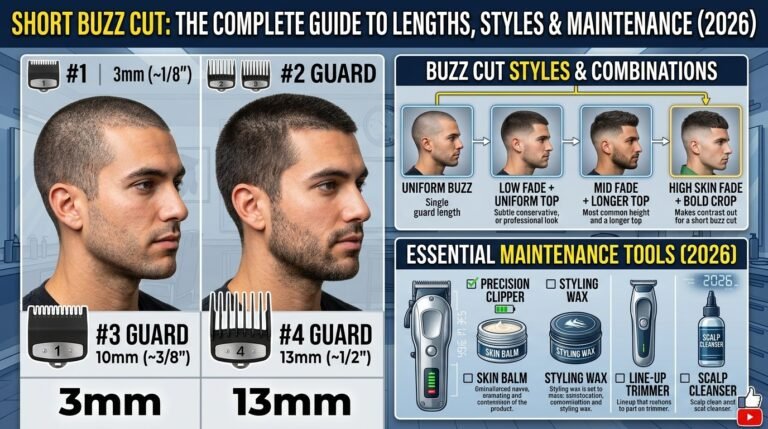
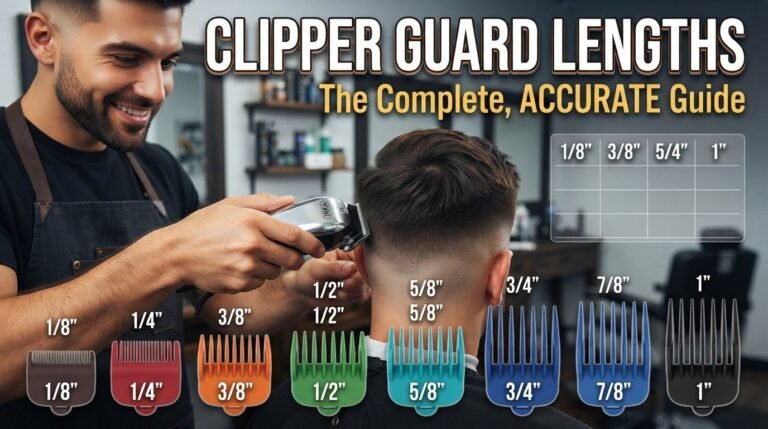
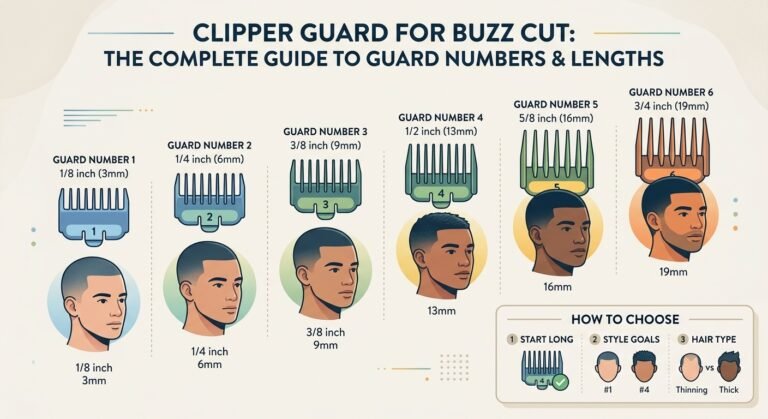
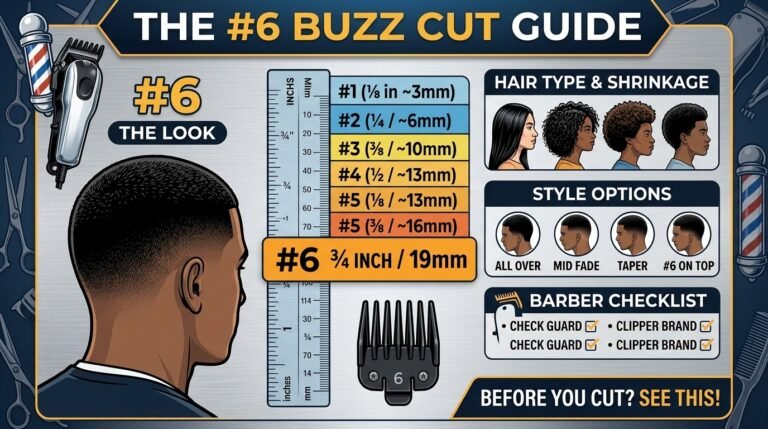
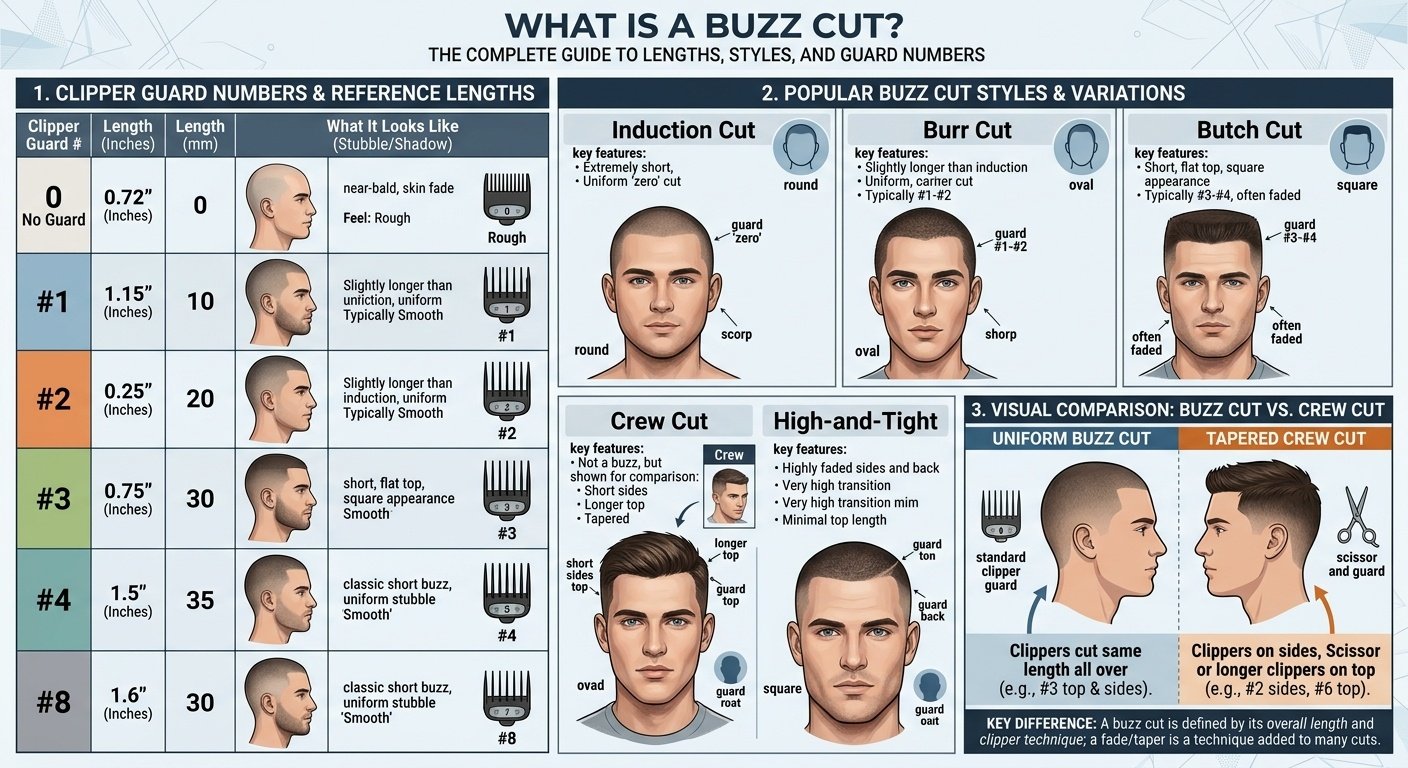
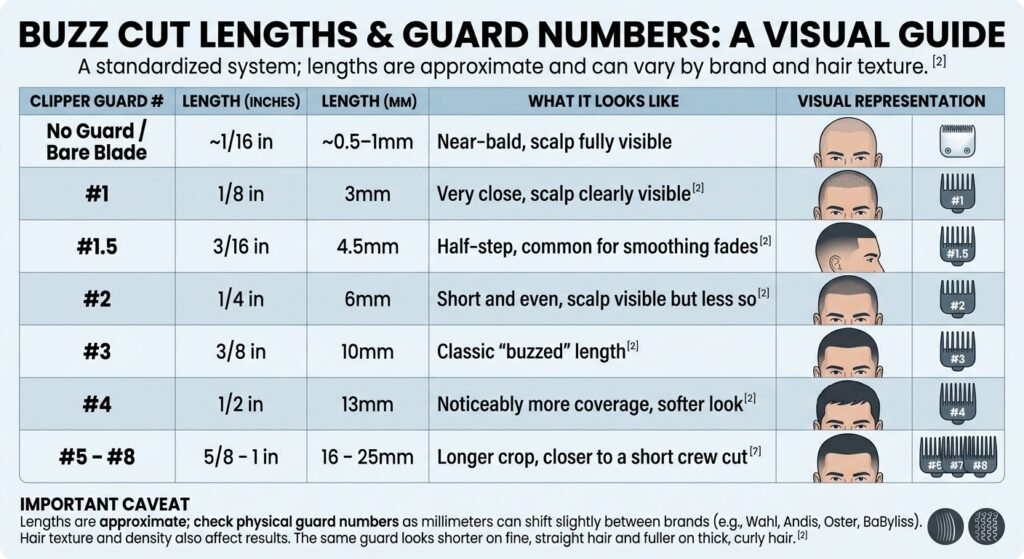
Clipper guard numbers are a standardized spacing system: each whole number adds roughly 1/8 inch (about 3mm) of length, a convention documented across major clipper manufacturers.<sup>[2]</sup>
| Guard | Length (inches) | Length (mm) | What it looks like |
|---|---|---|---|
| No guard / bare blade | ~1/16 in | ~0.5–1mm | Near-bald, scalp fully visible |
| #1 | 1/8 in | 3mm | Very close, scalp clearly visible |
| #1.5 | 3/16 in | 4.5mm | Half-step, common for smoothing fades |
| #2 | 1/4 in | 6mm | Short and even, scalp visible but less so |
| #3 | 3/8 in | 10mm | Classic “buzzed” length |
| #4 | 1/2 in | 13mm | Noticeably more coverage, softer look |
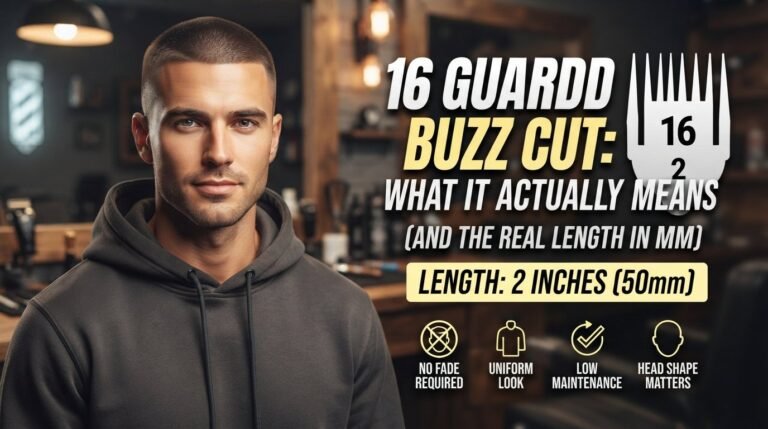
| #5–#8 | 5/8–1 in | 16–25mm | Longer crop, closer to a short crew cut |
Important caveat: these are widely used reference lengths, confirmed against Wahl USA’s own published guide-comb specifications<sup>[2]</sup> — but exact millimeters can shift slightly between brands (Andis, Oster, BaByliss). Always check the number printed on the physical guard rather than assuming it matches exactly across brands. Hair texture and density also affect the visual result: the same guard number looks shorter on fine, straight hair and slightly fuller on thick or curly hair, since curl pattern adds visible volume.
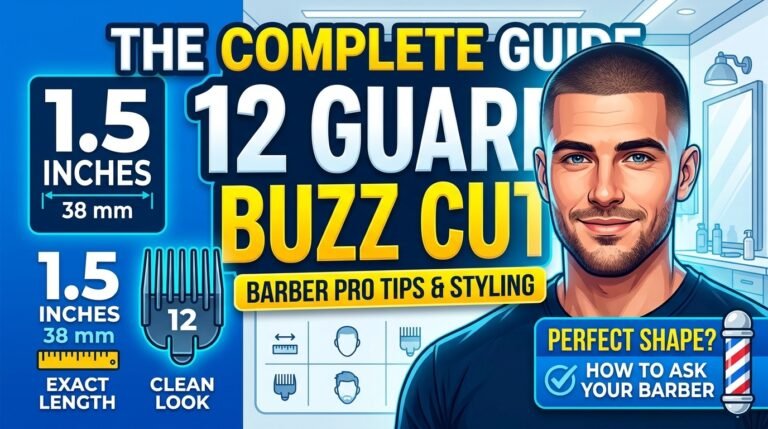
Related: 12 Guard Buzz Cut: The Complete Length, Look, and Barber Guide
Types of Buzz Cuts
Classic (Uniform) Buzz Cut
The same guard length is used across the whole head — top, sides, and back — for a completely even finish. This is the default mental image most people have of “a buzz cut.”
Induction Cut
The shortest common buzz-cut variation, traditionally the first haircut given to new recruits at the start of military basic training — hence the name.<sup>[3]</sup> It’s typically cut with no guard or a very short one, for a near-skin, uniform finish. Historically the practice was tied to reducing lice risk among recruits housed in close quarters and to creating visual uniformity among a new group; it’s also sometimes called a “mighty fine” or a “number zero.”<sup>[3]</sup>
Burr Cut
A close cousin of the induction cut — a very short, uniform clipper cut, often cut at a #1 or #2 guard rather than bare blade. In many shops the two terms are used interchangeably; where a distinction is made, a burr cut is fractionally longer and slightly less severe than an induction cut.
Butch Cut
An older term for a short, uniform, flat clipper cut, historically used somewhat interchangeably with “buzz cut” or “crew cut” depending on region and era. Where it’s still used, it generally describes a short, closely cropped style rather than one exact guard length.
Buzz Cut Fade
A buzz cut where the sides and back are cut progressively shorter toward the hairline, blending into a longer length on top. Covered in detail below.
Buzz Cut Taper
A subtler version of the fade concept, usually concentrated around the neckline, sideburns, and ears rather than a dramatic side blend. Covered in detail below.
Longer Buzz Cut
Using a #4 guard or higher keeps more length and softens the “buzzed” look while staying clipper-cut and low-maintenance — a common starting point for a first-time buzz cut.
Related: Long Buzz Cut Fade: The Complete Guide to Guards, Fades, and Styling
Buzz Cut With a Fade
A fade adds a graduated transition to the sides and back, cutting hair progressively shorter toward the hairline and ears, then blending it into the longer length above.
- Low fade — transition starts near the ears and neckline; more length stays uniform above it.
- Mid fade — transition starts around the middle of the side of the head, for more visible contrast.
- High fade — transition starts higher up the sides, for the most dramatic contrast with the top.
- Skin fade — any of the above, cut down to bare skin at the shortest point rather than stopping at a short guard.
A fade doesn’t change the core concept of a buzz cut — the top and main sections are still clipper-cut and short. It changes the side transition: instead of one flat length, the sides graduate smoothly from very short to the length used on top.
Buzz Cut With a Taper
A taper shortens hair gradually and subtly, mainly around the neckline, sideburns, and hairline perimeter, without the dramatic blend of a full fade.
| Taper | Fade | |
|---|---|---|
| Visual contrast | Subtle, mostly noticeable up close | More visible from a distance |
| Where it’s concentrated | Neckline, sideburns, edges | Broader area up the side of the head |
| Best for | A clean, understated finish | A modern, higher-contrast finish |
Exactly where “taper” ends and “fade” begins varies by barber and region — describe the level of contrast you want rather than relying on the label alone.
Buzz Cut vs Similar Haircuts
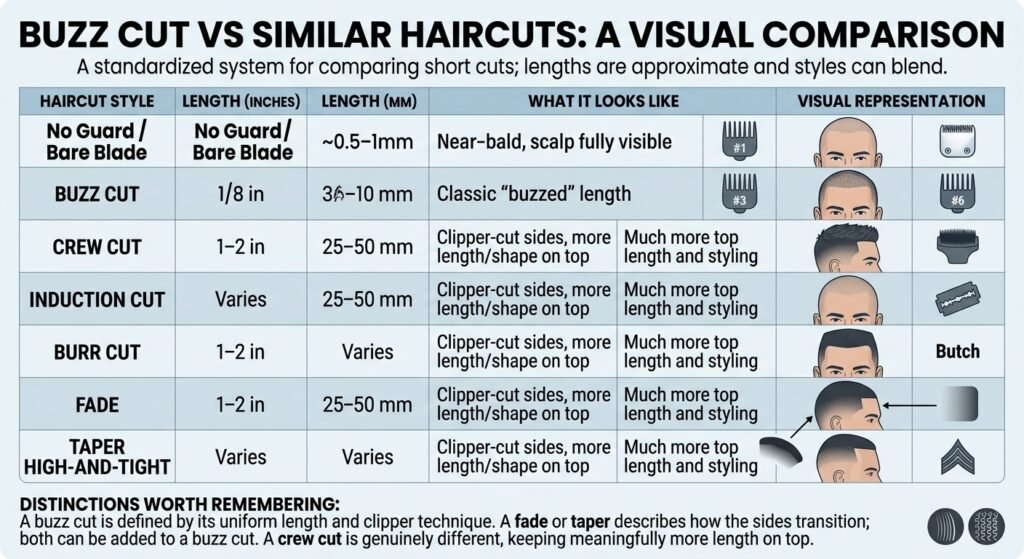
| Haircut | Main characteristic | Typical length | Key difference from a buzz cut |
|---|---|---|---|
| Buzz cut | Short, clipper-cut hair, uniform or graduated | Skin-close to ~1/2 in | — |
| Crew cut | Clipper-cut sides, more length/shape on top | Short sides, longer top (often 1–2 in) | Much more top length and styling |
| Induction cut | Extremely short, uniform, minimal styling | Near-skin | One of the shortest buzz-cut variations |
| Burr cut | Very short, uniform | Very short | Often interchangeable with induction cut; sometimes marginally longer |
| Butch cut | Short, flat, closely cropped | Short | Older regional term overlapping buzz/crew cut |
| Fade | Graduated side transition | Varies | A technique, not a full haircut — can be added to a buzz cut, crew cut, or others |
| Taper | Subtle graduated transition at the edges | Varies | Softer version of a fade |
| High-and-tight | Very short, heavily faded sides, minimal top | Very short sides | Sharper contrast, military-associated |
The distinction worth remembering: a buzz cut is about overall length and clipper technique; a fade or taper describes how the sides transition. A buzz cut can include a fade. A crew cut is a related but genuinely different haircut because it keeps meaningfully more length on top.
Who Can Wear a Buzz Cut?
There’s no rule about who “can” wear a buzz cut — the more useful question is what affects how it looks and feels for you:
- Face shape — different lengths and side treatments visually balance different proportions.
- Hair texture — straight, wavy, curly, and coily hair each read differently at short lengths.
- Hair density — affects how visible the scalp is at a given guard length.
- Hairline shape — short hair makes any hairline more visible.
- Personal comfort — some people go straight to skin-close; others ease in with a longer guard first.
- Maintenance tolerance — very short lengths need more frequent trims.
None of these rule a buzz cut out — they just point to the best starting length and variation.
You’ll Love This Post too: Buzz Cut Fade Haircut: The Complete Guide to Fade Levels, Guards & Barber-Ready Instructions
Buzz Cut for Different Face Shapes
General tendencies, not fixed rules — personal style and confidence matter more than any formula.
- Oval: Flexible with most buzz cut lengths and fades due to balanced proportions.
- Round: Slightly more length on top, or a higher-contrast fade, can add visual length.
- Square: Complements strong jawlines well; a fade can soften or sharpen the look.
- Oblong/rectangular: A little extra length on top rather than an extremely close cut helps balance proportions.
- Diamond: A fade adding width at the temples and less at the cheekbones can be flattering.
- Heart: Slightly longer top with shorter sides can balance a narrower jawline.
Buzz Cut for Different Hair Types
- Straight: Shows clipper lines and guard length cleanly.
- Wavy: Adds subtle texture and movement even at short lengths.
- Curly: Works well with a buzz cut; curl pattern adds visible volume, so the same guard number can look fuller than on straight hair.
- Coily: A popular low-maintenance option; shrinkage means the finished look can appear shorter than the guard number suggests.
- Thick/dense: Handles shorter guards well, looks full even at close lengths.
- Fine/thin: Very short lengths show more scalp than the same guard on thicker hair.
- Thinning: Popular for creating a uniform look — but see the note below.
A buzz cut does not make hair grow back thicker, reverse thinning, or treat any hair or scalp condition. It only creates an even, low-maintenance length. Anyone concerned about hair loss or scalp changes should consult a doctor or dermatologist.
Buzz Cut and Hairlines
Short hair naturally makes the hairline more visible — receding hairlines, widow’s peaks, uneven or asymmetrical hairlines, and density changes near the front of the scalp all become more noticeable at short clipper lengths, regardless of guard number. A buzz cut can’t hide or correct a hairline; a slightly longer guard on top can soften the effect somewhat, but that’s the extent of it.
Buzz Cut Pros and Cons
Advantages
- Minimal daily styling, often no product needed
- Fast to wash and dry
- Simple, low-effort grooming routine
- Clean, sharp appearance
- Practical in hot weather or for active lifestyles
Trade-offs
- Very short lengths need touch-ups every 1–2 weeks
- More scalp exposure means more direct sun exposure
- Head shape and skin marks are more visible
- Hairline and density patterns are more visible
- Growing it back out takes time and passes through awkward in-between stages
Experiences vary — these are general considerations, not guarantees.
Buzz Cut Maintenance
- Trim frequency: Very short guards (skin, #1, #2) typically need a touch-up every 1–2 weeks; longer buzz cuts (#4+) can go longer between trims.
- Washing: Regular shampooing matters more with a more exposed scalp.
- Scalp care: Sunscreen or a hat in strong sun, and basic moisturizing if the scalp feels dry, are worth considering.
- Fades and tapers need more frequent upkeep than a uniform buzz cut, since the blend softens faster than a flat length.
- Neckline and edges are often cleaned up between full haircuts to keep the style sharp.
- At-home upkeep: Some people maintain a buzz cut with home clippers between barber visits, though an even result on the back of the head takes practice.
There’s no single universal trimming schedule — it depends on your hair’s growth rate and how sharp you want the length at all times.
How to Ask a Barber for a Buzz Cut
Because “buzz cut” spans several lengths and styles, specificity gets you the result you want. Communicate:
- The guard number (or “skin” for bare-blade)
- Whether you want one uniform length, or shorter sides with more length on top
- Whether you want a fade or taper, and roughly where it should start
- Neckline preference — squared, rounded, or tapered
- Whether you want edges lined up or left more natural
Example phrasing:
- “A classic buzz cut, a #2 all over, no fade.”
- “A #3 on top with a low fade on the sides.”
- “As short as possible — skin on the sides, a #1 on top.”
- “A buzz cut with a taper around the neckline, nothing dramatic on the sides.”
A reference photo is one of the most reliable ways to align on the result, since guard numbers and terms like “fade” or “taper” can be interpreted slightly differently between barbers.
Complete Instruction: Short Buzz Cut: The Complete Guide to Lengths, Styles & Maintenance (2026)
Should You Get a Buzz Cut?
It may appeal to you if:
- You want a low-effort, minimal-styling routine
- You’re comfortable with more scalp and hairline visibility
- You want a clean, simple, clipper-cut finish
A longer short haircut may suit you better if:
- You want more day-to-day styling flexibility
- You’d prefer more coverage over the scalp and hairline
- You’re easing into short hair rather than jumping straight to it
There’s no universally “right” answer — it comes down to comfort with short hair, maintenance tolerance, and personal style.
Buzz Cut Terminology Guide
- Buzz cut: A short hairstyle cut mainly with electric clippers.
- Clipper cut: Any haircut done primarily with clippers rather than scissors.
- Guard / guide comb: A plastic attachment that sets a consistent clipper cutting length.
- Blade: The clipper’s metal cutting component; used bare for the closest possible cut.
- Fade: A gradual, blended transition from very short at the hairline to longer above.
- Taper: A subtler, more gradual shortening, usually at the neckline and edges.
- Line-up (edge-up): Sharpening and cleaning the hairline, usually with a trimmer or razor.
- Neckline: The hairline at the back of the neck — squared, rounded, or tapered.
- #1–#4 (and higher): Standard guard numbers, each roughly 1/8 inch longer than the last.<sup>[2]</sup>
- Induction cut: An extremely short, uniform buzz cut historically tied to military induction.<sup>[3]</sup>
- Burr cut: A very short, uniform clipper cut, closely related to the induction cut.
- Butch cut: An older term for a short, flat, closely cropped clipper cut.
- Crew cut: A haircut with short clipper-cut sides and noticeably more length on top.
A Brief, Sourced History
The buzz cut’s rise is tied directly to the invention of the manual hair clipper in the late 19th century, which let barbers cut hair close and fast for the first time.<sup>[4]</sup> The style became strongly associated with military, athletic, and institutional settings because of its practicality: it’s fast to produce, uniform across a group, and low-maintenance. In U.S. military basic training specifically, the “induction cut” became a first-day rite of passage — originally justified on hygiene grounds (reducing lice risk among recruits housed in close quarters) and reinforced by its effect of visually erasing individual differences among a new group.<sup>[3]</sup> Outside institutional settings, the buzz cut has also carried different, sometimes conflicting cultural meanings over time — as a practical grooming choice, an athletic default, and at various points a marker of subcultural identity — so it’s best understood as a style shaped by context rather than one single origin story.
Buzz Cut Length Decision Guide
Very short (skin, #1) if: you want the simplest routine and are comfortable with high scalp visibility.
Medium-short (#2–#3) if: you want a clearly “buzzed” look with a bit more coverage, or you’re trying it for the first time.
Longer (#4+) if: you want extra coverage and a softer look while keeping clipper-cut simplicity.
Add a fade or taper if: you want more contrast between sides and top, or a more modern, barbered finish.
Frequently Asked Questions
What is a buzz cut? A short hairstyle cut mainly with electric clippers, close to the scalp, either at one uniform length or with a fade or taper.
Is a buzz cut the same as a crew cut? By dictionary definition, yes — Merriam-Webster treats them as synonyms.<sup>[1]</sup> In barbering practice, no — a crew cut keeps meaningfully more length on top.
How short is a buzz cut? From skin-close (no guard) up to about half an inch (a #4 guard), depending on the variation.
What number is a typical buzz cut? #1 through #3 are most common for a classic, closely cropped look; #4 and above are still buzz cuts, just longer.
What is the difference between a #1, #2, #3, and #4 buzz cut? Each leaves progressively more hair — roughly 3mm, 6mm, 10mm, and 13mm — with less scalp visibility as the number increases.<sup>[2]</sup>
What is an induction buzz cut? An extremely short, uniform buzz cut, often cut with no guard, historically the first haircut given at the start of military basic training.<sup>[3]</sup>
What is a burr cut? A very short, uniform clipper cut closely related to — and often used interchangeably with — the induction cut.
What is a butch cut? An older term for a short, flat, closely cropped clipper cut, historically overlapping with “buzz cut” and “crew cut.”
Can a buzz cut have a fade? Yes — a fade blends the sides from very short near the hairline into a longer length above, instead of one flat length throughout.
Is a buzz cut good for thick or curly hair? Yes to both — thick hair looks full at short lengths, and curl pattern adds visible volume even when cut short.
Is a buzz cut good for thinning hair? Many people with thinning hair choose it for an even look across the scalp, though it doesn’t change density or treat hair loss.
Does a buzz cut suit a round face? It can — more length on top or higher-contrast side fading can help balance a rounder face shape.
How often should you get a buzz cut? Commonly every 1–2 weeks for very short lengths; less often for longer buzz cuts.
Is a buzz cut low maintenance? Daily styling is minimal, but very short lengths need frequent trims — “low maintenance” applies to daily upkeep, not trim frequency.
Can women wear a buzz cut? Yes — it’s a hairstyle choice available to anyone, adjustable in length and style to personal preference.
Conclusion
A buzz cut is best understood as a family of short, clipper-based styles sharing one technique — hair cut close to the scalp with electric clippers, either uniform or blended with a fade or taper — rather than one exact haircut. Once you know how guard numbers work, what separates a buzz cut from a crew cut or induction cut, and how to describe the finish you want, getting the right cut becomes a five-minute conversation instead of a guessing game.

Daniel Carter is the Senior Men’s Grooming Editor at FadeBuzzCut, where he specializes in fade buzz cuts, barbering techniques, men’s hairstyles, and evidence-based grooming advice. With more than 12 years of experience researching haircut trends, clipper techniques, face shape recommendations, and hair care, he creates in-depth guides that help readers confidently choose, maintain, and style modern buzz cuts.
Daniel works closely with experienced barbers, grooming professionals, and trusted industry resources to ensure every guide reflects current barbering standards and practical, real-world advice. His editorial approach combines expert research, clear explanations, and user-focused recommendations to make men’s grooming accessible for beginners and experienced enthusiasts alike.
At FadeBuzzCut.com, Daniel oversees editorial quality, content accuracy, and regular updates so readers receive reliable, up-to-date information on fade buzz cuts, beard combinations, hairstyle trends, clipper guard lengths, maintenance routines, and grooming products. Every article is written with a commitment to Experience, Expertise, Authoritativeness, and Trustworthiness (EEAT) while delivering helpful answers for both readers and AI-powered search experiences.
Whether you’re choosing your first fade buzz cut, comparing low, mid, or high fades, or looking for practical maintenance tips, Daniel’s goal is to provide trustworthy guidance that helps you achieve the best possible results.