FADE BUZZ CUT EXPERTS
Discover the Perfect Fade Buzz Cut with Expert Guidance
FadeBuzzCut.com is your trusted destination for everything related to fade buzz cuts. Explore detailed haircut guides, face shape recommendations, clipper guard comparisons, beard pairing ideas, grooming routines, and maintenance tips—all created to help you achieve a clean, modern, and confident look.
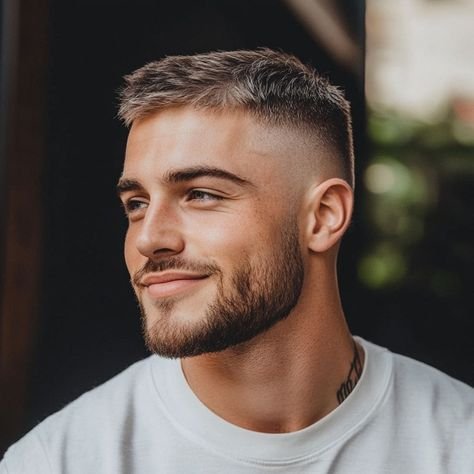
Fade Buzz Cut: The Complete Guide to Every Style, Guard Number, and Barber Trick
Quick Answer
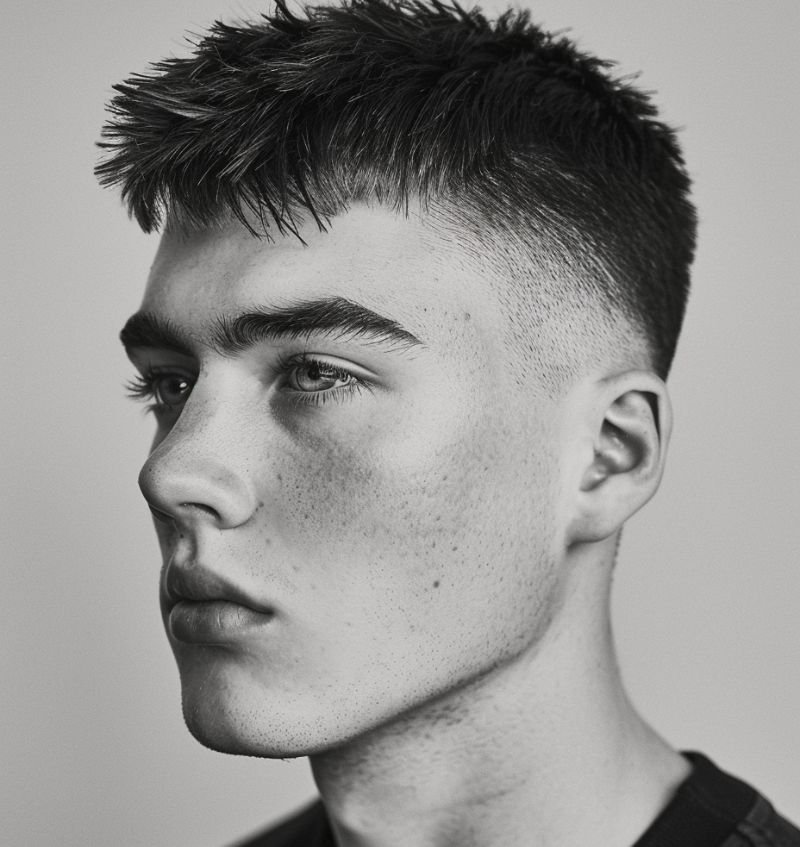
A fade buzz cut pairs a uniform clipper buzz on top — typically a #2, #3, or #4 guard — with a graduated fade around the sides and back that steps down to a #1 or bare skin near the hairline. It suits nearly every face shape and hair type, requires no daily styling, and can be adjusted from subtle (low fade) to bold (high skin fade) depending on how much contrast you want.
Key Takeaways
- The top length and the fade are two separate decisions — always specify both to your barber.
- Fade height (low, mid, high) and fade finish (skin vs. taper) are independent choices that combine to create the final look.
- Skin fades and high fades need the most frequent trims (every 2–3 weeks); low fades and tapers stretch to 4–5 weeks.
- Face shape, hairline pattern, and hair texture should all inform which variation you choose — not just a reference photo.
- A skin fade is generally the most flattering option for a receding hairline, since it removes the harsh line where thinning hair meets scalp.
Quick Style Finder
| If you want… | Ask your barber for… | Best-fit hair type |
| The most conservative, office-safe option | Low fade, #3 on top, fade starting above the ear | Any texture |
| The most popular all-purpose version | Mid fade, #3 on top, fade starting at temple level | Any texture |
| Maximum contrast and edge | High fade, #3–4 on top, fade starting above the temple | Straight, wavy |
| The sharpest possible line | Skin fade to bare scalp | Fine to medium |
| A softer, more gradual blend | Taper fade, no hard skin line | Thick, coarse, curly, coily |
| A contoured line that follows the skull | Drop fade, curving down behind the ear | Round or oval head shape |
| A rounded fade isolated around the ear | Burst fade, semi-circular blend | Wavy or curly with longer top |
| Thinning or receding hair | Skin fade — removes the visual “gap” at the hairline | Any texture |
What Is a Fade Buzz Cut, Exactly?
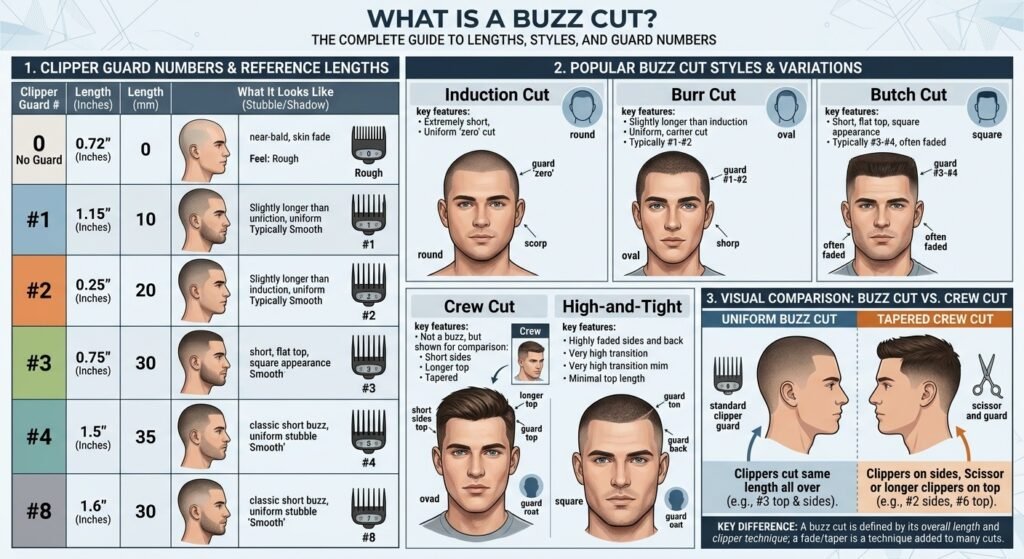
A buzz cut, on its own, is clippers run over the whole head at one guard length — usually between a #1 (1/8″) and a #4 (1/2″). It’s uniform, fast, and low-fuss. A fade buzz cut adds a graduated blend around the sides and back, so hair gets progressively shorter moving down toward the neckline and ears, often finishing at skin or a #0.5.
The result carries two identities at once: the practicality of a buzz cut and the sculpted look of a fade. From a barber’s chair, the fade itself is a blending exercise, not a length. You’re choosing where the fade line sits on the head, how gradual or sharp the transition is, and how it works with your natural hairline, ears, cowlicks, and the curve of your skull — including areas like the occipital bone at the back of the head, where hair growth direction often shifts and can make blending trickier. That’s the part most guides skip, and it’s what actually separates a custom-shaped haircut from a generic clipper job.
Why the Fade Buzz Cut Has Taken Over
Three things drive this haircut’s popularity, and none of them are trend-chasing:
- Zero styling required. No product decisions, no morning routine, no bad-hair days from humidity or sleep.
- It hides what a plain buzz cut can’t. A flat, one-length buzz can make a round head look boxier or draw attention to a receding hairline. The fade breaks up that solid mass of hair and redirects the eye toward the jaw and cheekbones instead.
- It scales with commitment level. A first-timer can choose a subtle low fade that barely reads as a “fade,” while someone who wants a statement look can push a high skin fade with a hard part or shaved design.
It also holds up better in photos and video calls than a growing-out buzz cut, which matters more to most readers than trend appeal alone.
Types of Fade Buzz Cuts
Low Fade Buzz Cut
The fade begins about an inch above the ear. It’s the most subtle version — from a few feet away, it can look like a regular buzz cut with tidier edges.
- Guard numbers: #3–4 on top, fading to #1 or skin
- Best for: first-timers, conservative workplaces, anyone easing into a fade
- Barber tip: if unsure how much fade you want, always start low. A barber can take more off next visit; they can’t put hair back.
Mid Fade Buzz Cut
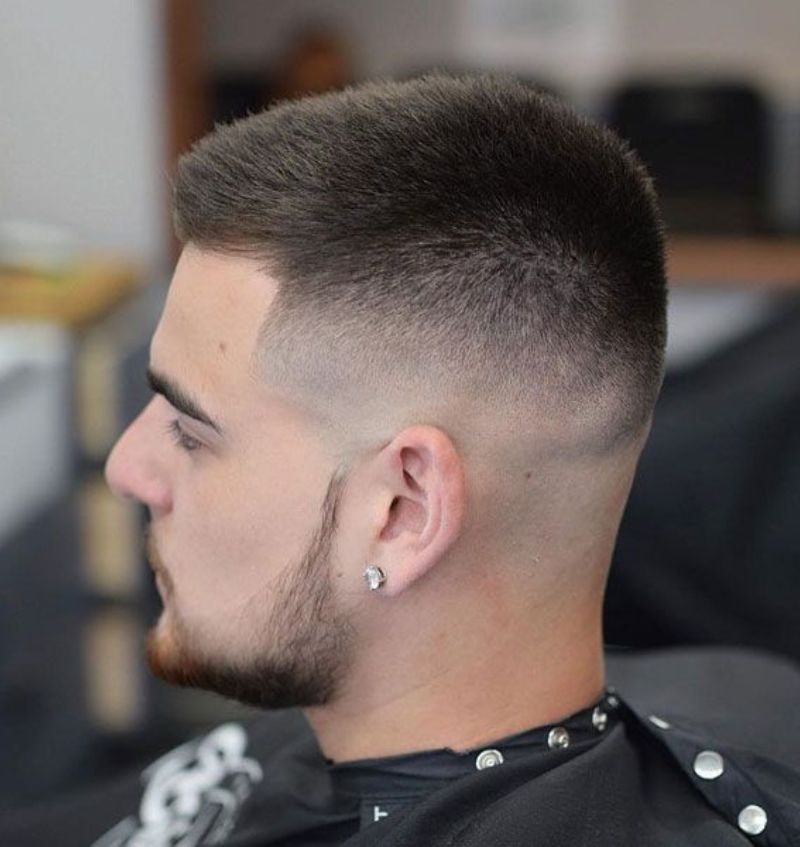
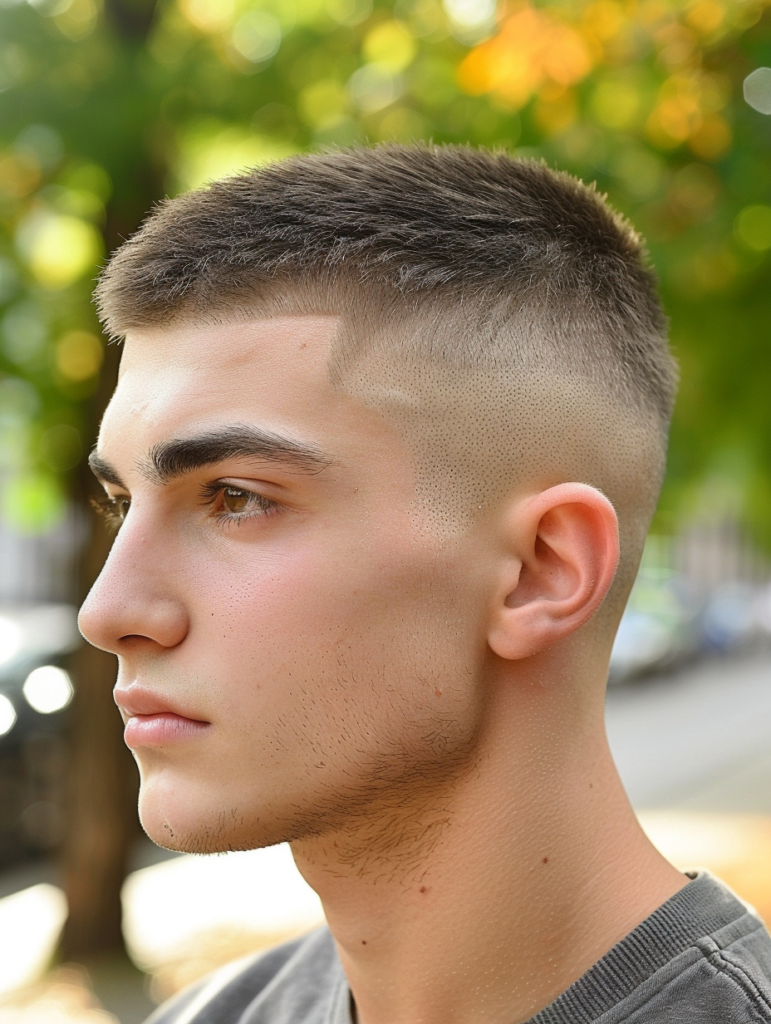
The most requested version in most shops. The fade starts around temple height, level with the top of the ear.
- Guard numbers: #2–3 on top, fading to skin or #0.5
- Best for: nearly every face shape and workplace — the safest default choice
- Barber tip: “mid” means slightly different things in different shops. Point to exactly where you want the fade to start rather than relying on the word alone.
High Fade Buzz Cut
The fade starts above the temple, sometimes near the crown, leaving a smaller island of longer hair on top.
- Guard numbers: #3–4 on top, dropping fast to skin
- Best for: maximum contrast, athletic or streetwear styling, round or square faces wanting more visual length
- Barber tip: high fades grow out fastest — plan on a trim every two to three weeks, not four.
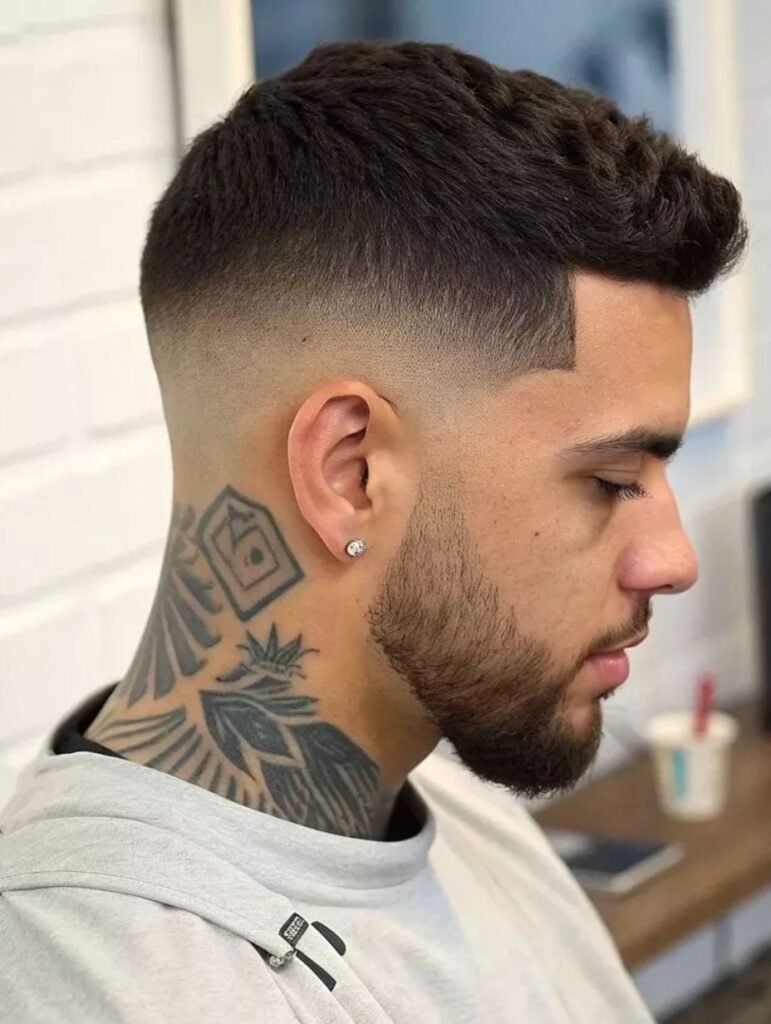
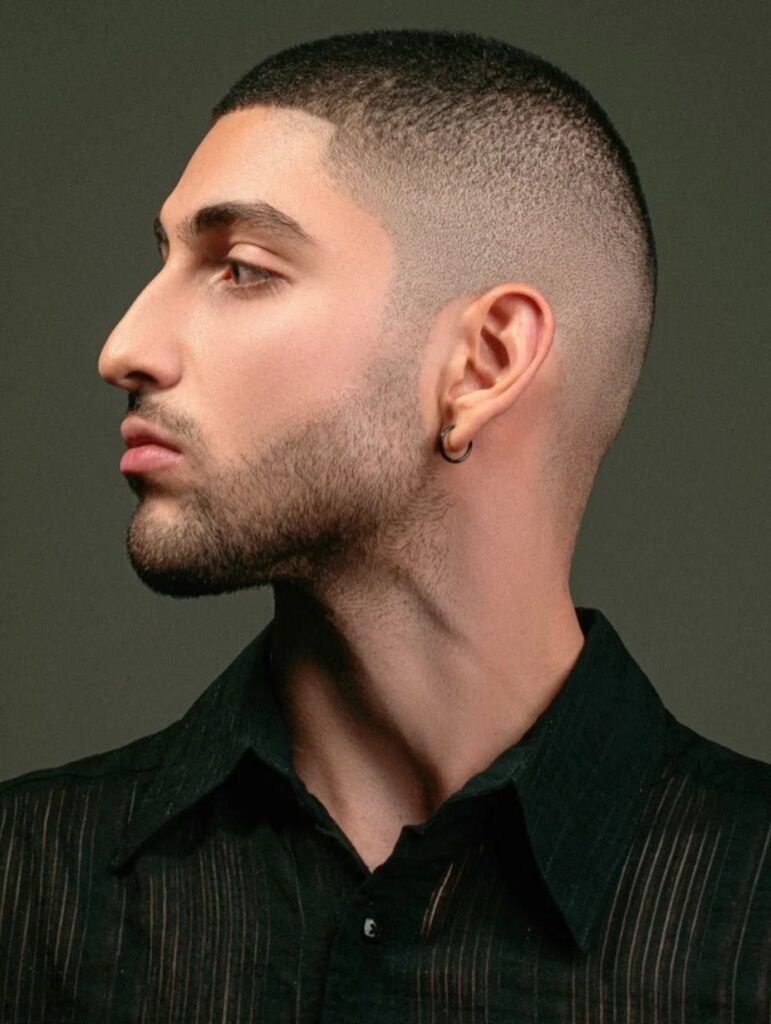
Skin Fade Buzz Cut
Any fade height taken all the way to bare skin rather than stopping at a #1. This is a technique, not a height — you can combine it with a low, mid, or high fade.
- Best for: thinning or receding hairlines, anyone wanting the crispest possible finish
- Barber tip: skin fades show regrowth fastest of all, since stubble becomes visible at the fade line within days.
Taper Fade Buzz Cut
A softer relative of the skin fade — hair shortens gradually without ever fully exposing scalp.
- Best for: thicker or coarser textures that hold a clean line without skin exposure, and workplaces where a skin fade reads as too bold
- Barber tip: tapers are the most forgiving between cuts, since there’s no hard skin line to visibly grow out.
Drop Fade Buzz Cut
The fade line curves downward behind the ear and toward the nape instead of running in a straight, horizontal line — following the natural curve of the skull rather than cutting across it.
- Best for: round or oval head shapes; adds a more contoured, less blocky line
- Barber tip: this variation depends heavily on barber skill — ask specifically for a “drop” fade rather than assuming a standard fade will curve.
Burst Fade Buzz Cut
The fade radiates in a semi-circle isolated around the ear rather than running across the entire side of the head. Most often paired with slightly longer top length or a fringe.
- Best for: wavy or curly hair with a bit more length on top; a hybrid pick between a full buzzed top and a longer style
- Barber tip: less common as a true short buzz, but worth knowing if your reference photo shows fading only around the ear.
Fade Height Comparison
| Low Fade | Mid Fade | High Fade | |
| Fade starting point | Above the ear | Temple level | Above the temple / near crown |
| Contrast level | Subtle | Moderate | Bold |
| Trim frequency | Every 4–5 weeks | Every 3–4 weeks | Every 2–3 weeks |
| Verdict | Best default for conservative settings | Best all-around choice for most readers | Best for readers wanting a statement look |
Skin Fade vs. Taper Fade
| Skin Fade | Taper Fade | |
| Finish | Blends to bare skin | Blends to short hair, no skin shown |
| Best hair texture | Fine to medium | Thick, coarse, curly |
| Grows out | Fast — stubble shows within days | Slower — stays clean-looking longer |
| Verdict | Choose for sharpest contrast and receding hairlines | Choose for lower upkeep and softer texture |
Drop Fade vs. Burst Fade vs. Standard Fade
| Standard Fade | Drop Fade | Burst Fade | |
| Line shape | Straight/horizontal | Curves down behind the ear | Semi-circle around the ear only |
| Best head shape | Any | Round, oval | Any, with longer top |
| Barber skill required | Standard | Higher | Higher |
| Verdict | Safest, most universally available | Best for a contoured, custom look | Best if pairing with longer top hair |
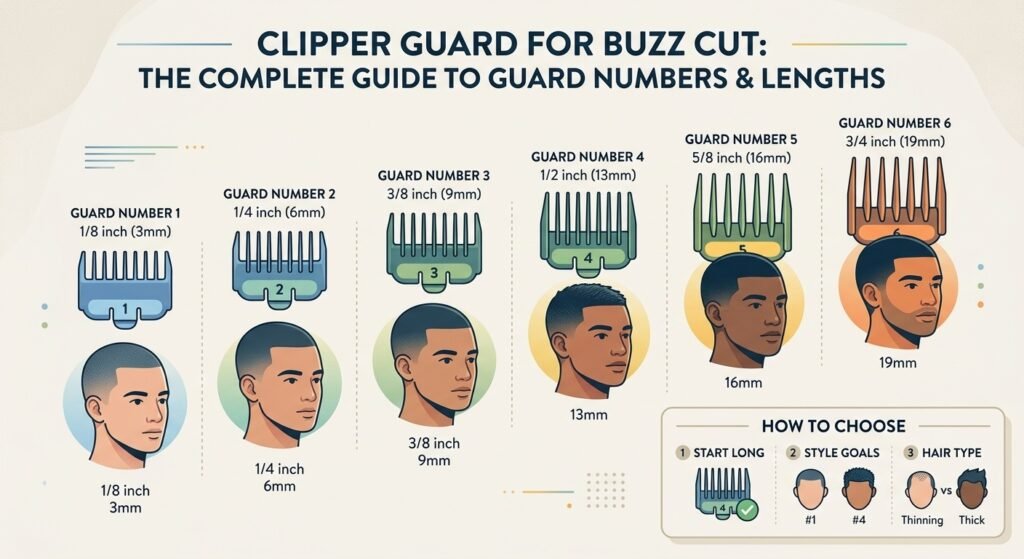
Buzz Cut Guard Numbers Explained
| Guard Number | Length | Look |
| #0 / Skin | 0″ (bare) | Used only for fade lines and blending |
| #1 | 1/8″ | Very close, classic “buzz” look |
| #2 | 1/4″ | Short with visible texture and hairline definition |
| #3 | 3/8″ | The most common top length for fade buzz cuts |
| #4 | 1/2″ | Slightly longer, suits thicker or wavier hair |
| #5 | 5/8″ | Borderline crew cut territory |
For a fade buzz cut, the top is almost always a #2, #3, or #4 — the fade itself steps down through #0–2 as it approaches the skin.
Face Shape Guide
| Face Shape | Best Fade Buzz Cut | Why |
| Round | High fade, #4 on top | Adds visual height, breaks up facial width |
| Square | Mid fade, softer taper | Keeps strong jawlines from looking boxy |
| Oval | Any fade height | The most flexible shape for this haircut |
| Oblong / long | Low fade, #4 on top | Avoids adding extra height |
| Diamond | Mid fade | Softens angular cheekbones |
| Heart | Low or mid fade, fuller top | Balances a wider forehead with a narrower chin |
A barber will also check your hairline shape and any cowlicks before recommending a fade height. Many barbers informally reference general hairline-recession patterns when suggesting a skin fade — though only a dermatologist can properly assess hair loss, so treat this as styling guidance, not a medical opinion.
Hair Type Guide
Straight hair: Takes a fade cleanly with sharp, crisp lines — the texture that shows the fade transition most clearly.
Wavy hair: Holds slightly more texture on top even at short guard lengths, softening the contrast. Works well with mid or high fades.
Curly hair: Adds natural volume even at a #3 or #4. A skin fade on the sides balances that volume.
Coily hair: Needs a barber experienced with coily textures — a taper fade often blends more forgivingly than a hard skin fade here.
Thick hair: Handles any fade height and holds shape longer between cuts than fine hair.
Thin hair: A shorter top guard (#2) and a low or mid fade usually look best; thin hair can appear sparse under a high-contrast high fade.
Receding hairline: A skin fade is generally the most flattering option, since it removes the visual line where thinning hair meets scalp.
Fade Buzz Cut vs. Other Short Cuts
| Fade Buzz Cut | Crew Cut | Burr Cut | Induction Cut | |
| Top length | #2–4, uniform | #3–5, longer at front | #1 or lower, uniform | #0.5 or lower, uniform |
| Sides | Faded/graduated | Tapered, less contrast | Same as top, no fade | Same as top, no fade |
| Styling needed | None | Minimal | None | None |
| Maintenance frequency | 2–4 weeks | 4–6 weeks | 3–4 weeks | 3–4 weeks |
| Verdict | Best balance of style + upkeep | Best if you want slightly more length | Best for extreme low-maintenance | Best for military-style simplicity |
Beard Pairing Guide
- Low fade → full beard or medium stubble — keeps focus on facial hair.
- Mid fade → short boxed beard or heavy stubble — the most balanced, professional pairing.
- High fade → stubble or a tightly lined beard — a loose, full beard can clash with a high-contrast top.
- Skin fade → clean shave or very short stubble — matches the sharpness of the fade line.
- Taper fade → any beard length works, since there’s no hard skin line competing for attention.
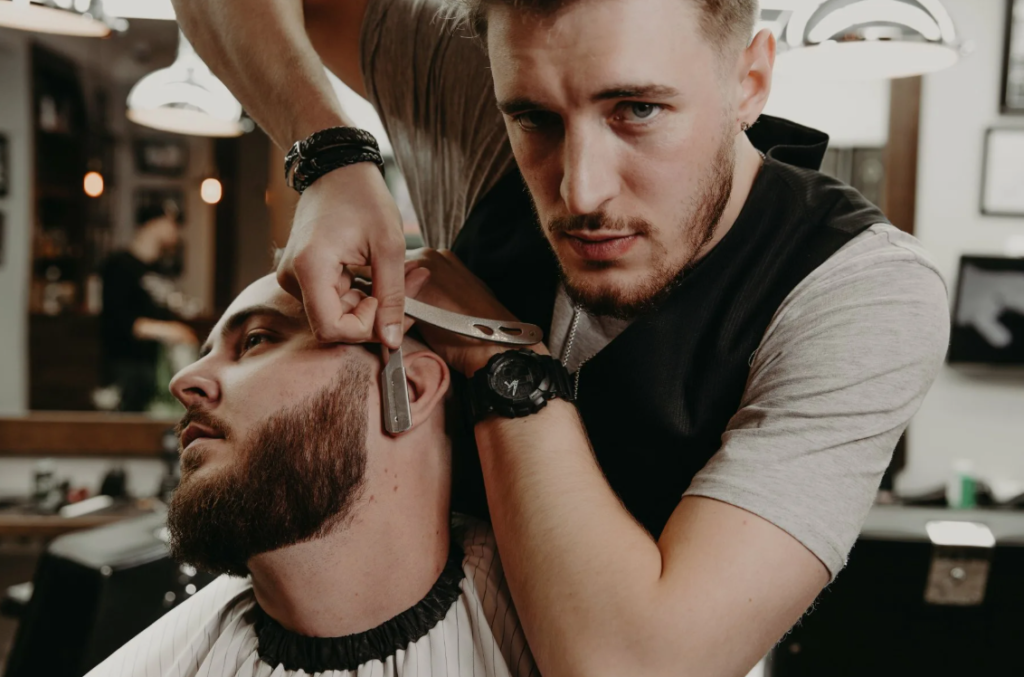
Barber tip: ask your barber to blend the beard’s neckline and cheek line using the same fade technique as the sides. Mismatched blending is one of the most common reasons a fresh haircut looks slightly “off” in photos.
How to Ask Your Barber for a Fade Buzz Cut
Bring three pieces of information, not just a photo:
- Top length — the guard number, not just “short” (“a #3 on top”).
- Fade start point — point to your own head (above the ear for low, at the temple for mid, higher for high).
- Fade finish — skin, or stop at a taper/#1.
Script to use in the chair: “I’d like a #3 on top, fading to skin starting at my temple, blended into my beard’s neckline.”
Questions to ask before the clippers start
- “Where exactly will the fade start and end?”
- “Will this fade to skin, or stop at a guard?”
- “How will this look in two to three weeks as it grows out?”
- “Can you blend my beard line to match?”
- “Given my hairline, does a lower or higher fade suit me better?”
A side-profile reference photo is still useful — a straight-on shot alone won’t show where the fade line sits.
Tools That Make Maintenance Easier
None of these replace a barber for the actual fade, but they extend how sharp the cut looks between visits:
- Cordless clippers with an adjustable taper lever — for touching up top length yourself
- A boar-bristle or nylon fade brush — redistributes product evenly across short hair
- A dedicated beard/edge trimmer — for neckline and sideburn upkeep between visits
- Broad-spectrum SPF scalp spray or lotion — important for skin fades, where more scalp is exposed to sun
- A light matte clay or pomade — optional texture for #3–4 tops; most fade buzz cuts don’t strictly need product
Maintenance Routine
| Fade Height | Recommended Trim Schedule |
| Low fade | Every 4–5 weeks |
| Mid fade | Every 3–4 weeks |
| High fade | Every 2–3 weeks |
| Skin fade (any height) | Every 2–3 weeks |
| Taper fade | Every 4–5 weeks |
Between visits: touch up top length yourself if it grows past your preference, moisturize the scalp (especially with skin fades, which can dry out faster), and trim stray neckline hairs weekly with a beard trimmer to keep the edge sharp.
Common Mistakes to Avoid
- Asking for “a fade” with no other detail. Every barber interprets it differently — always give a guard number and fade start point.
- Choosing a high skin fade without accounting for hair texture. Curly or coily hair can look uneven at a hard, high fade unless the barber has experience with that texture.
- Skipping the first trim. The cut looks sharpest in the first one to two weeks; waiting five or six lets the whole shape grow out unevenly.
- Not mentioning a cowlick or hairline quirk before the clippers start.
- Picking a fade height from a photo alone, ignoring face shape. A high fade that suits an oval face can overwhelm a round one.
- Neglecting scalp care. Exposed skin at the fade line needs sun protection and moisturizer, especially in summer.
Where the Fade Buzz Cut Fits: Work, School, and Military Contexts
Professional workplaces: Low and mid fades are safest in conservative offices, law, finance, and client-facing roles. A hard part or shaved design is best avoided in formal settings.
School-friendly versions: Most grooming-code schools accept low or mid fades with a #3 or #4 on top. High skin fades with shaved designs are more likely to run into dress-code issues — check your school’s specific policy.
Military-inspired versions: Standards vary by branch, but the general baseline is a shorter guard (#2–3) with a tight, high-and-tight or induction-style fade. Confirm your specific branch’s current regulation rather than assuming any fade buzz cut will pass inspection.
Seasonal Considerations
- Summer: A shorter guard (#2) with a mid or high fade keeps you cooler; sunscreen on skin-faded areas is worth the thirty seconds.
- Winter: A slightly longer top (#4) with a low fade or taper retains a bit more warmth and holds up better under a hat.
Frequently Asked Questions
What guard number is a fade buzz cut?
Most use a #2, #3, or #4 on top, fading through #1 and #0.5 to either a short taper or bare skin at the sides and back.
How long does a fade buzz cut last before it needs a trim?
Low fades and tapers stretch four to five weeks. Mid fades typically need attention every three to four weeks; high and skin fades look sharpest with a trim every two to three weeks.
Does a fade buzz cut work with curly or coily hair?
Yes — though a taper fade usually blends more forgivingly than a hard skin fade on coilier textures, so it’s worth choosing a barber experienced with your hair type.
Is a fade buzz cut good for a receding hairline?
Often, yes. A skin fade removes the visible line where thinning hair meets scalp, which tends to look more deliberate than a plain buzz cut with a receding edge.
Can I do a fade buzz cut myself at home?
The buzzed top is easy to maintain with clippers at home. The fade is the harder part — it needs steady hands to graduate the length smoothly, so most people get the fade done professionally and only touch up the top themselves between visits.
What’s the difference between a taper and a fade?
A taper gradually shortens hair without ever exposing bare skin. A fade goes further, blending down to skin at some point. Every fade is a type of taper, but not every taper is a fade.
What’s the difference between a drop fade and a burst fade?
A drop fade curves the fade line downward behind the ear, following the skull’s shape. A burst fade isolates the fade in a semi-circle around the ear only, rather than running it across the whole side of the head.
Does a fade buzz cut cost more than a regular haircut?
It typically costs the same as a standard men’s haircut at most barbershops, though skin fades, drop fades, and any shaved-in design work may carry an added charge — worth confirming with your specific barber.
What if my fade grows out unevenly?
This usually means the transition zone was too narrow to begin with. Ask your next barber to widen the blend zone slightly, which makes the regrowth period look intentional for longer.
Final Word From the Chair
The fade buzz cut earns its popularity honestly — it’s one of the few haircuts that’s genuinely low-maintenance and genuinely stylish at once. The real decision isn’t picking a trendy variation off a reference photo; it’s matching fade height, guard number, and finish to your own hair texture, face shape, and how often you’ll realistically sit in the chair. Get that match right, and it’s one of the easiest cuts to keep looking sharp between visits.
Trending Buzz Cut Styles
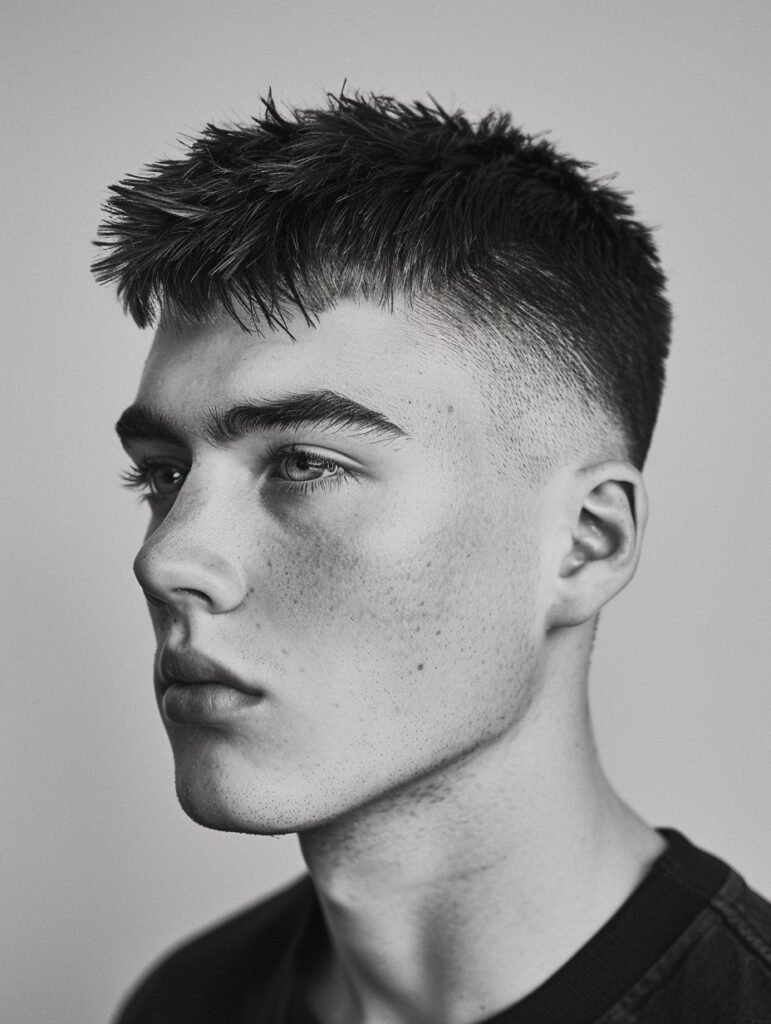
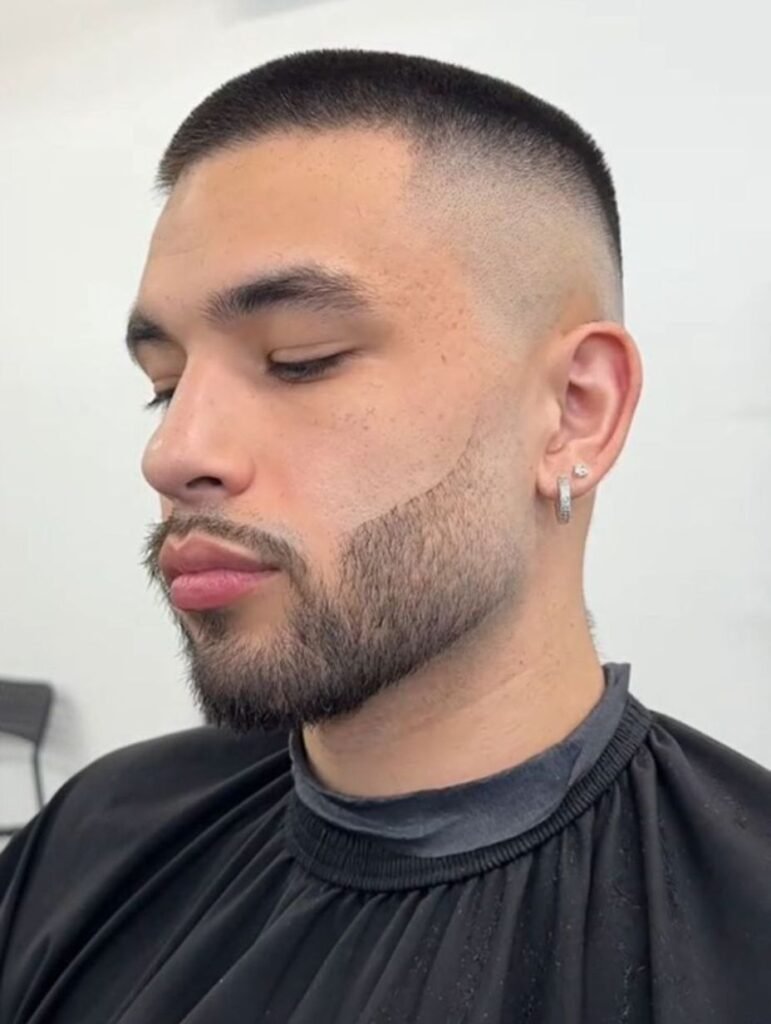
Read Our Guides
- Fringe Long Buzz Cut Fade: The Complete Guide
- Bleached Buzz Cut: The Complete Guide to Length, Color, and Maintenance
- Clipper Guard for Buzz Cut: The Complete Guide to Guard Numbers, Lengths, and How to Choose
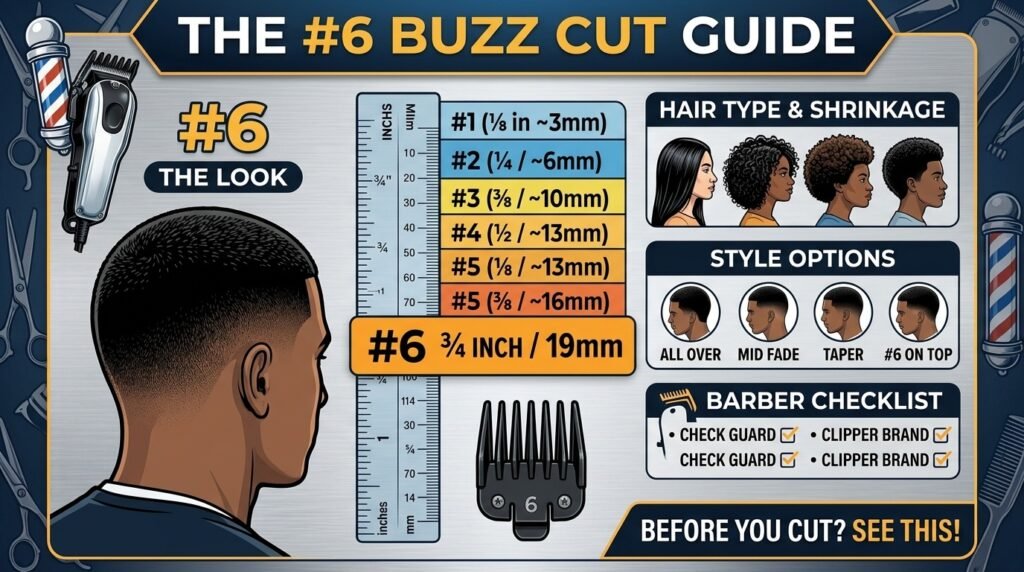
- 6 Guard Buzz Cut: Length, Look, and Everything to Know Before You Get One
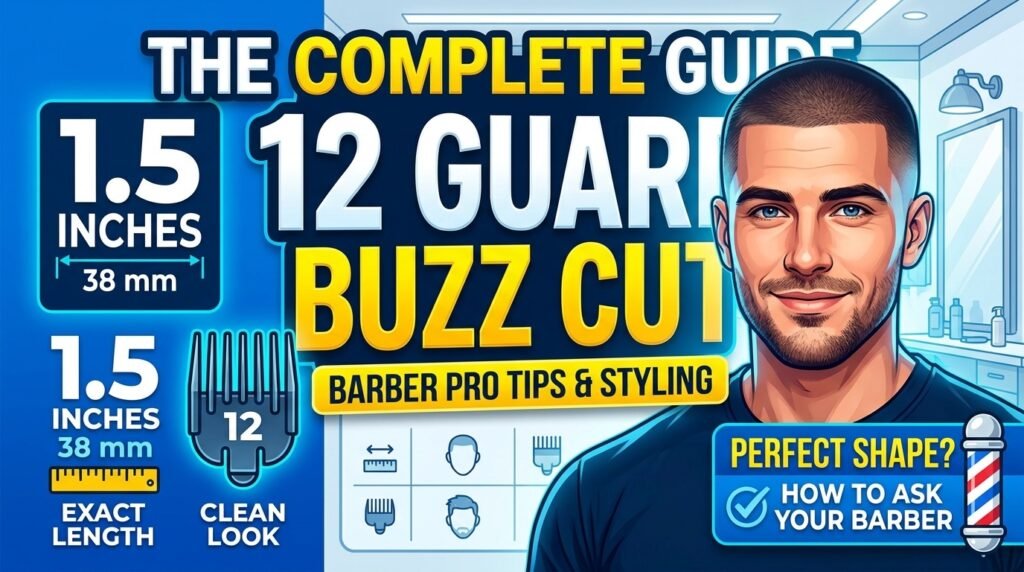
- 12 Guard Buzz Cut: The Complete Length, Look, and Barber Guide
- What Is a Buzz Cut? The Complete Guide to Lengths, Styles, and Guard Numbers