6 Guard Buzz Cut: Length, Look, and Everything to Know Before You Get One
Last updated: August 16, 2026 · Fact-checked against current clipper manufacturer specifications · Reviewed by: Daniel Carter
If you’ve been searching “6 guard buzz cut,” you’re probably trying to picture how short it actually is before you commit — or before you tell your barber to go for it. This guide covers what a #6 guard leaves behind, how it compares to shorter and longer guards, whether it still counts as a true buzz cut, and how to get exactly the version you want.
Sources & methodology: The length figures below are cross-referenced across multiple clipper manufacturer specifications and professional barbering references, not taken from a single source. Where sources disagree or a brand uses a different system, that’s flagged explicitly rather than smoothed over.
What Is a 6 Guard Buzz Cut? (Direct Answer)
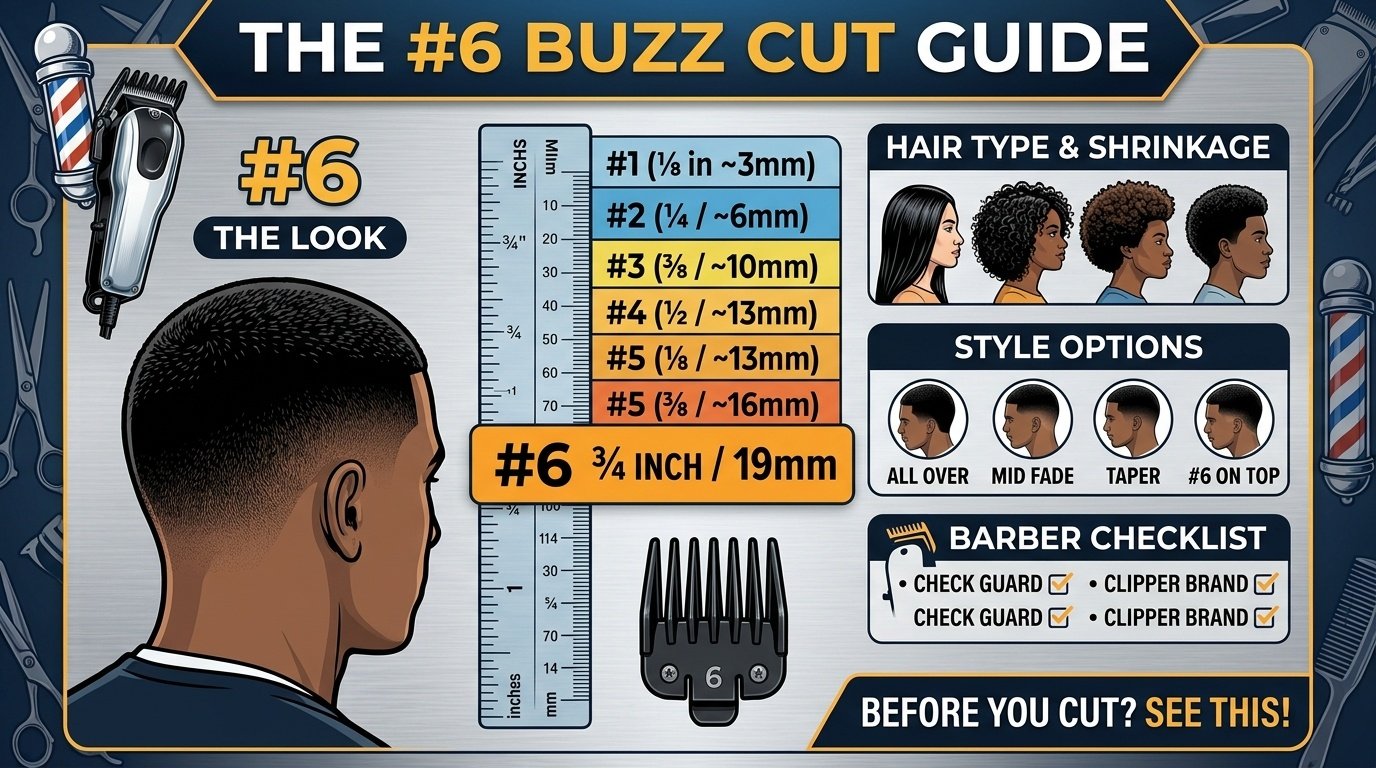
A 6 guard buzz cut is a clipper cut done with a #6 attachment guard, which most clipper brands mark at roughly ¾ inch (about 19mm). That makes it one of the longer common buzz cut lengths — noticeably fuller than a #1–#4 cut, with enough hair to show texture and movement rather than close scalp exposure. Exact length can shift slightly by clipper brand and taper-lever position, but #6 is generally treated as a medium-to-long buzz cut rather than a close-cropped one.
Key takeaways:
- A #6 guard leaves approximately ¾ inch (~19mm) of hair — long for a buzz cut, but still clipper-uniform.
- It’s meaningfully longer than a #4 (~13mm) and slightly shorter than an #8 (~25mm).
- Wahl and Andis mark #6 the same way; Oster’s detachable-blade system works differently (details below).
- It can be worn all over, on top only, or paired with a fade or taper.
- It’s one of the more forgiving lengths to cut yourself at home, if done as a uniform all-over cut.
Quick Finder
| If you want to know… | Go to… |
|---|---|
| What a #6 buzz cut is | What Is a 6 Guard Buzz Cut? |
| How long #6 is | How Long Is a #6 Buzz Cut? |
| Whether guard numbers match across brands | Do #6 Guards Match Across Clipper Brands? |
| What #6 looks like | What Does a #6 Buzz Cut Look Like? |
| Whether #6 counts as a buzz cut | Is a #6 Buzz Cut Really a Buzz Cut? |
| How #6 compares with #4 and #8 | Guard Length Comparison |
| Whether #6 works with a fade or taper | Fade and Taper Options |
| What to tell (and show) a barber | Talking to Your Barber |
| How to maintain it | Maintenance |
| Common questions | FAQs |
What Is a 6 Guard Buzz Cut? The Full Explanation
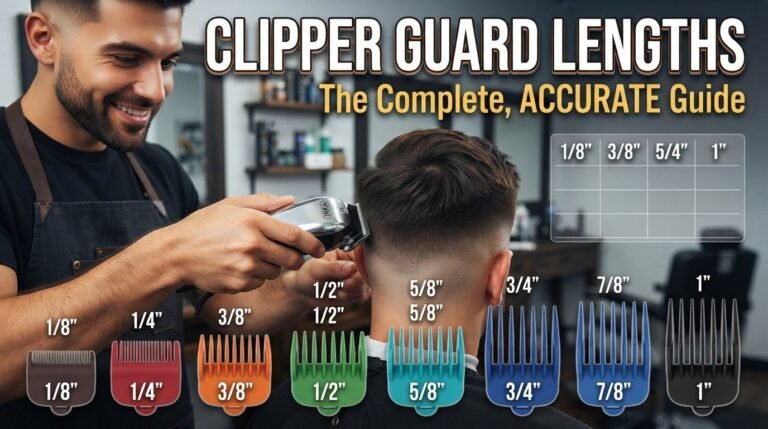
A clipper guard is a plastic attachment that clips onto the clipper blade and controls how far the blade sits from the scalp, which determines how much hair gets left behind. Guard numbers are shorthand for that cutting length: lower numbers cut closer, higher numbers leave more hair. A #6 guard sits toward the longer end of the standard 1–8 range used by most barbershops and home clipper kits.
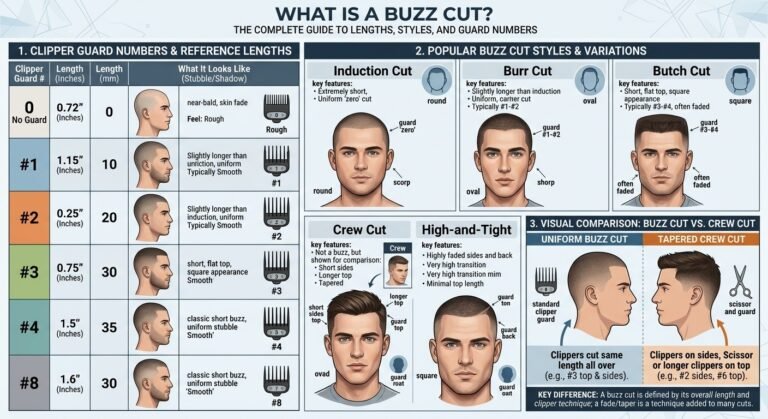
“Buzz cut” itself isn’t one fixed length — it’s a broad category covering any uniform or near-uniform clipper-cut hairstyle, from an almost-shaved #1 to a fuller, textured #7 or #8. A #6 guard buzz cut sits in the “medium-to-long” part of that range: short enough to stay low-maintenance and clipper-uniform, but long enough that it doesn’t read as a tight, military-style crop.
Guard terminology isn’t perfectly standardized across every clipper system, either. Wahl and Andis use a similar 1–8 numbering convention with roughly 3mm added per number, but the exact millimeter marked on a #6 guard can still vary slightly by brand and model — and Oster’s detachable-blade clippers work differently altogether (see the next section). Treat any single guard number as an approximate cutting length, not a universal measurement.
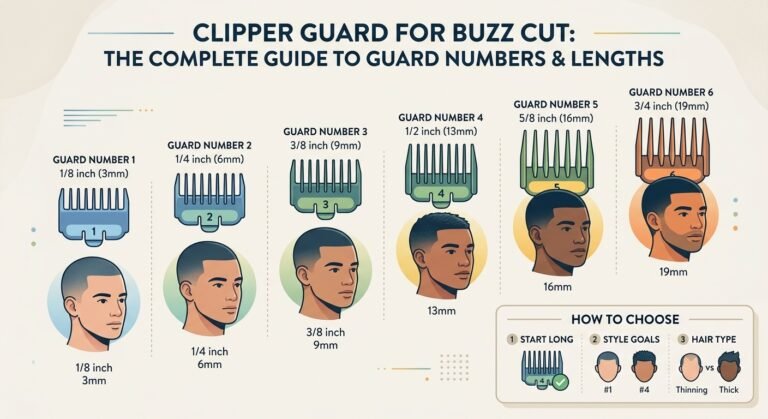
See complete Guide: Clipper Guard for Buzz Cut: The Complete Guide to Guard Numbers, Lengths, and How to Choose
How Long Is a #6 Buzz Cut?
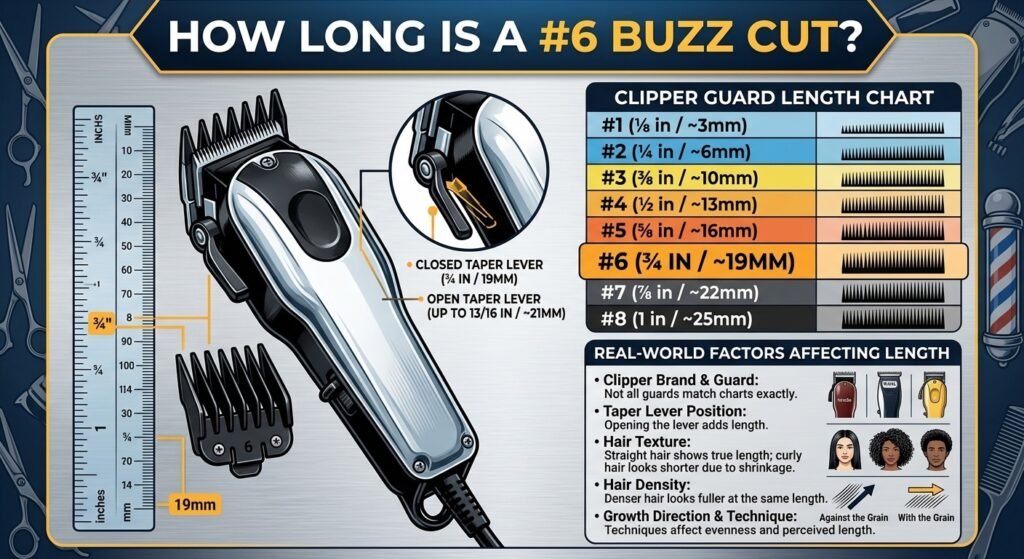
Across clipper brands and barbering references, a #6 guard is most commonly listed at around ¾ inch, or approximately 19mm, when the clipper’s taper lever is closed. Opening the taper lever fully can add slightly more — some references list it up to roughly 13/16 inch in that position. That puts #6 noticeably above the mid-range #3–#4 guards and just below the longest standard guard, #8.
| Guard | Approx. length (closed) |
|---|---|
| #1 | ⅛ in / ~3mm |
| #2 | ¼ in / ~6mm |
| #3 | ⅜ in / ~10mm |
| #4 | ½ in / ~13mm |
| #5 | ⅝ in / ~16mm |
| #6 | ¾ in / ~19mm |
| #7 | ⅞ in / ~22mm |
| #8 | 1 in / ~25mm |
Even with a chart like this, several real-world factors change how a “#6 cut” ends up looking or measuring:
- Clipper brand and guard manufacturer — a third-party or off-brand guard may not match a name-brand guard exactly.
- Taper-lever position — opening the lever moves the blade slightly farther from the guard, adding length even on the same numbered guard.
- Hair texture — straight hair shows the true clipped length; curly or coily hair can look shorter than the measurement due to shrinkage.
- Hair density — thicker, denser hair looks fuller at the same length than fine or sparse hair.
- Growth direction and technique — cutting with or against the grain, and how many passes the barber makes, affects how even and how “long” the finished cut reads.
If exact length genuinely matters to you, ask your barber to confirm the specific measurement their #6 guard is marked at, rather than assuming it matches a chart exactly.
Related: 12 Guard Buzz Cut: The Complete Length, Look, and Barber Guide
Do #6 Guards Match Across Clipper Brands?
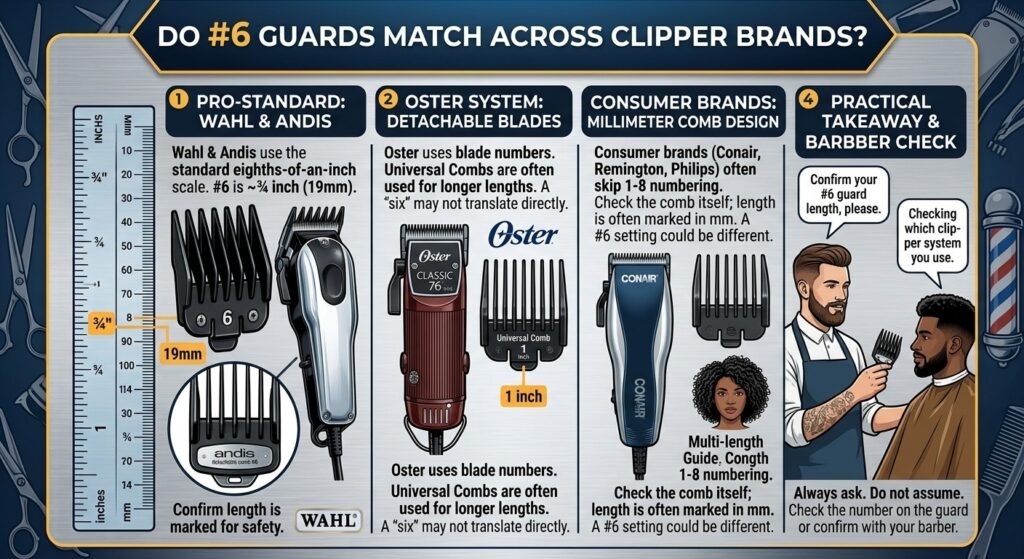
Not always — and this is one of the more overlooked details in most buzz cut guides. Guard-number consistency depends on which clipper system is being used:
| Clipper system | How #6 (or equivalent) works |
|---|---|
| Wahl | Uses attachment combs on the standard eighths-of-an-inch scale — #6 ≈ ¾ inch (~19mm). |
| Andis | Follows the same eighths-of-an-inch convention as Wahl, so the marked length lines up, even though the physical guard housings aren’t interchangeable between the two brands. |
| Oster (detachable-blade clippers, e.g., Classic 76) | Uses blade numbers rather than attachment-comb numbers, and lengths beyond about ⅜ inch are typically produced with inch-labeled universal comb attachments instead of a “#6” designation. Asking an Oster-based barber for “a six” may not translate the same way. |
| Consumer brands (Remington, Conair, Philips, and similar) | Often skip the 1–8 numbering system entirely and print the length directly in millimeters on the comb. |
Practical takeaway: If you’re getting the cut at a barbershop, confirm which clipper system your barber uses, especially if you’re specifically expecting a ¾ inch / 19mm result. If you’re cutting your own hair, check the number printed on your own guard rather than assuming it matches the chart above exactly.
What Does a #6 Buzz Cut Look Like?
At roughly ¾ inch, a #6 buzz cut leaves enough hair to visibly cover the scalp under most lighting and hair densities — a clear step up from the close, skin-adjacent look of a #1 or #2. Hair at this length has enough substance to show some natural texture: waves start to show their pattern, curls hold some shape, and straight hair has a slightly brushable quality rather than lying completely flat.
Compared to shorter buzz cuts, a #6 tends to read as softer and fuller rather than sharply cropped. The hairline stays visible and defined, but the overall silhouette looks more like a very short, deliberate haircut than a shaved one.
The exact visual result still depends on individual factors:
- Hair color — darker hair against lighter skin tends to look more solid and less “shorn” than very light or gray hair at the same length.
- Density and texture — thick, dense hair looks fuller; fine or thinning hair may show more scalp even at #6.
- Growth pattern — cowlicks, whorls, or uneven growth directions can be more visible at #6 than at a shorter guard, since there’s more hair to catch the light or stand up.
- Hairline shape — a straight or receded hairline changes how the front of the cut frames the face.
As a general rule, #6 is the length where a buzz cut starts to look like “short hair” rather than “shaved hair.”
Related: Buzz Cut Fade Haircut: The Complete Guide to Fade Levels, Guards & Barber-Ready Instructions
Is a #6 Buzz Cut Really a Buzz Cut?
This is a fair question, because #6 sits close to the upper edge of what most people picture when they hear “buzz cut.” The term traditionally describes any uniform, clipper-cut style, and barbershops commonly apply it to anything from a #1 up through a #7 or #8 — so yes, #6 is within the accepted range.
That said, if your mental image of a “buzz cut” is closer to a #2 or #3 — short, close, minimal coverage — a #6 will look noticeably longer and fuller than that. Barbers often describe it as a “long buzz cut” or “medium buzz cut” for exactly this reason. Since terminology varies by shop and region, it’s worth using both the guard number and a length description (“a longer buzz, like a #6”) when booking, rather than relying on the word “buzz cut” alone.
In short: #6 is a legitimate buzz cut length, but it produces a visibly longer, fuller result than the short buzz cuts most people default to picturing.
Related: 16 Guard Buzz Cut: What It Actually Means
#6 Guard Length Comparison
| Guard | Relative length | Typical visual result |
|---|---|---|
| #1 | Very short | Close, scalp clearly visible |
| #2 | Short | Classic short buzz, some scalp visible |
| #3 | Short | Slightly more coverage, still close |
| #4 | Short-medium | Noticeably fuller, less scalp showing |
| #5 | Medium | More visible hair and texture |
| #6 | Medium-long | Fuller, textured, minimal scalp showing |
| #7 | Long | Thick, brushable, crew cut territory |
| #8 | Longest standard guard | Full coverage, most texture and styling flexibility |
#6 vs. #4
A #4 guard leaves about ½ inch (~13mm) — noticeably shorter than #6. #4 shows more scalp, has less texture and movement, and needs slightly less frequent trimming to stay tidy, since there’s less length to grow out unevenly. #6 offers more coverage, more visible texture, and a softer look, but needs trims a bit sooner. #4 leans toward a traditional short buzz; #6 leans toward a fuller, longer buzz.
#6 vs. #8
An #8 is the longest standard clipper guard, at roughly 1 inch (~25mm). Compared to #6, an #8 cut shows more hair, more texture, and more styling flexibility (often enough to lightly style or brush), but it also starts blurring into crew-cut territory and needs more frequent trims to stay looking like a clean buzz rather than growing shaggy. #6 sits in a middle ground: fuller than a classic buzz, but still clearly uniform and low-effort compared to #8.
#6 vs. Crew Cut
A #6 all-over cut is uniformly one length across the entire head, with no deliberate shaping beyond the guard itself. A crew cut is typically shaped with intentional variation — often slightly longer on top (sometimes finished with scissors for texture) and tapered shorter on the sides — rather than one flat length everywhere. A #6 can serve as the base length for a crew cut’s top section, but a crew cut generally involves more deliberate styling and blending.
#6 vs. Induction Cut
An induction cut (sometimes called a burr cut) is typically done with a #1 guard or no guard at all, producing a very close, uniform result historically associated with military induction. A #6 is far longer and fuller and doesn’t carry the same close-to-skin appearance.
#6 Buzz Cut All Over vs. #6 on Top
#6 all over means using the same #6 guard on the top, sides, and back with no shorter guard or fade anywhere. This produces a fully uniform result with no contrast or blending to think about. It’s simple to execute (only one guard involved), low-maintenance (no fade line to keep sharp), and grows out consistently since the whole head lengthens at the same rate.
#6 on top with shorter sides uses #6 only on top, with a shorter guard (commonly #2–#4) on the sides and back. This creates more contrast than an all-over #6 and starts to resemble a short textured hairstyle rather than a strict buzz cut. It gives more visual shape than a flat, uniform buzz, but needs slightly more upkeep to keep the length transition clean — and that transition can be blended gradually (a taper) or sharply (a fade), depending on the look you want. Be specific about the side length and the sharpness of the blend when requesting this version, since “6 on top” can look very different depending on both.
#6 Buzz Cut With a Fade or Taper
A fade refers to how the sides transition from longer to shorter (often down to skin near the hairline), while the guard number describes the length on top or across the rest of the head. These are two separate pieces of terminology combined together — “#6 with a fade” isn’t one standardized haircut; it’s a #6 length paired with whichever fade style you choose:
- Low fade — transition starts low, near the ears and neckline, keeping more length on the sides overall.
- Mid fade — transition starts around the temple area, creating more visible contrast.
- High fade — transition starts higher on the head, producing the strongest contrast against the #6 top.
- Skin fade — blends all the way down to bare skin near the hairline, at a low, mid, or high starting point.
A taper is a gentler, more gradual version of the same idea — the hair shortens slightly toward the sideburns, temples, and neckline without the sharp contrast a fade creates. Compared to a fade, a taper blends more subtly, stays presentable longer as it grows out, and suits anyone who wants some shaping without a dramatically barbered look.
The difference between a #6 all-over cut, a #6 with a taper, and a #6 with a fade comes down to how much contrast you want at the sides: none, subtle, or sharp.
Who Is a #6 Buzz Cut Good For?
A #6 guard buzz cut tends to appeal to people who:
- Want the low-maintenance appeal of a buzz cut without going as short as a #1–#3.
- Prefer more hair coverage and less scalp visibility than a classic close buzz.
- Like seeing some natural texture — waves, slight curl, or body — rather than a flat, shaved look.
- Want a simple, minimal-styling haircut for everyday wear.
- Are trying short hair for the first time and want a less extreme starting point.
- Want a length that still pairs well with a fade or taper for more shape.
It isn’t a universal fit for every preference — someone who wants the closest, most scalp-exposing buzz will likely prefer a shorter guard, and someone who wants more styling flexibility may prefer an #8 or a crew cut instead.
#6 Buzz Cut for Different Hair Types
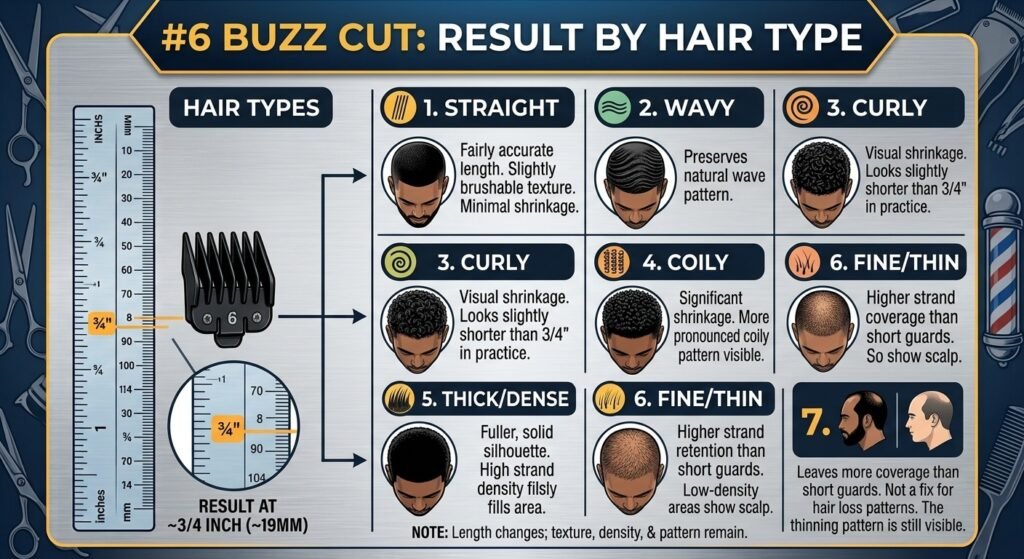
| Hair type | What to expect at #6 |
|---|---|
| Straight | Shows the clipped length fairly accurately, with a slightly brushable texture. |
| Wavy | Preserves more of the natural wave pattern than a shorter guard would. |
| Curly | Curl pattern causes some visual shrinkage — may look shorter than the measured ¾ inch once it settles. |
| Coily | Similar shrinkage effect to curly hair, often more pronounced. |
| Thick/dense | Produces a fuller, more solid-looking silhouette, since more strands fill the same area. |
| Fine/thin | Retains more length than a shorter guard, but lower-density areas may still show some scalp. |
| Thinning | Leaves more coverage than a very short guard, but isn’t a fix for hair loss patterns. |
Cutting hair with a #6 guard changes its length only — not its underlying texture, density, or growth pattern.
#6 Buzz Cut, Face Shape, and Hairline
Face shape can influence how a #6 buzz cut visually balances your features, but there’s no single “correct” length for any shape — side treatment, hairline, and personal preference usually matter more than face shape alone.
- Oval: Generally versatile for most #6 variations, from all-over to faded.
- Round: Some people find that keeping more visible length or adding a side taper creates more visual structure than a completely uniform cut.
- Square: A uniform #6 tends to emphasize the jaw and overall structure rather than softening it.
- Oblong/rectangular: A very short #1–#2 can emphasize length; a #6 with some top texture is sometimes preferred to avoid adding visual height.
- Diamond: Side treatment and any facial hair can shift how the cheekbones and jaw appear balanced.
- Heart: A #6 with a slightly fuller top and tighter sides is sometimes used to balance a narrower chin, though this is personal preference.
On hairlines: a #6 guard leaves considerably more hair than a #1–#3, which can make a receding hairline, widow’s peak, or naturally uneven hairline less immediately obvious than an extremely short buzz would. More length isn’t a guarantee of full coverage, though — visibility depends on hair density along the hairline itself, not just the overall guard length. A #6 is not a treatment for hair loss of any kind.
#6 Buzz Cut and Scalp Visibility
Scalp visibility decreases as guard length increases. A #1–#2 typically shows the most scalp; #6 shows noticeably less, since there’s more hair covering the same surface area. Beyond guard length, visibility also depends on hair density, hair color, skin tone, lighting, and growth direction. There’s no exact percentage that applies to everyone, since these factors interact differently person to person.
Pros and Cons of a #6 Buzz Cut
Potential advantages:
- More hair coverage than shorter buzz cuts, with less scalp exposure.
- Minimal daily styling required.
- Simple, low-effort everyday routine.
- Preserves more visible natural texture than a close buzz.
- A middle-ground length for anyone transitioning from longer hair to something shorter.
- Pairs well with a fade or taper if you want more shape.
- Less extreme in appearance than a #1–#3, which can suit first-time buzz cut wearers.
Potential considerations:
- Doesn’t have the close, military-style look some people specifically want from a buzz cut.
- Grows out and starts looking uneven somewhat faster than a shorter guard, simply because there’s more length to shift.
- A uniform #6 can make natural growth direction or cowlicks more visible than a shorter length would.
- Dense or heavily textured hair can produce a different silhouette than straight hair at the same guard.
- A fade pairing softens relatively quickly and needs more frequent upkeep to stay sharp.
- Offers less shaping and styling flexibility than a crew cut or longer style.
How to Ask a Barber for a #6 Buzz Cut
Saying only “I want a buzz cut” leaves a lot open to interpretation — barbers commonly do buzz cuts anywhere from a #1 to a #8. To get a predictable result, be specific about:
- Whether you want #6 all over or only on top.
- How short you want the sides, if different from the top.
- Whether you want a fade and, if so, low, mid, or high.
- Whether you want a taper instead of a fade.
- Whether the neckline should be left natural or cleaned up.
- Whether you want the hairline edged or left as-is.
- Whether you want a completely uniform result or some shaping.
Practical examples you can use at the chair:
“I want a #6 guard all over — same length on the top, sides, and back.”
“I want about a #6 on top with shorter, tapered sides.”
“I want a #6 on top with a low fade on the sides.”
If exact length matters to you, ask your barber to confirm the actual measurement of their #6 guard — see Do #6 Guards Match Across Clipper Brands? above.
What to Show Your Barber
A reference photo helps even when you already know the guard number you want. Bring, or pull up on your phone:
- A front view of the desired length and shape.
- A side view, especially if you want a fade or taper.
- A back view, if available, for neckline and crown treatment.
- A close-up of the side transition, if a fade or taper is involved.
The guard number communicates the intended length; the photo communicates the intended overall look. Even with both, results can vary slightly based on your own hair texture, density, growth direction, head shape, and the barber’s technique — a photo is a strong guide, not a guarantee of an identical outcome.
#6 Buzz Cut DIY Guide
A uniform #6 all-over cut is one of the more approachable buzz cuts to attempt at home, though a clean fade, taper, or precise neckline generally requires more practice.
Before you start:
- Confirm the actual length marked on your #6 guard.
- Make sure the guard is securely attached to your clipper.
- Check that the clipper blades are clean and running smoothly.
- Start with clean, dry, fully detangled hair.
- Clear any heavy product buildup that could clog the blades.
While cutting:
- Attach the guard securely before starting.
- Work through the head systematically — top first, then sides, then back — rather than jumping around.
- Use controlled, even passes rather than rushing.
- Check the top, sides, and back separately as you go.
- Pay close attention to the area behind the ears, which is easy to miss.
- Use a handheld mirror alongside a wall mirror to check the back of your head.
- Recheck the whole head under bright, even lighting before finishing.
After cutting:
- Inspect the full head for uneven patches or missed spots.
- Touch up any unevenness with the same guard.
- Clean up the neckline only if you’re comfortable doing so, or leave it for a follow-up trim.
- Brush or rinse away loose hair.
- Clean and store the clipper and guard.
A #6 all-over cut is relatively forgiving for a first attempt at home. A fade, sharp taper, or precise lineup takes considerably more skill and is generally better left to a barber for a polished result.
How to Maintain a #6 Buzz Cut
- Trims: Regular touch-ups keep the length even as hair grows.
- Washing: Regular washing keeps the scalp clean, which matters more at shorter lengths since more scalp is exposed.
- Scalp care: An occasional light exfoliating wash can help prevent buildup.
- Clipper cleaning: If you maintain the cut yourself between barber visits, keep the clipper and guard clean and oiled.
- Neckline and sideburns: These tend to need attention between full cuts to keep the cut looking fresh.
- Fade or taper upkeep: Expect to need touch-ups sooner than a uniform #6, since the contrast between lengths softens as hair grows.
A uniform #6 all-over cut is generally simpler to maintain than a #6 paired with a fade, because the fade’s sharp line loses definition faster than a flat, uniform length does.
How Often Should You Get a #6 Buzz Cut?
There’s no single universal schedule — it depends on your hair growth rate, how uniform you want the length to stay, and whether a fade or taper is involved. As a practical estimate, a uniform #6 typically holds its look for a few weeks longer than a #6 paired with a fade, which needs more frequent attention to keep the transition sharp. Treat any specific timeframe as a starting point to adjust based on your own hair.
#6 Buzz Cut Grow-Out and Transition Options
As a #6 grows out, expect a gradual increase in length and texture, more natural movement (and, on wavy or curly hair, more visible wave or curl pattern), and a gradual loss of the crisp, uniform clipper look. If a fade or taper was included, that transition line softens and becomes less distinct over time. Eventually, there’s enough length that the cut starts to resemble a short textured hairstyle rather than a buzz cut. Grow-out speed differs substantially from person to person, so there’s no fixed timeline for when a #6 “turns into” something else — it’s a gradual shift.
If you’re ready to move on from a #6, common directions include:
- Growing longer: Transitioning to an #8 buzz cut, a crew cut, or a longer textured short style.
- Going shorter: Stepping down gradually — #6 → #5 → #4 → shorter buzz — if you want to ease into a closer cut rather than jumping straight to a #1 or #2.
- Adding shape: Moving from a uniform #6 into a fade-based or crew-cut style once there’s enough length to work with.
None of these are required — they’re simply common paths from a #6 base.
#6 Buzz Cut Style Variations
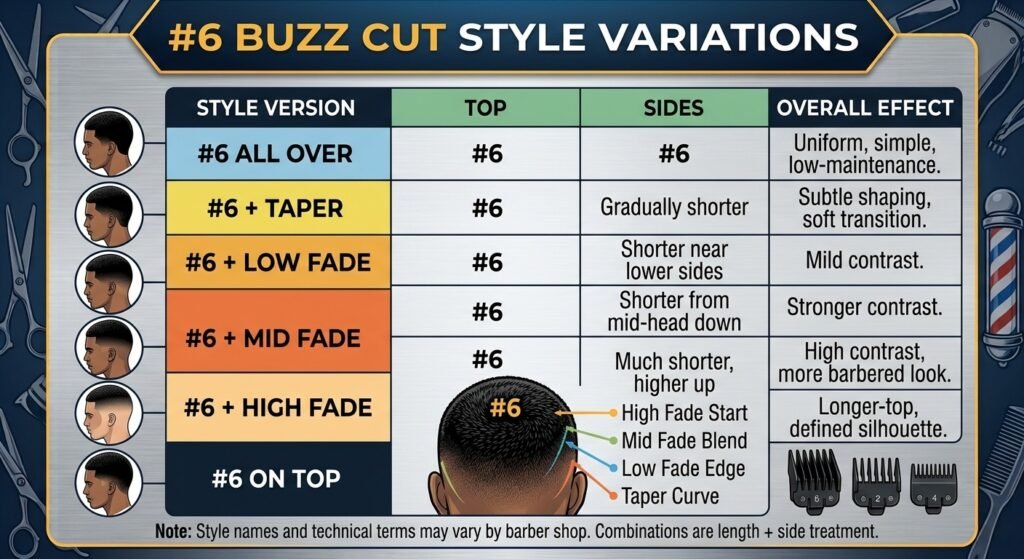
| Version | Top | Sides | Overall effect |
|---|---|---|---|
| #6 all over | #6 | #6 | Uniform, simple, low-maintenance |
| #6 + taper | #6 | Gradually shorter | Subtle shaping, soft transition |
| #6 + low fade | #6 | Shorter near lower sides | Mild contrast |
| #6 + mid fade | #6 | Shorter from mid-head down | Stronger contrast |
| #6 + high fade | #6 | Much shorter, higher up | High contrast, more barbered look |
| #6 on top | #6 | Shorter guard (e.g., #2–#4) | Longer-top, defined silhouette |
These are practical combinations of length and side treatment rather than fixed, universally named styles — naming conventions vary by barbershop.
Ten Ways to Wear a #6 Buzz Cut
- Classic #6 all-over — Uniform length, no transitions. Best for maximum simplicity. Low maintenance.
- #6 with a low taper — Gentle shortening near the ears and neckline. Best for a subtly polished look. Low-medium maintenance.
- #6 with a low fade — Fade starting low near the ears. Best for a cleaner finish with mild contrast. Medium maintenance.
- #6 with a mid fade — Fade starting around the temples. Best for more noticeable shape. Medium-high maintenance.
- #6 with a high fade — Fade starting higher for strong contrast. Best for a sharper, barbered look. High maintenance.
- #6 on top, shorter sides — Distinctly shorter side guard, no dramatic blend. Best for a defined but simple silhouette. Medium maintenance.
- #6 with a natural neckline — No additional shaping. Best for the lowest-effort version. Low maintenance.
- #6 with a clean lineup — Sharply edged hairline and temples. Best for a crisp front profile. Medium maintenance.
- #6 with facial hair — Paired with stubble or a short beard for visual balance below the face. Maintenance depends on beard routine.
- #6 growing into a crew cut — Allowed to grow slightly longer on top, then shaped. Best as a transitional length. Medium maintenance, increasing over time.
Common Mistakes to Avoid
- Assuming every #6 guard is identical. As covered above, clipper brands and systems can mark #6 differently — confirm if exact length matters.
- Saying only “buzz cut.” Without a guard number, a barber may default to a shorter length than expected.
- Forgetting to specify “all over.” A #6 on top with shorter sides looks very different from a uniform #6.
- Asking for a “#6 fade” without specifying the fade type. Low, mid, and high fades produce noticeably different results.
- Not accounting for hair texture. Curly or coily hair can look shorter than the measured length due to shrinkage.
- Expecting a #6 to look like a #2. The difference in retained length is significant and easy to underestimate.
- Assuming the guard number describes the entire haircut. The guard sets the length; the finished haircut also depends on shape, blending, neckline, and hairline work.
Before You Get a #6 Buzz Cut: Checklist
- Decide whether you want #6 all over or just on top.
- Decide how short you want the sides, if different from the top.
- Choose fade, taper, or no transition.
- Consider your natural hair texture and how it might affect the result.
- Think about your preferred maintenance level.
- Bring a reference photo if the exact look matters to you.
- Confirm the actual guard length with your barber.
- Ask how much length will realistically remain.
- Decide whether you want the neckline cleaned up.
- Decide whether you want a lineup at the hairline.
FAQs
What is a #6 guard buzz cut? A buzz cut done using a #6 clipper guard, commonly marked at around ¾ inch (about 19mm), producing a fuller, more textured result than shorter buzz cuts.
How long is a #6 buzz cut? Approximately ¾ inch, or around 19mm, though this can vary slightly by clipper brand and taper-lever position.
How many millimeters is a number 6 guard? Most commonly around 19mm on Wahl and Andis systems — check the specific guard for confirmation, since Oster and consumer brands can differ.
Is a #6 buzz cut long? Relative to the full 1–8 guard range, yes — #6 is toward the longer end, producing a fuller, softer look than a #1–#4 cut.
Is #6 a good buzz cut length? It’s a strong choice for anyone who wants a low-maintenance clipper cut with more coverage and texture than a very short buzz. Whether it’s “good” depends on your personal preference for length and scalp visibility.
Does a #6 buzz cut show your scalp? Less than shorter guards like #1–#3, though visibility still depends on hair density, color, and lighting.
Is #6 longer than #4? Yes — #4 is roughly ½ inch, while #6 is roughly ¾ inch.
Is #6 longer than #5? Yes, though the difference is smaller — #5 is roughly ⅝ inch, and #6 is roughly ¾ inch.
Is #8 longer than #6? Yes — #8 is the longest standard clipper guard, at roughly 1 inch, compared to #6’s roughly ¾ inch.
Can you get a fade with a #6 buzz cut? Yes — a #6 length on top pairs well with a low, mid, or high fade on the sides.
Can you get a taper with a #6 buzz cut? Yes — a taper gives a softer, more gradual transition than a fade, with less contrast at the sides.
Can you get a #6 buzz cut all over? Yes — using the #6 guard uniformly on the top, sides, and back is one of the simplest and most common versions of this cut.
Is a #6 buzz cut good for thick hair? Yes — thick hair tends to look fuller and more solid at #6 than at a shorter guard.
Does #6 work for curly hair? Yes, though curl pattern can cause the hair to look somewhat shorter than the measured ¾ inch due to shrinkage.
How do I ask my barber for a #6 buzz cut? Specify the guard number, whether you want it all over or just on top, your preferred side length, and whether you want a fade or taper — a reference photo helps too.
Can I cut a #6 buzz cut at home? A uniform #6 all-over cut is one of the more manageable DIY buzz cuts; fades, tapers, and precise necklines are harder to do well without practice.
Is a #6 buzz cut the same as a crew cut? Not exactly — a #6 all-over cut is uniformly one length, while a crew cut typically involves more deliberate shaping and variation between the top and sides.
Conclusion
A #6 guard buzz cut lands in the medium-to-long end of the standard clipper guard range — commonly around ¾ inch, or 19mm, though it’s worth confirming the exact measurement with your barber or your own clippers, since guard systems vary slightly between brands like Wahl, Andis, and Oster. It offers more coverage, more visible texture, and a softer look than a short buzz cut, while staying simple to maintain. Whether you go all-over, add a taper, or pair it with a fade, the key to getting the result you actually want is being specific: name the guard number, describe where it should and shouldn’t be used, and bring a reference photo if the details matter to you.

Daniel Carter is the Senior Men’s Grooming Editor at FadeBuzzCut, where he specializes in fade buzz cuts, barbering techniques, men’s hairstyles, and evidence-based grooming advice. With more than 12 years of experience researching haircut trends, clipper techniques, face shape recommendations, and hair care, he creates in-depth guides that help readers confidently choose, maintain, and style modern buzz cuts.
Daniel works closely with experienced barbers, grooming professionals, and trusted industry resources to ensure every guide reflects current barbering standards and practical, real-world advice. His editorial approach combines expert research, clear explanations, and user-focused recommendations to make men’s grooming accessible for beginners and experienced enthusiasts alike.
At FadeBuzzCut.com, Daniel oversees editorial quality, content accuracy, and regular updates so readers receive reliable, up-to-date information on fade buzz cuts, beard combinations, hairstyle trends, clipper guard lengths, maintenance routines, and grooming products. Every article is written with a commitment to Experience, Expertise, Authoritativeness, and Trustworthiness (EEAT) while delivering helpful answers for both readers and AI-powered search experiences.
Whether you’re choosing your first fade buzz cut, comparing low, mid, or high fades, or looking for practical maintenance tips, Daniel’s goal is to provide trustworthy guidance that helps you achieve the best possible results.