Curly Fringe: The Complete Guide to Shapes, Shrinkage, Styling and Care
Quick answer
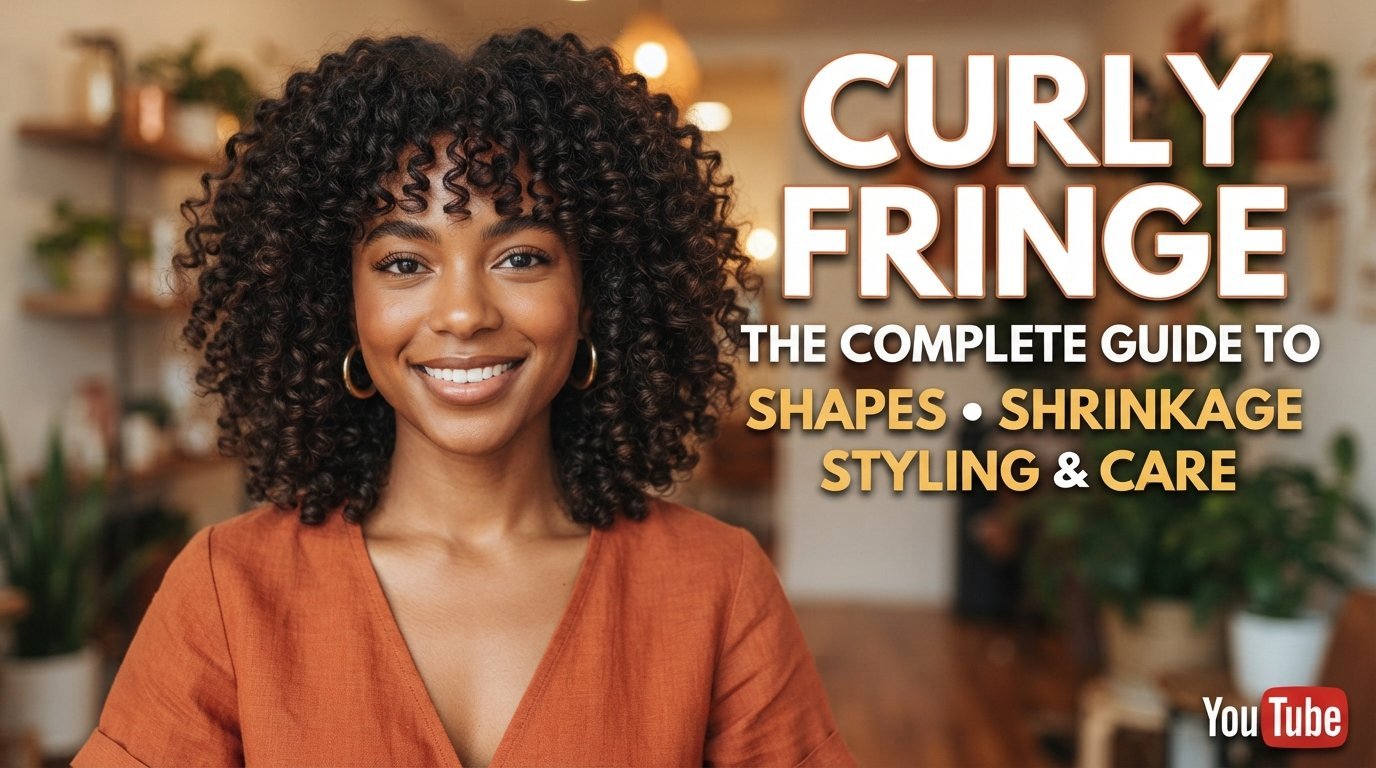
A curly fringe is hair worn across the forehead that keeps its natural curl or wave instead of being cut straight. Its finished shape depends on curl pattern, shrinkage, density, and styling — and the length you see when it’s wet is rarely the length you get once it dries.
If you’ve searched “curly fringe” or “curly bangs,” you’ve likely already run into the two biggest fears people share: cutting it too short, and not knowing how to keep it from frizzing by mid-afternoon. This guide covers both, along with the decisions in between — which shape suits your curl pattern, how to brief a stylist, and what to do if the first cut isn’t right.
Curly fringe vs. curly bangs: is there a difference?
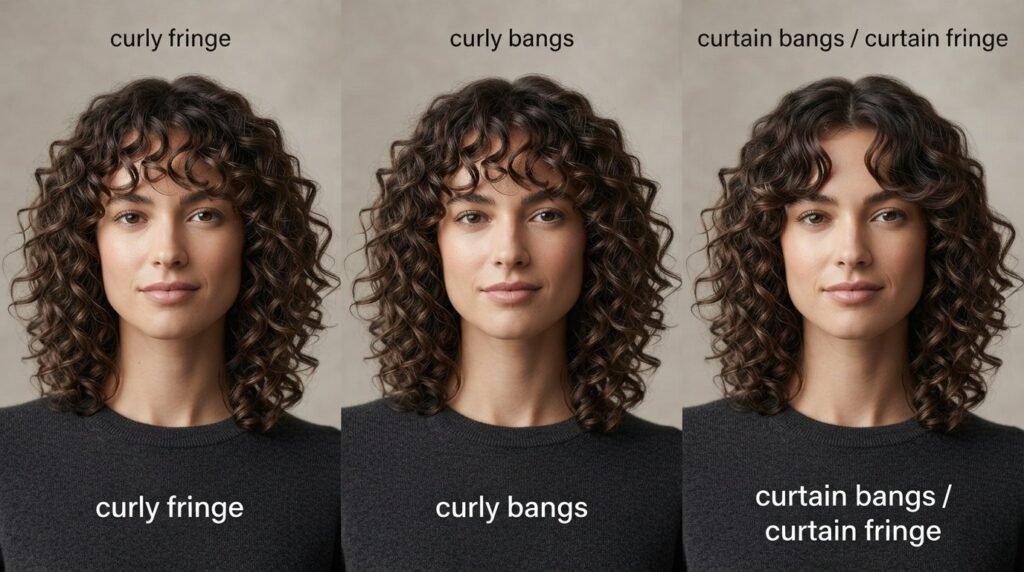
No meaningful difference in the haircut itself. “Fringe” is the term used in the UK, Ireland, Australia, and much of the Commonwealth; “bangs” is the American term for the same section of face-framing hair. Both words appear throughout this guide and throughout your own research, interchangeably.
The one place the terms occasionally split into their own category is “curtain bangs” or “curtain fringe” — parted and swept to the sides rather than covering the forehead. That’s a distinct shape, covered below, not a regional quirk.
Understanding your curl pattern and shrinkage
This is the section to read closely before you book anything. Almost every curly-fringe disappointment traces back to one of the two ideas below.
How curl pattern changes the same fringe
| Curl type | General tendency | Main consideration |
|---|---|---|
| Wavy-curly (loose S-waves) | Softer movement, mild shrinkage | Fringe stays closer to its cut length |
| Loose, springy curls | Rounded, bouncy shape | Moderate shrinkage — plan for some length loss |
| Medium curls | Defined, separated curl groups | Shape and volume become more visible |
| Tight curls | Strong contraction as hair dries | Significant shrinkage — cut longer than you think |
| Coily hair | High shrinkage and density both in play | Length and volume both need planning for |
None of this is a fixed formula — density and overall hair length interact with curl pattern too. But it explains why the same reference photo, on a loose-wave curl pattern versus a tightly coiled one, can produce two very different results from an identical cut length.
Related: Hairdos for Long Hair With Layers: Styles, Cuts & How to Choose
What shrinkage actually means for your finished length
Shrinkage is the gap between how long your hair looks wet or stretched and how long it looks once it’s fully dry and the curl has contracted. Because a fringe sits directly on the face, that gap is far more visible there than anywhere else on the head — hair that reaches past the eyebrows wet can sit an inch or more higher once dry.
A few practical consequences follow:
- Different sections of the hairline can shrink at different rates if your curl pattern isn’t perfectly uniform — normal, not a sign of a bad haircut.
- Humidity changes the shape on a given day, separately from the cut itself.
- Stretching the hair (brushing it, blow-drying it straight, pulling it down) makes it look longer than its natural resting length.
There’s no universal shrinkage ratio that applies to every curl type, so the safer process is: ask for extra length, see it dry and styled the way you’ll actually wear it, then trim from there.
Should curly fringe be cut wet or dry?
Cut dry, or at minimum finished dry. Cutting curly hair wet means cutting a length that will shrink into something different once dry — the stylist is effectively guessing at the finished result. Many curl-focused stylists use a two-stage method: a wet or damp first pass to establish rough shape and remove bulk, followed by a dry, curl-by-curl finishing cut once the hair is fully styled, so each curl’s fall can be seen and adjusted.
This isn’t enforced identically at every salon, and experienced curl cutters have their own variations on the technique. The practical takeaway to bring into a consultation is simpler than the technique itself: ask for it longer than you think you want, and have the final length assessed dry.
Related: Short Hairdressers: How to Find and Vet a Stylist Who’s Actually Good at Short Hair
Choosing a shape and length
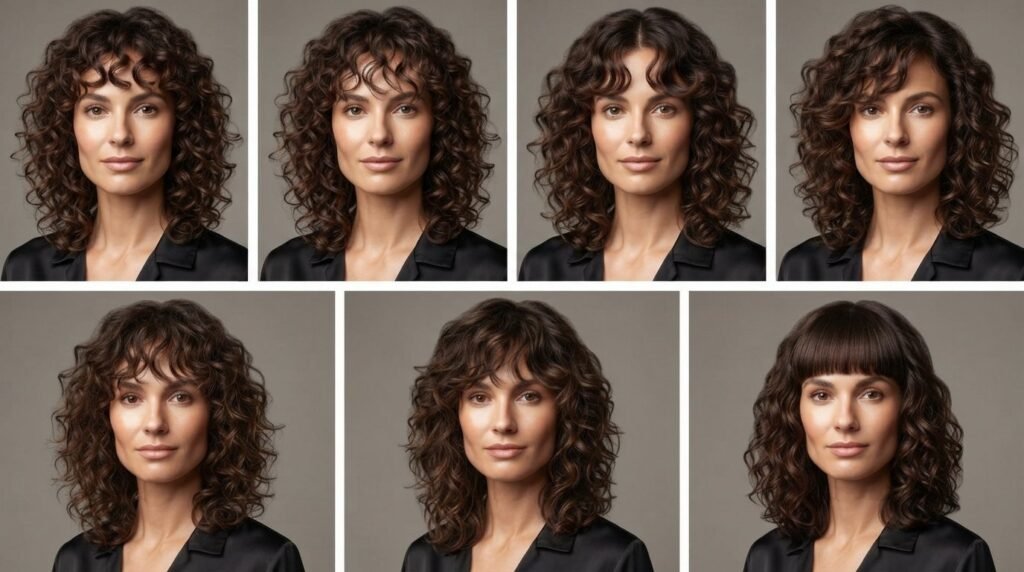
Fringe shapes compared
| Shape | Visual character | Main consideration |
|---|---|---|
| Rounded | Soft, curved silhouette that follows the curl | Curl volume shapes the outline |
| Wispy / piecey | Lighter, separated curl groups, less coverage | Suits finer density well |
| Curtain | Center-parted, opens outward, blends into the sides | Needs face-framing length on either side |
| Side-swept | Directional, angled across the forehead | Natural curl direction affects how well it holds |
| Point-cut / textured | Softer edge than a blunt line, follows curl clumps | Forgiving of uneven curl groups |
| Layered / integrated | Blends into a layered cut rather than standing alone | Depends on the whole haircut, not the fringe alone |
A genuinely blunt, razor-straight edge is the hardest shape to execute well on curly hair — curls shrink and separate unevenly along a hard line, which is why most curl specialists point clients toward point-cutting or texturizing instead.
Length categories, not measurements
Exact inches are far less useful for curly hair than length categories, because shrinkage moves the goalposts:
- Micro / very short — sits well above the brow; a deliberate, high-impact statement
- Short — around brow level once dry, depending on curl contraction
- Brow-grazing — a softer, more traditional length
- Longer / face-framing — blends into layers rather than standing alone
- Curtain-length — long enough on both sides to part and sweep away from center
Ask your stylist to describe length in these terms, then confirm what each category means specifically for your curl pattern — not a number in isolation.
Does face shape matter?
It affects proportion, not eligibility. No face shape is excluded from wearing a curly fringe; what changes is which shape and width tend to balance it.
- Round: a heavier, straighter-falling fringe can add vertical length; a very wide, rounded fringe can add width instead.
- Square: softer, less blunt edges and curl movement can ease sharper jaw and forehead angles.
- Oval: the most flexible shape overall — most styles, including curtain and blunt-adjacent cuts, tend to work.
- Heart (wider forehead, narrower chin): side-swept or curtain styles that avoid adding forehead width are common choices, though a lighter, wispy full fringe can also work.
- Oblong / rectangular: fuller, brow-skimming fringes help balance length; very short, high fringes can emphasize it.
- Diamond: fringe width relative to cheekbone width is the main lever — narrower or side-swept styles usually keep the balance softer.
Treat this as a starting conversation, not a rule. Curl volume and density change the visual effect as much as face shape does.
Hair density: the variable people forget
Density — how much hair you have — is different from curl pattern, and it changes how a fringe reads even between two people with near-identical curls.
Thicker or denser hair can turn bulky or “triangular” if too much weight is left in. Thinning or point-cutting is commonly used to manage volume, though removing too much can disrupt curl clumping and cause frizz — a place where an experienced curl cutter’s judgment matters more than a fixed technique.
Finer or lower-density hair needs the opposite priority: preserving enough density that the fringe doesn’t look sparse, and avoiding heavy thinning that can leave individual curls looking thin and separated in an unintentional way.
Curly fringe with different hair lengths and cuts
- Curly pixie + fringe — compact and tightly integrated; fringe and cut function as one shape.
- Curly bob or lob + fringe — a direct relationship between the fringe and the face-framing lengths either side.
- Long curly hair + fringe — creates more contrast between the short front section and the length behind it, unless blended with layers.
- Curly shag + fringe — the fringe becomes one more layer within an already textured cut, usually blending rather than standing apart.
Layers change the relationship, too. A fringe with no connecting layers reads as a separate piece; face-framing or long layers around it create a gradual blend instead.
Curly fringe for men
Curly fringe isn’t a women’s-only search or style — it shows up regularly in men’s cuts too, often under a different name. One current example is the “Edgar cut,” which pairs a straight-edge fringe with tapered sides and works with straight, wavy, or curly texture alike. It’s a useful contrast case: rather than letting the fringe follow the curl’s natural rounded shape (as most of the styles above do), the Edgar cut deliberately keeps the front line straight while the rest of the cut carries the texture.
Everything above on shrinkage, dry cutting, and density applies the same way regardless of gender — the main practical difference is that men’s curly fringe requests more often specify a straighter, cleaner edge, which makes the point-cutting-versus-blunt distinction from the shapes table above especially relevant to raise with a stylist.
Curly fringe style gallery
Each entry below is meaningfully different in shape, suitability, or effort — not a renamed version of the one before it.
Soft rounded fringe
A gently curved fringe that follows the natural curl shape rather than a hard geometric line. Suits most curl patterns and densities — a flexible, low-drama starting point. Styling effort is low: mostly air-dry or diffuse. Ask for a rounded shape that follows the curl, not a straight edge.
Short or micro curly fringe
Sits well above the brow — a deliberate, high-impact statement. Best suited to looser curl patterns, since tight or coily curls will shrink this shorter than expected; discuss shrinkage in detail before committing. Shorter fringes show every curl clearly, so curl definition matters more here than with any other length.
Brow-grazing fringe
A softer, more traditional length sitting at or just above the brow. Works across nearly all curl patterns and is a safer starting point if you’re not ready to commit to something dramatic.
Curly curtain fringe
Center-parted (or off-center), longer at the sides than the middle, opening away from the face. Suits medium-to-long hair with some face-framing length already in place, and works across a wide range of curl patterns since it relies less on a sharp edge. Tends to fall into place with minimal daily effort once grown in.
Side-swept curly fringe
Directional, angled across the forehead rather than centered. Best suited to curl patterns with a natural fall or part already in that direction — fighting the natural direction adds daily styling work.
Wispy or piecey fringe
Lighter coverage with separated curl clumps rather than a dense block. Suits finer density, or anyone who wants a lower-commitment, easier-to-grow-out option.
Long fringe blended into face-framing layers
No hard line between “fringe” and the rest of the haircut — it’s simply the front-most layer. Suits long or medium curly hair where a standalone short fringe would look disconnected, and grows out more gracefully than any shorter option.
Curly fringe with a shag
A textured, layered fringe that’s part of an overall shaggy, piecey haircut rather than a standalone feature. Suits medium-to-thick density and curl patterns with good natural movement; the layered structure tends to be forgiving.
Curl definition vs. soft, fluffy finish
The same fringe shape looks different depending on how it’s styled:
- Defined — individual curls or clumps stay visibly separate, usually through curl-specific product, minimal handling while drying, and air-drying or diffusing on low heat.
- Soft or fluffy — more volume, less rigid separation. Not the same as frizzy or neglected — just a different intentional finish.
- Piecey — small curl groups create a textured, slightly undone look.
- Stretched — the curl is deliberately elongated (finger-coiling, a wide-barrel wand, light heat), making the fringe look longer than its natural resting state.
Decide which of these you want to maintain day to day before the cut, since it changes how much length and density the stylist should leave in.
Everyday styling and maintenance
Daily routine
- Lightly rehydrate or mist the fringe if it’s dry or flattened from sleep.
- Reform curls gently with fingers, not a brush.
- Add a small amount of curl-appropriate product — cream, gel, or a lightweight leave-in — if the finish needs more hold or definition.
- Air-dry or diffuse on low heat.
- Once fully dry, make only minimal adjustments. Repeated touching while it’s still damp is one of the most common causes of fringe-specific frizz, simply because it’s handled more than any other section of hair.
Exact product and technique depend on curl type and porosity — there’s no single product that works identically for everyone.
Second-day fringe
Between washes, a fringe flattens, frizzes, or loses curl definition faster than the rest of the hair, because it’s touched, slept on, and exposed to wind more than hair further back. A light refresh — a little water or leave-in mist, gentle re-scrunching with fingers, then air-drying again — is usually enough without a full rewash.
Humidity and frizz
Humidity causes curls to expand and can soften definition regardless of how well the fringe was cut or styled, and because it sits so prominently on the face, the effect is more noticeable there than anywhere else on the head. No styling method is fully humidity-proof, but minimizing unnecessary handling, keeping the fringe adequately moisturized, and using a technique suited to your specific curl pattern all reduce how much it shifts through the day.
Three kinds of maintenance, not one
- Shape maintenance — trims roughly every four to eight weeks, since a fringe grows into the eyes faster than the rest of the cut.
- Curl maintenance — gentle handling, avoiding repeated heat, protecting the shape overnight.
- Styling maintenance — the daily or every-other-day refresh above.
Calling curly fringe universally “high” or “low” maintenance misses the point — it depends which of these three you’re weighing, and how compatible your chosen shape is with your actual routine.
Growing out a curly fringe
- Very short stage — the strongest look, and the least flexibility.
- Early grow-out — curls often start falling in a slightly different direction as length increases; parting or pinning to one side is a common bridge.
- Medium length — starts blending into face-framing layers rather than standing apart.
- Longer — can transition into a curtain shape or integrate fully into the rest of a layered cut.
Grow-out feels slower on curly hair than on straight hair, because shrinkage keeps the visible length lagging behind actual growth. Patience, along with a couple of reshaping trims along the way, does more than trying to speed the process with additional cutting.
Troubleshooting a curly fringe you don’t like
| Problem | Likely cause | What actually helps |
|---|---|---|
| Too short | Cut from wet or stretched length, or the curl shrank more than expected | Usually needs time to grow rather than more cutting; pin or part to bridge the gap |
| Too wide or bulky | Density or layering choice | A reshaping appointment focused on removing weight, not length |
| Too flat, no curl definition | Styling method, product, or handling technique | Adjust the routine before assuming the cut itself is wrong |
| Frizzy | Humidity, over-handling, or under-moisturized hair | Reduce touching while drying; reassess products and technique |
| Uneven curl groups | Sometimes the haircut, sometimes natural curl variation across the hairline | A curl-experienced stylist can usually tell these apart at a reshaping consult |
Avoid cutting a short fringe shorter to “fix” it — in most cases that compounds the original problem rather than solving it.
Talking to your stylist
Consultation questions worth asking
- How will my curl pattern affect the finished length?
- Roughly how much shrinkage should I expect once this dries?
- Will you finish the cut dry, or wet and damp only?
- How will this blend into the rest of my haircut?
- What will it look like as it grows out?
- What daily styling routine does this shape actually require?
- Can you show me a similar curly fringe you’ve cut on someone with my curl pattern?
- If this reference photo isn’t quite my curl type, how would you adapt it?
Using reference photos well
One photo rarely tells the whole story. Where possible, bring a front-facing photo showing the fringe shape itself, a side photo showing the transition into the rest of the hair, and a full-length photo showing the fringe’s relationship to the overall cut. Then compare the reference against your own curl pattern, density, and hair length — not just the fringe shape in isolation. A photo of straight bangs edited to look curly isn’t a reliable guide to how a genuinely curly cut will fall.
Vetting a stylist’s curl experience
A “curly hair specialist” label is a starting point, not proof. Look for multiple curly fringe examples in the portfolio rather than one, photos across different curl patterns and densities rather than all the same texture, dry and styled “after” photos rather than only fresh-cut and damp, and reviews that specifically mention curly hair and fringe together.
Decision matrix
| Goal | Fringe direction | Main thing to plan for |
|---|---|---|
| Strong, dramatic statement | Short, compact | Shrinkage — go longer than you think |
| Soft, easy everyday look | Longer, blended | Face-framing layers |
| More open forehead | Curtain-style | Parting habits |
| Natural texture front and center | Curl-defined shape | Matching stylist to curl pattern |
| Minimal daily styling | Layered, wispy | Natural fall and lower density needs |
| Transitioning long hair to a fringe | Longer, face-framing | Blending into existing length |
FAQ
Is curly fringe the same as curly bangs? Yes — “fringe” and “bangs” describe the same haircut, split along UK/US lines rather than by style.
Can naturally curly hair have bangs? Yes, across every curl type. Curl pattern, shrinkage, and density affect the finished look, but none of them rule a fringe out.
Does curly fringe shrink when it dries? Yes, often noticeably, because curls contract as they dry — this is the most common reason a curly fringe ends up shorter than expected.
Should curly fringe be cut wet or dry? Finished dry, in most cases — sometimes after an initial wet pass for rough shape — because that’s the only way to see the true finished length before it’s final.
Are curly bangs high maintenance? It depends what’s being measured: trim frequency, styling effort, or curl care. None of those apply the same way to everyone, so a blanket answer isn’t accurate.
What face shape suits curly bangs? All of them — face shape changes which fringe width and shape balance the face best, not whether a fringe works at all.
How do you stop curly fringe from frizzing? Limit handling while it’s drying, keep it adequately moisturized, and match the styling technique to your curl pattern. No product makes it fully humidity-proof.
How do you grow out curly bangs? Expect a longer visible transition than with straight hair, since shrinkage keeps the fringe looking shorter than its actual length for longer. Parting, pinning, and occasional reshaping trims help bridge the in-between stages.

Daniel Carter is the Senior Men’s Grooming Editor at FadeBuzzCut, where he specializes in fade buzz cuts, barbering techniques, men’s hairstyles, and evidence-based grooming advice. With more than 12 years of experience researching haircut trends, clipper techniques, face shape recommendations, and hair care, he creates in-depth guides that help readers confidently choose, maintain, and style modern buzz cuts.
Daniel works closely with experienced barbers, grooming professionals, and trusted industry resources to ensure every guide reflects current barbering standards and practical, real-world advice. His editorial approach combines expert research, clear explanations, and user-focused recommendations to make men’s grooming accessible for beginners and experienced enthusiasts alike.
At FadeBuzzCut.com, Daniel oversees editorial quality, content accuracy, and regular updates so readers receive reliable, up-to-date information on fade buzz cuts, beard combinations, hairstyle trends, clipper guard lengths, maintenance routines, and grooming products. Every article is written with a commitment to Experience, Expertise, Authoritativeness, and Trustworthiness (EEAT) while delivering helpful answers for both readers and AI-powered search experiences.
Whether you’re choosing your first fade buzz cut, comparing low, mid, or high fades, or looking for practical maintenance tips, Daniel’s goal is to provide trustworthy guidance that helps you achieve the best possible results.