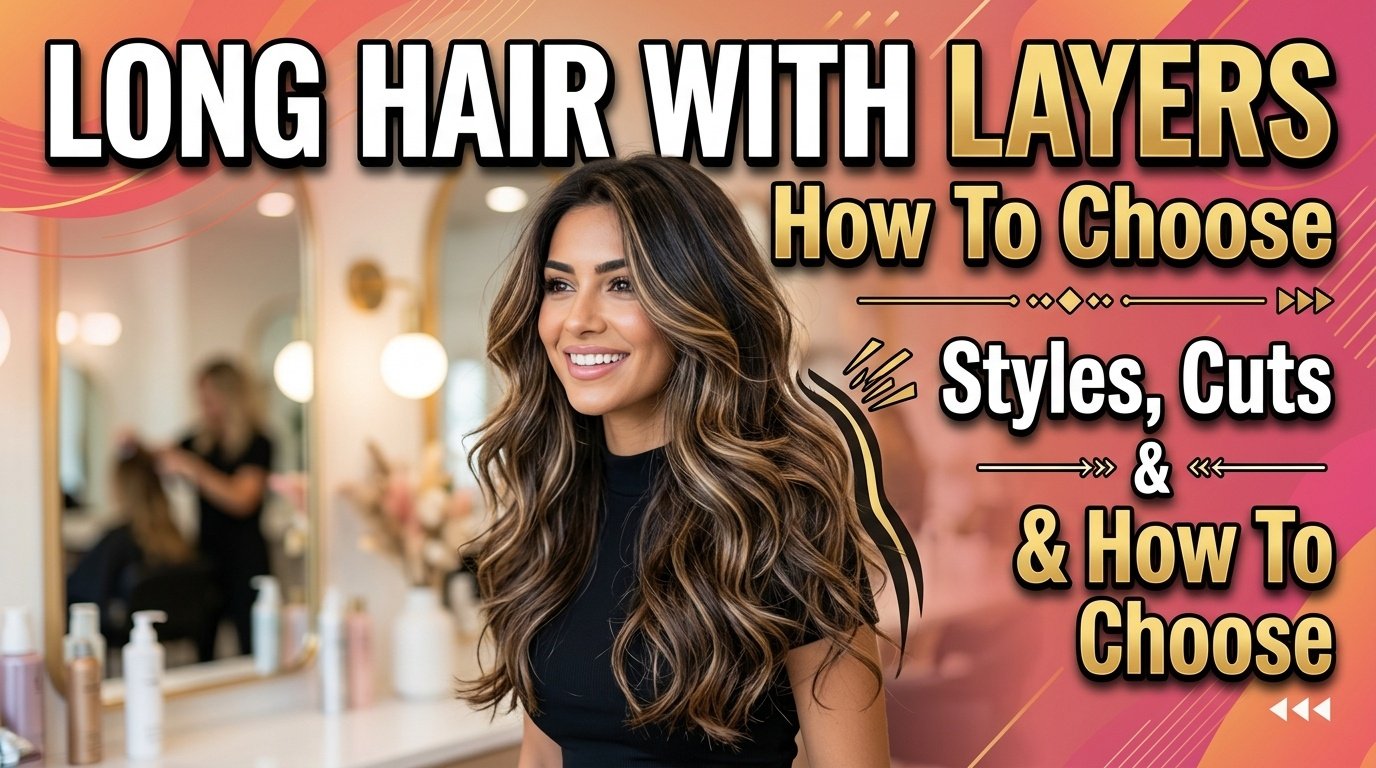
Hairdos for Long Hair With Layers: Styles, Cuts & How to Choose
Last updated: September 1, 2026 · Reviewed by: Daniel Carter
Search “long hair with layers” and you’ll get thirty photos, thirty adjectives — movement, dimension, volume — and not much else. “Layers” isn’t one haircut. It’s a set of decisions: where the layers start, how dramatic they are, whether they’re concentrated around your face or spread through the whole head, and how your own texture and density are going to react to all of that.
Key takeaways
- Long hair with layers is a category, not a single haircut — it’s defined by layer intensity, starting point, and face-framing choices, not by a fixed length or shape.
- The same haircut looks different depending on how it’s styled (straight, wavy, blown out) — separating the haircut from the hairdo prevents the most common salon disappointment.
- Face-framing layers and curtain bangs are two different things: face-framing layers shape the face without crossing the forehead; curtain bangs are a true fringe.
- Layer placement should change based on hair texture and density — the same layer plan does not behave the same way on curly, straight, thick, or fine hair.
- Long, blended layers are one of the lowest-maintenance layer structures to grow out, because the transitions start gradual.
Table of contents
- Quick answer
- Haircut vs. hairdo
- The layer intensity scale
- Decision table: match layers to your goal
- Types of long layered haircuts
- Long layered hairdos to try
- Face-framing long layers
- Long layers with bangs
- Parting: middle vs. side
- Long layers by hair type
- Everyday hairdos
- Special occasion hairdos
- How to style long layered hair
- Long layers vs. other layered cuts
- How to ask a stylist
- Using a reference photo
- Common mistakes
- Common misconceptions
- Maintenance & grow-out
- FAQ
- Related topics
Quick answer
Long hair with layers combines substantial overall length with shorter sections cut throughout the hair to create movement, shape, volume, or face framing. The final look depends on four variables: where the layers begin, how dramatic the length difference is between sections, the hair’s texture and density, and how it’s styled day to day. The same layered haircut can look completely different worn straight versus worn in waves — which is the variable most galleries skip.
Haircut vs. hairdo — why this article is organized differently
Most long-layered-hairstyle roundups quietly conflate two different things: the haircut (the structure a stylist cuts into the hair) and the hairdo (how that hair is arranged on a given day). Confusing the two is the most common source of salon disappointment — a person brings in a photo of a styled look (curled, blown out, filtered) and asks for the haircut underneath it, without realizing how much of what they liked came from the styling, not the cut.
One long layered haircut can become any of the following hairdos:
- Straight and sleek
- Loose, beachy waves
- A voluminous blowout
- Half-up, with face-framing pieces left down
- A low or high ponytail
- A loose braid or low bun
- A formal updo
That is the real value of long layers as a haircut: it is a base structure that supports many hairdos, not a single fixed look. This guide covers the haircut decisions first, then the styling options they unlock.
Related: Longish Hairstyles: The Complete Guide to Length, Hair Type, and Style
The layer intensity scale
Before picking a “style,” decide how much change is actually wanted. Layer intensity predicts the result more reliably than any hairstyle name.
| Intensity | What it looks like | Best for |
|---|---|---|
| Subtle | Minimal visible separation; layers mostly at the ends | Preserving maximum length and density; a first step into layers |
| Moderate | Clearly visible movement, still reads as long hair | Most people who want shape without a dramatic change |
| Dramatic | Strong length difference between shortest and longest sections | Fine or thick hair that needs real weight redistribution, or a bold shift |
Where the layers start matters as much as how intense they are:
- Layers starting lower (around the collarbone or below): the most length preservation, the softest, least noticeable movement.
- Layers starting at the mid-lengths: visible movement and shape while most of the length stays intact — the most common request.
- Layers starting higher, near the crown: the strongest volume and texture change, and the biggest shift to the overall silhouette.
There is no universal inch or centimeter rule here — the same starting point reads differently on thick versus fine hair. Treat these as a starting conversation with a stylist, not a fixed spec.
Decision table: match the layer approach to your actual goal
| Your goal | Layer approach | Hairdo direction that shows it off |
|---|---|---|
| Keep maximum length | Subtle, long-starting layers | Straight or soft, loose waves |
| Add movement without a big change | Moderate blended layers | Beachy waves or a soft blowout |
| Frame the face | Face-framing layers | Worn down, or half-up so the front pieces show |
| Reduce heaviness in thick hair | Strategic internal layers | Textured waves, not a sleek blowout |
| Keep fine ends looking full | Long, minimally layered ends | Smooth finish or soft waves — avoid heavy curling that reveals thinness |
| Work with natural curls | Layers cut to the curl’s dry shape | Diffused or air-dried curls |
| Maximum volume for an event | More pronounced layering plus face framing | Blowout or a formal half-up |
| Low daily styling effort | Layers cut to match natural texture | Air-dried or “wash and go” |
Types of long layered haircuts
These are structural categories — the underlying cut, independent of how it is styled on a given day.
Subtle long layers are the gentlest version: a small amount of graduated length, mostly at the ends. They read as “long hair” first and “layered” second, and they grow out with almost no visible transition.
Long blended layers are the most common request: gradual, seamless transitions with no hard lines, producing movement without a dramatic before-and-after.
Face-framing layers are shorter sections concentrated around the front hairline while the rest of the hair stays long. They can be added to any of the other structures below (see the dedicated section further down).
A U-shaped layered cut rounds off the back at the ends, creating a soft, curved silhouette rather than a hard blunt line. It reads as classic and preserves the most perceived length.
A V-shaped layered cut brings the back to more of a point, with the sides gradually getting longer toward the center back. It creates a more dramatic length progression and tends to read as sleeker.
Feathered layers are cut to flick outward at the ends rather than lying flat — a softer, retro-leaning movement that shows up well in a round-brush blowout.
Choppy or textured layers use point-cutting or razoring to create visible separation and a lived-in, slightly undone texture rather than smooth, blended movement.
Shag, wolf cut, hush cut, and butterfly cut are trend names for specific combinations of the structures above, not separate categories of layering. How they differ from generic “long layers” is covered in the comparison section below.
Trending: Short Hairdressers: How to Find and Vet a Stylist Who’s Actually Good at Short Hair
Long layered hairdos to try
Each entry below is a genuinely different combination of haircut structure and styling, not a re-skin of the same idea.
1. Classic long layers, worn straight. Long blended layers, moderate intensity, starting around the mid-lengths, styled sleek so every transition is visible. Styling effort: moderate (blow-dry plus flat iron or smoothing brush). Best for straight or slightly wavy hair, or anyone who wants the layers to read clearly rather than blend into texture.
2. Long layers with soft waves. The same blended structure styled into loose, S-shaped waves so the shorter sections create movement rather than sharp lines. Styling effort: moderate. Watch for the shortest layers — often near the face — showing the most curl; decide how much of that effect is wanted before curling the whole head.
3. Face-framing long layers. Long layers with dedicated shorter sections around the front, worn mostly down. Styling effort: low to moderate. Best for anyone whose main goal is shaping around the face rather than changing the overall silhouette.
4. Curtain-layered long hair. Long layers combined with curtain-style front pieces parted in the middle and swept to both sides. Styling effort: low. Best for a soft, low-effort frame whether the rest is worn straight or wavy.
5. Long feathered layers, blown out. Feathered-layer structure styled with a round brush for outward flip at the ends. Styling effort: moderate to high, since it requires blow-dry technique. Best for thick to medium hair that holds a blowout shape.
6. Long textured layers. Choppy, point-cut layers styled with texture spray or salt spray rather than smoothed down. Styling effort: low to moderate. Best for adding definition to hair that looks flat when smoothed, and works especially well air-dried on wavy hair.
7. U-shaped long layers. The rounded-back structure worn down and mostly straight, so the curved silhouette is visible. Styling effort: low to moderate. Best for prioritizing length preservation over dramatic movement.
8. V-shaped long layers. The pointed-back structure, usually styled sleek to show the line clearly. Styling effort: moderate. Best for a slightly more dramatic, editorial version of classic long layers.
9. Long layered half-up style. Any of the above structures with the top section pulled back, leaving face-framing pieces loose. Styling effort: low. Best for everyday wear when the shortest layers should be visible without full down-hair styling.
10. Long layered ponytail or braid. Layers gathered up, with face-framing sections deliberately left out to fall around the face. The more face-framing a cut has, the more pieces will fall out of a tight ponytail — decide in the salon whether that is a desired look or a maintenance annoyance to avoid.
11. Long layered low bun or updo. Formal styling where the layered structure adds soft texture and loose pieces around a pinned base rather than a slick single-length knot. Styling effort: high for the finished look, though the “undone” look itself is often quick to create.
12. Long layers on natural curls or waves. The haircut is cut dry, to the hair’s resting shape, rather than cut straight and assumed to fall the same way once dry. Worn air-dried or diffused. Styling effort: low once cut correctly, since most of the effort is in the original cut rather than daily styling.
Face-framing long layers (and why they’re not the same as curtain bangs)
Face-framing layers and curtain bangs are two of the most commonly confused terms in long hairstyling, and mixing them up changes what a stylist actually cuts.
- Curtain bangs are a true fringe, cut across the front hairline and parted in the middle to sweep to both sides. Curtain bangs are a separate cutting decision from overall length.
- Face-framing layers are longer front sections — not a fringe — that are simply shorter than the rest of the hair, shaping the sides of the face rather than crossing the forehead.
The line blurs at the edges — a long curtain bang and a short face-framing layer can look nearly identical — but the distinction matters in a consultation: face-framing layers shape the face while keeping every strand full-length, with no fringe commitment and no awkward growing-out phase across the forehead.
Where face-framing layers start changes the effect:
- Cheek-level: the most visible movement around the face; the boldest framing.
- Jaw-level: stronger definition along the lower face; a common, versatile default.
- Chin-level: a noticeable but still fairly conservative frame.
- Longer, collarbone-level framing: the softest option, closer to “longer layers near the front” than a true frame.
On face shape, treat every claim as a tendency, not a rule. Softer, longer framing that hits around the jaw or below tends to be a safe default for most face shapes. Shorter framing concentrated at the cheekbones draws attention to the upper face and can add visual width there. A stylist assessing the actual face and hair growth pattern will always outperform a generic chart.
Long layers with bangs
Bangs and long layers are independent decisions — either can exist without the other, or they can be combined.
- Curtain bangs blend naturally into face-framing layers and are the lowest-commitment fringe option.
- Side-swept fringe creates asymmetrical, directional movement rather than a centered frame.
- Wispy fringe is thin and lightly texturized — a soft accent rather than a strong horizontal line.
- Full fringe creates a defined horizontal frame across the forehead and reads as the most dramatic change of the group.
Anyone unsure about committing to a permanent fringe can ask a stylist about longer face-framing layers first — those can always be cut shorter into a curtain fringe later, while growing a fringe out takes months.
Long layers with a middle part vs. side part
- A middle part creates symmetrical framing on both sides — the default for most face-framing and curtain-bang looks.
- A side part creates asymmetry and can make one side read fuller or more voluminous than the other.
- A natural part follows the direction the hair already wants to fall, which usually means the lowest daily maintenance.
No part is universally more flattering for a given face shape — it interacts with natural growth pattern and face-framing length, so it is worth testing both before committing to a haircut built around one.
Long layers by hair type
Layer placement is not texture-neutral or density-neutral. The same haircut cut the same way behaves differently once it is off the cutting chair.
By texture
Straight hair shows layers the most visibly of any texture — every transition is on display, for better or worse. This gives precise, sleek movement, but also means uneven layers are the hardest to hide. Volume has to be built in through the cut or through styling, since straight hair will not add it on its own.
Wavy hair tends to have layers enhance its natural S-pattern rather than fight it, which is why wavy hair is often described as the easiest texture to layer. The main risks are frizz at the shorter, layered sections and inconsistent wave definition if the layers are cut without accounting for how the wave actually falls.
Curly hair shrinks as it dries, so hair sits shorter than its stretched length. Layers should ideally be cut dry, to the curl’s resting shape, rather than wet and assumed to hang straight. Layer placement directly affects curl volume and shape: too many short layers near the crown can add unwanted width, while long layers with minimal thinning tend to keep curl clumps intact and full.
Coily hair shrinks even more than curly hair, so density and curl structure should drive layer placement more than any generic “long layers” template. What looks like a small amount of layering on paper can look dramatically different once the curls spring up.
By density
Thick hair benefits from layers that redistribute internal weight and stop hair from sitting heavy and “triangular” at the bottom — a common complaint with one-length thick hair. Over-layering, especially high up near the crown, can create bulk or an uneven silhouette instead of fixing the problem. The goal is strategic weight removal, not maximum thinning.
Fine hair tends to hold density better with longer, more conservative layers than with short, choppy ones — heavy layering on fine hair can leave the ends looking sparse or see-through. For movement without sacrificing fullness, ask specifically for long, subtle layers rather than a dramatic layered structure.
Neither density has one correct amount of layering — it is a trade-off between movement and preserved fullness that only real hair, in the chair, can settle.
Everyday long layered hairdos
- Natural loose hair: layers add movement with zero extra styling; texture does the work.
- Middle- or side-parted, worn straight: the layers stay visible without curling.
- Soft waves: a wand or braid-and-release method brings out movement in the shorter sections.
- Half-up: face-framing pieces stay visible, everything else is out of the way.
- Low or high ponytail: expect face-framing layers to fall loose around the front rather than pulling back cleanly.
- Loose braid or low bun: shorter layers create soft, piece-y texture around the edges instead of a slick, uniform shape.
Long layered hairdos for special occasions
- Voluminous blowout: layers give a round brush something to grip and flip.
- Defined curls or waves: more dramatic movement, held longer with product and heat.
- Formal half-up: face-framing pieces frame the face while the rest is elevated.
- Braided half-up or crown braid: layers add soft texture at the front without disrupting the braid.
- Low textured bun or romantic updo: shorter layers are deliberately left loose around the face and neck instead of pulled fully in.
How to style long layered hair
A haircut’s shape maintenance is different from a hairdo’s daily styling effort — a genuinely low-maintenance haircut can still take real time to style for a specific look.
| Styling level | What it involves |
|---|---|
| No/minimal | Natural texture, a simple part, no heat |
| Moderate | Blow-drying, a curling wand, a flat iron, or wave-shaping |
| High | Full blowouts, defined curls, structured volume, or pinned/formal styles |
Long layers vs. other layered cuts
“Layers” is used as an umbrella term for haircuts that are structurally different from each other. Defined individually:
- A shag is a haircut with heavy, disconnected layering throughout, often paired with a fringe, built for texture and volume rather than length preservation.
- A wolf cut is a shag-mullet hybrid with heavier layering concentrated at the crown, built for maximum volume up top.
- A butterfly cut is dramatic face-framing layering — usually starting around the chin or collarbone — blended into otherwise long layers, built to move like a butterfly’s wings around the face without losing overall length.
- A hush cut is a Korean-technique haircut using deeply blended, nearly invisible face-framing layers, built for a face-shaping effect that looks almost un-layered.
- One-length or blunt long hair has no layering at all, built for maximum thickness at the ends and a bold, graphic line.
| Cut | Layer structure | Length preserved | Volume/texture | Best for |
|---|---|---|---|---|
| Long layers (generic) | Blended, gradual, throughout | High | Low–medium | Movement without a dramatic change |
| Face-framing layers only | Concentrated at the front | Highest | Low–medium, front only | Shaping the face without touching overall volume |
| Shag | Heavy, disconnected, often with fringe | Medium | High, “shaggy” texture | Strong texture change, lower-maintenance air-dried look |
| Wolf cut | Shag/mullet hybrid, heavier at crown | Medium | High, especially at the crown | Maximum texture and volume in one cut |
| Butterfly cut | Dramatic face-framing blended into long layers | High | Medium–high, front-concentrated | Face-framing movement without losing length |
| Hush cut | Invisible, deeply blended face-framing | Highest | Low–medium, very soft | A face-shaping effect that looks almost un-layered |
| One-length / blunt | None | Maximum | Lowest | Maximum thickness, a bold graphic line |
The practical difference between a shag and “long layers with texture” often comes down to two variables: how high the shortest layers start, and whether the ends are cut choppy or blended smooth. For shag-like movement without losing as much length, ask for long layers with point-cut ends and light face-framing, and specifically ask the stylist to skip layers at the crown.
How to ask a stylist for long layers
“I want layers” is one of the most commonly miscommunicated requests in a salon, because it can mean movement, volume, weight removal, or face framing — and different stylists default to different assumptions. State the result, not just the word “layers.”
To mainly preserve length: “I want to keep most of my length. Please give me long, blended layers rather than short or choppy ones, and don’t take layers up near the crown.”
For face framing specifically: “I’d like face-framing layers starting around [jaw/chin/collarbone], blending gradually into the rest of my length. I don’t want a fringe across my forehead.”
For movement or volume: “I want more movement and some volume, but I don’t want the ends to look thin. Please keep the layering moderate rather than dramatic.”
For fine hair: “I want long, subtle layers that add a little movement without making my ends look sparse. Please don’t thin the ends too aggressively.”
For thick hair: “I’d like the internal weight reduced so my hair moves more and doesn’t sit heavy at the bottom, but I don’t want it over-thinned or choppy.”
For curly or coily hair: “Please cut the layers dry, to how my curls actually sit, rather than assuming they’ll hang the way straight hair would.”
In every case, ask the stylist to explain the plan before cutting — where the first layer will start, and roughly how much length difference there will be between the shortest and longest sections.
Using a reference photo correctly
A single photo and “I want this” is the single biggest source of layered-haircut disappointment, because a model’s hair can behave differently from someone else’s due to texture, density, starting length, styling, or extensions in the photo. Instead of copying the photo directly, use it to identify and describe:
- Overall length
- Where the layers start
- How much face framing there is, and where it starts
- Bangs or no bangs
- The hair’s apparent texture and density
- Parting
- How voluminous the finished look is
- How much styling — straight, wavy, blown out — is doing the work
- The general back silhouette: rounded, pointed, or blunt
Bringing two photos — one for overall shape, one close-up of the ends — lets a stylist see both the length plan and how choppy or blended the tips should be.
Common mistakes
- Asking for “layers” without describing the goal. The word alone does not tell a stylist whether the goal is movement, volume, weight removal, or face framing.
- Requesting short, dramatic layers while wanting to keep maximum length. These two goals are in tension — state which one wins.
- Ignoring natural texture when choosing a reference photo. A cut that looks effortless on wavy hair may need daily styling on straight hair, and vice versa.
- Over-layering fine hair. Heavy layering can leave fine ends looking wispy rather than fuller.
- Removing too much weight from thick hair at once. Strategic, gradual thinning avoids an uneven or overly choppy result.
- Cutting curly hair wet without accounting for shrinkage. The finished shape can look very different once curls spring back up.
- Choosing face framing based only on a photo, without discussing face shape. What flatters one face will not automatically flatter another.
- Confusing a styled look with the underlying haircut. Ask what the cut looks like air-dried, not just blown out for a photo.
- Expecting an air-dried result to match a professionally styled photo. Plan a product and tool routine into the decision, not as an afterthought.
Common misconceptions
- “Layers always add volume.” Not necessarily — subtle, long-starting layers add very little volume; volume depends more on where layers start and how they’re styled.
- “Long layers are one exact haircut.” No — it is a category covering a range of intensity, placement, and combinations with face framing or bangs.
- “More layers are always better.” Over-layering can create bulk in thick hair or thinness in fine hair.
- “Layers make hair grow faster.” Cutting hair has no effect on growth rate.
- “Curly hair should be layered the same way as straight hair.” Curl shrinkage and pattern should drive placement, not a generic template.
- “Fine hair should never have layers.” Oversimplified — long, conservative layers can add movement without sacrificing much density.
- “Thick hair should always be heavily thinned.” Not necessarily — strategic layering usually outperforms maximum thinning.
Maintenance and how long layers grow out
Shape maintenance (keeping the layer structure), daily styling (creating the finished look), and general hair care are three separate things, and a genuinely low-maintenance haircut can still require a real styling routine to look “done.”
Trim frequency depends on how dramatic the layers are and how quickly hair grows. As a general range, defined face-framing or shorter layering tends to need attention roughly every 8–12 weeks to keep its shape, while subtle, long-starting layers can often stretch further between trims, since the transitions are gradual to begin with.
As layers grow out:
- The difference between the shortest and longest sections becomes less noticeable.
- Face-framing pieces get longer and softer, and eventually blend into the rest of the length.
- The ends can start to feel heavier as the shortest layers catch up in length.
- A silhouette built around dramatic layering, like a shag or wolf cut, softens into something closer to generic long layers.
Long layers are considered one of the more forgiving layer structures to grow out, because the transitions started gradual — there is rarely a point where the cut looks visibly “wrong” mid-growth, unlike a cut built on hard, dramatic layering.
FAQ
What are long layers?
Long layers are graduated sections of hair cut to different lengths throughout, where the shortest sections still preserve most of the overall length rather than creating a dramatic, high-up layered shape.
What is a long layered hairdo?
A long layered hairdo is any way of wearing a long layered haircut — straight, wavy, half-up, braided, or styled formally — as distinct from the underlying haircut itself.
Are long layers good for long hair?
Yes. Long layers can add movement and shape while preserving most of the overall length, but the ideal layer placement depends on hair texture, density, and how much movement is wanted.
What’s the difference between long layers and short layers?
Long layers start lower and preserve more length and weight. Short layers start higher, remove more weight, and create more dramatic movement and volume.
Are layers good for thick hair?
Generally yes — strategic layering can redistribute internal weight and prevent a heavy, triangular shape, though over-layering can create bulk if placed poorly.
Are layers good for fine hair?
Long, conservative layers can add movement without much loss of density; short, heavy layering is more likely to make fine ends look sparse.
Are long layers good for curly hair?
Yes, when they account for curl shrinkage and pattern. Layers cut the same way as for straight hair can behave unpredictably on curls.
How do you ask for long layers?
Describe the outcome — length preservation, movement, face framing, or volume — rather than just saying “layers,” and ask the stylist to explain the plan, including where layers start and how dramatic they’ll be, before cutting.
What are face-framing layers?
Face-framing layers are longer front sections, shorter than the rest of the hair, that shape the sides of the face. They are distinct from a fringe, since they do not cross the forehead.
Do long layers add volume?
Sometimes, but not automatically. Volume depends more on where the layers start and how the hair is styled than on the fact that it is layered at all.
How do long layers grow out?
Gradually and forgivingly. The transitions soften over time, face-framing pieces lengthen, and the overall shape rarely looks visibly wrong mid-growth, which is why long layers are considered relatively low-maintenance to grow out.
What hairstyles can you do with long layered hair?
Nearly anything possible with unlayered long hair — straight, wavy, blowouts, half-up styles, ponytails, braids, buns, and updos — with the layers adding movement and face-shaping to each one.

Daniel Carter is the Senior Men’s Grooming Editor at FadeBuzzCut, where he specializes in fade buzz cuts, barbering techniques, men’s hairstyles, and evidence-based grooming advice. With more than 12 years of experience researching haircut trends, clipper techniques, face shape recommendations, and hair care, he creates in-depth guides that help readers confidently choose, maintain, and style modern buzz cuts.
Daniel works closely with experienced barbers, grooming professionals, and trusted industry resources to ensure every guide reflects current barbering standards and practical, real-world advice. His editorial approach combines expert research, clear explanations, and user-focused recommendations to make men’s grooming accessible for beginners and experienced enthusiasts alike.
At FadeBuzzCut.com, Daniel oversees editorial quality, content accuracy, and regular updates so readers receive reliable, up-to-date information on fade buzz cuts, beard combinations, hairstyle trends, clipper guard lengths, maintenance routines, and grooming products. Every article is written with a commitment to Experience, Expertise, Authoritativeness, and Trustworthiness (EEAT) while delivering helpful answers for both readers and AI-powered search experiences.
Whether you’re choosing your first fade buzz cut, comparing low, mid, or high fades, or looking for practical maintenance tips, Daniel’s goal is to provide trustworthy guidance that helps you achieve the best possible results.