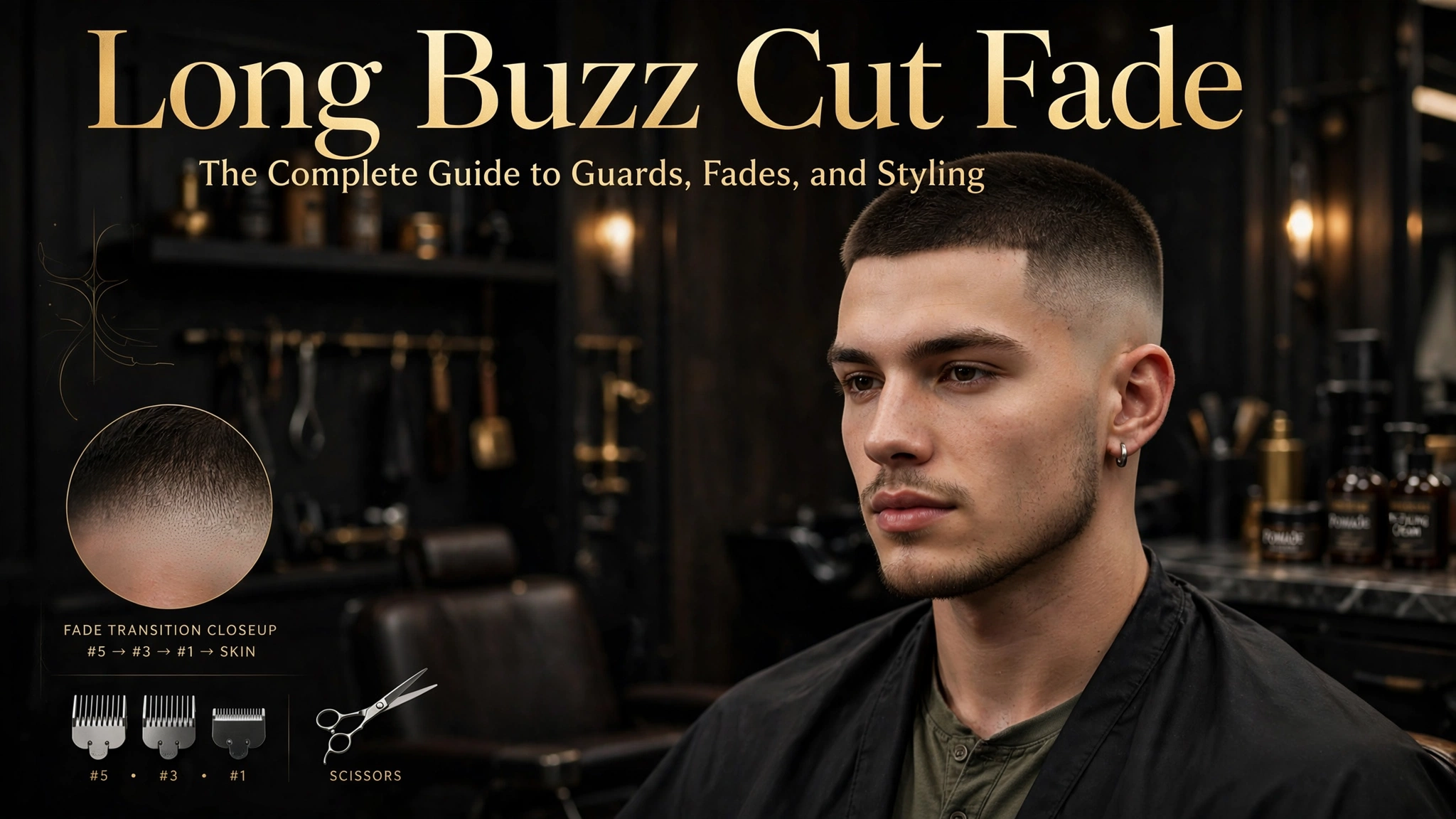
Long Buzz Cut Fade: The Complete Guide to Guards, Fades, and Styling
Last updated: July 2026 · Fact-checked by our grooming and barbering editorial team
If you’ve spent any time in a barber chair scrolling through reference photos, you’ve probably landed on the long buzz cut fade — the haircut that gives you buzz cut simplicity without shaving everything down to the scalp. It solves a real problem: guys want low maintenance, but they don’t want to look like they’re in basic training.
A long buzz cut fade keeps the top hair longer — a guard #4 to #7 — while the sides and back taper or fade down to skin or a short guard. It suits nearly every hair type and face shape and needs a trim only every 2–3 weeks. Below is everything a barber would actually walk you through in the chair.
Key Takeaways
- A long buzz cut fade = long top (guard #4–#7) + faded sides (skin or guard #0–#2).
- Guard #4 on top is the most requested, lowest-risk starting point for first-timers.
- Fade height (low, mid, high) changes the amount of contrast — not the top length.
- Curly and coily hair generally need a longer top guard (#6–#7) than straight hair.
- Face shape affects fade height, not guard length — see the table further down.
- Plan on a fade touch-up every 2–3 weeks; the top can stretch to 4+ weeks.
In This Guide
- What Is a Long Buzz Cut Fade?
- Buzz Cut Fade Terms, Explained
- Long Buzz Cut Fade vs. Regular Buzz Cut
- Who It’s Best For — and Who Should Skip It
- Which Fade Height Should You Choose?
- What Guard Number Should You Ask For?
- Growth Timeline: What to Expect Week by Week
- Best Option by Hair Type
- Best Option by Face Shape
- Beard Pairing Guide
- Styling and Maintenance
- How to Ask Your Barber
- Common Mistakes to Avoid
- How It Compares to Other Popular Cuts
- FAQ
Quick Style Finder
Match your situation to a starting point, then jump to the linked section for full detail.
| If you’re… | Start with this guard | Best fade height | Read more |
| New to fades, want something safe | #5 top, #2 sides | Low fade | Fade heights |
| In a corporate or client-facing role | #4 top | Low or mid taper (no skin) | Guard numbers |
| Athletic, active, low-maintenance | #4 top | Skin fade | Maintenance |
| Rocking curly or coily hair | #6–#7 top | Mid fade | Hair type guide |
| Dealing with a thinning crown | #5 top | Low fade | Hair type guide |
| Going for a bold, modern look | #6 top | High or burst fade | Fade heights |
Barber Pro Tip: The bigger the gap between your top guard and your side guard, the more “faded” the cut looks. A #6 on top with a #1 on the sides reads as dramatic. A #4 on top with a #3 on the sides reads as subtle. Neither is wrong — it depends on how much contrast you want to maintain between visits.
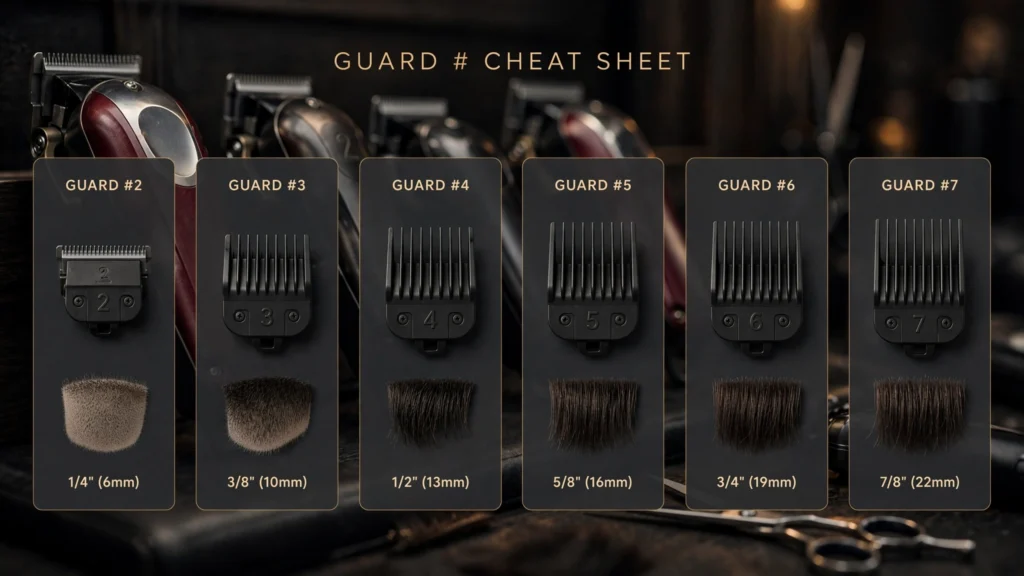
Guard Number Cheat Sheet
| Guard # | Length left on hair | Look it creates |
| #2 | 1/4″ (6mm) | Very short, close to scalp |
| #3 | 3/8″ (10mm) | Classic short buzz |
| #4 | 1/2″ (13mm) | The standard “long buzz” starting length |
| #5 | 5/8″ (16mm) | Visible texture, light styling possible |
| #6 | 3/4″ (19mm) | Enough length to comb or finger-style |
| #7 | 7/8″ (22mm) | Longest end of buzz territory, borders on a crop |
Related: 6 Guard Buzz Cut: Length, Look, and Everything to Know Before You Get One
Buzz Cut Fade Terms, Explained
A quick reference Fade Buzz Cut, so the rest of this guide — and your next barber conversation — makes sense at a glance.
- Fade — a gradual transition from longer to shorter (or skin) hair, blended so there’s no visible line.
- Taper — a shorter, tighter version of a fade, confined close to the hairline and neckline.
- Guard — the plastic attachment on clippers that controls cut length; numbered #1–#8, higher number = more length left.
- Skin fade — a fade that blends all the way down to bare skin.
- Blend — the barber’s technique for making the transition between two lengths look seamless rather than stepped.
- Drop fade — a fade line that curves downward behind the ear instead of running straight.
- Burst fade — a fade that curves in a semicircle around the ear only, leaving the rest of the perimeter longer.
- Line-up / edge-up — sharpening the hairline and sideburns with a trimmer for a crisp finish.
What Is a Long Buzz Cut Fade?
A regular buzz cut runs the same guard length over the entire head — usually a #2 or #3 — so there’s no contrast between top and sides. A long buzz cut fade changes that in two ways: the top is left noticeably longer (typically #4–#7), and the sides fade gradually down to a shorter guard or skin. You keep the low-effort appeal of a buzz cut but gain the shape and dimension a fade provides
How It Differs From a Regular Buzz Cut
The practical difference comes down to two things: how much length stays on top, and whether the sides are blended or left uniform. A regular buzz cut is one guard, all over — fastest to cut, fastest to grow out evenly. A long buzz cut fade requires two guard lengths plus a blend, which means slightly more chair time and a shorter window before the fade needs a touch-up, in exchange for a more defined, photograph-friendly shape.
Must Read: Short Buzz Cut: The Complete Guide to Lengths, Styles & Maintenance (2026)
Who It’s Best For — and Who Should Skip It
It’s a strong fit if you want a haircut that looks intentional without a daily styling routine, you’re comfortable visiting a barber every 2–3 weeks for a fade touch-up, and your hair type is straight, wavy, curly, or coily (it works for all four, at different top lengths).
It’s probably not the right call if you can’t commit to fade touch-ups every couple of weeks — the sides grow out and soften the blend faster than the top length changes, so infrequent visits mean you’re often wearing a “half-grown-out” version of the cut. It’s also not the best option if you have very fine, sparse hair overall (not just a thinning crown) — in that case, a slightly longer, uniform crop without a hard fade line tends to look fuller than a short guard next to skin.
Which Fade Height Should You Choose?
Fade height is the single biggest factor in how bold or subtle the haircut reads.
Low fade. Starts just above the ears. The most conservative option, and the easiest to keep looking sharp under office lighting or a hat. Image suggestion: side profile, fade beginning just above the ear line.
Mid fade. Starts around temple height. The most balanced choice — enough contrast to look intentional without dominating the cut. Image suggestion: 45° angle showing the transition point at the temple.
High fade. Starts near the top of the head, leaving a smaller “island” of longer hair. Creates the most dramatic contrast and pairs especially well with a #6–#7 top. Image suggestion: back-and-side view showing the blend line’s height relative to the crown.
Skin fade. Blends all the way down to bare skin rather than a short guard. Can be combined with a low, mid, or high starting point for the sharpest possible line. Image suggestion: close-up on the fade zone showing the skin-to-guard gradient.
Taper fade. A shorter, tighter blend close to the hairline and neckline. The safest option for conservative workplace grooming standards. Image suggestion: front view focused on the neckline and sideburn area.
Drop fade. The fade line curves downward behind the ear. A more advanced technique that tends to suit rounder head shapes by adding an angular break. Image suggestion: back view capturing the curve behind the ear.
Burst fade. Curves in a semicircle around the ear only, leaving the rest of the perimeter longer. Pairs well with longer top lengths for a textured, undone finish. Image suggestion: 45° angle isolating the curved fade around the ear.
What Guard Number Should You Ask For?
Guard numbers are the actual instruction your barber works from — not vague terms like “medium length.”
#4 on top is the most requested starting point. Enough length to look deliberate without requiring styling effort.
#5 on top starts to show visible texture and allows light finger-styling — a good middle ground if you’re unsure between short and long.
#6–#7 on top gives enough length to comb, add texture cream to, or let curls fully express themselves. This range borders on “textured crop” and needs the most upkeep of the group.
Sides typically run shorter — #1, #2, or skin — with the fade handling the transition between the two lengths.
#3 vs. #4 vs. #5 vs. #6 Guard Comparison
| Guard | Best for | Styling needed | Comfortable until |
| #3 | Very low maintenance, hot climates, fine hair | None | ~2 weeks |
| #4 | First-time fade wearers, professional settings | Minimal | ~3 weeks |
| #5 | Curly/wavy hair, light texture seekers | Optional light product | ~3–4 weeks |
| #6 | Thick or coily hair, bolder personal style | Light-medium product | 4+ weeks |
Related: 12 Guard Buzz Cut: The Complete Length, Look, and Barber Guide
Growth Timeline: What to Expect Week by Week
Hair grows roughly half an inch per month, but the fade softens faster than the top length changes — which is why the two need different maintenance mindsets.
| Timeframe | What’s happening | What to do |
| Days 1–4 | Freshest state — crisp fade line, defined top shape. | Nothing needed; this is the reference point for how you want it to look. |
| Week 1–2 | Top length is barely different; fade line starts softening as side hair grows past the guard length. | Fine to leave alone if you don’t mind slightly less contrast. |
| Week 2–3 | Fade blend visibly loses its sharp edge; neckline and sideburns start looking untidy before the top does. | This is the standard window for a fade touch-up — the top usually doesn’t need cutting yet, just the sides refreshed. |
| Week 3–4 | Top hair (especially at #5–#7) has enough length to start looking shapeless without product; fade has mostly grown out. | Full re-cut recommended, especially for shorter top guards (#4 and under). |
| Week 4+ | At #6–#7 top guards, hair is long enough to transition into a textured crop if you want to skip a cycle. | Decide whether to re-fade or let it grow into the next length stage. |
The practical takeaway: if you can only make it to the barber once a month, choose a slightly longer top guard (#5–#6) and a low fade — both grow out more gracefully than a short #4 top with a high or skin fade.
Best Option by Hair Type
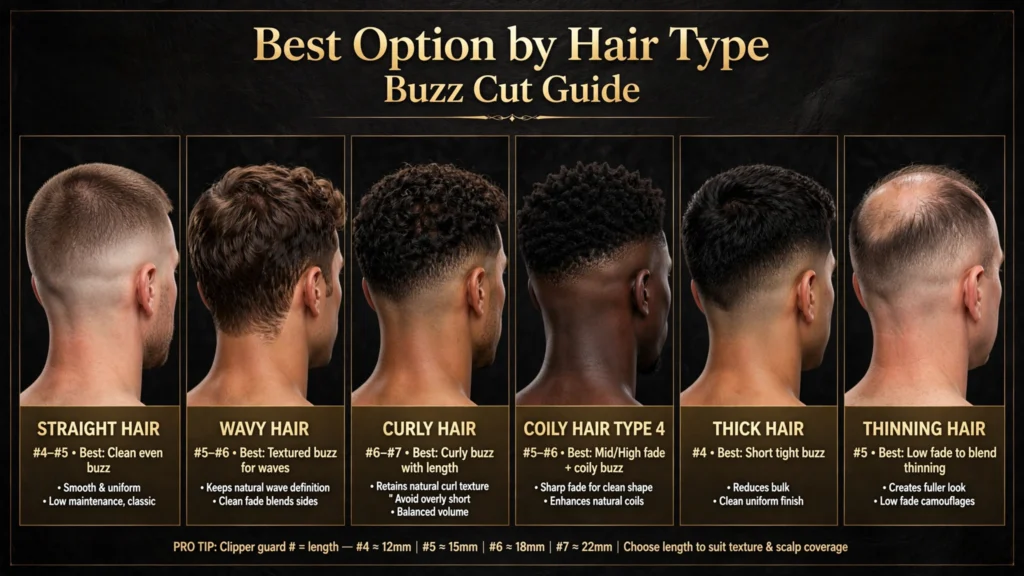
Hair texture changes how this haircut behaves as it grows out, so the “right” guard isn’t the same for everyone.
Straight hair shows the fade line most clearly and holds shape the longest between cuts. A #4 or #5 on top keeps things clean without falling flat.
Wavy hair benefits from a slightly longer top — #5 or #6 — since the wave pattern needs a bit of length to actually show instead of just looking messy.
Curly hair is where this haircut performs best. A #6 or #7 on top lets curls form properly instead of being cut into a tight, undefined puff, while the faded sides keep the shape controlled.
Coily hair (Type 4) holds shape and volume even at shorter lengths, so a #5 or #6 on top with a mid or high fade creates strong, sculptural contrast.
Thick hair can handle shorter top guards (#4) without looking sparse, and the fade removes some of the bulk on the sides that thick hair tends to hold.
Thinning hair or a receding hairline benefits from a slightly longer top (#5) to create the illusion of density, paired with a low fade rather than high or skin — high contrast next to thinning hair draws attention to the thin areas, not away from them.
Best Option by Face Shape
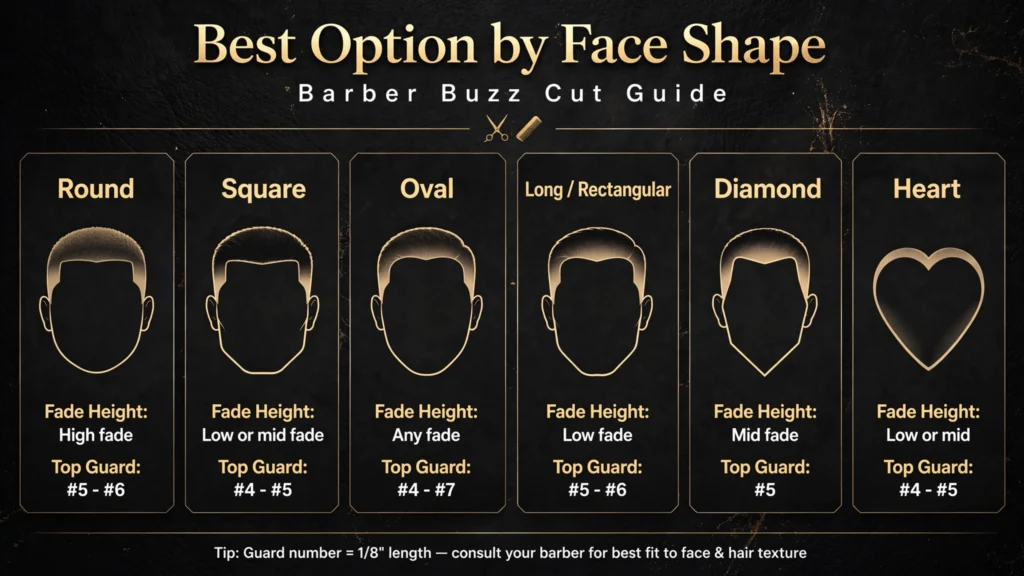
| Face Shape | Fade Height | Top Guard | Why It Works |
| Round | High fade | #5–#6 | Adds vertical length, breaks up width |
| Square | Low or mid fade | #4–#5 | Softens the jawline without competing with it |
| Oval | Any fade height | #4–#7 | Most versatile shape — nearly anything works |
| Long/Rectangular | Low fade (avoid high) | #5–#6 | Keeps proportion balanced, avoids extra height |
| Diamond | Mid fade | #5 | Balances wider cheekbones with tapered sides |
| Heart | Low or mid fade | #4–#5 | Avoids extra top volume that widens the forehead |
Beard Pairing Guide
A well-blended beard finishes the haircut and avoids an awkward gap between hairline and jawline.
- Round face → boxed or slightly angular beard, for jaw definition.
- Square face → shorter, rounded beard, to soften angles.
- Oval face → nearly anything works — short stubble, full beard, or a defined goatee.
- Long face → fuller on the sides, shorter at the chin, to avoid adding length.
- Diamond face → fuller through the jawline, to balance a narrower chin.
In every case, ask for a beard fade — blending the beard into the sideburn area — so the two don’t read as separate grooming decisions.
Image suggestion: front-facing shot showing the sideburn-to-beard blend. Caption: “The beard fade is what makes the haircut look finished, not just short.”
Styling and Maintenance
Products, by guard length:
- Matte clay or paste — for #5 and up, worked into damp hair for a natural, non-shiny finish.
- Texture spray — adds grip and volume for wavy or straight hair at #5–#6.
- Light pomade — subtle sheen for a more polished, professional look.
- Curl cream — for curly/coily hair at #6–#7, applied to damp hair to define curl pattern without weighing it down.
At #4 and below, skip product most days — the length is short enough to hold texture on its own, and product tends to look greasy rather than styled.
Maintenance schedule:
| Guard Length | Barber Visit Frequency | Between-Visit Care |
| #4 | Every 2 weeks | Neckline touch-up at home if you’re comfortable with clippers |
| #5 | Every 2–3 weeks | Light product as hair grows past guard length |
| #6–#7 | Every 3–4 weeks | Trim only the top for shape; leave the fade blend to a barber |
DIY touch-ups: a neckline and sideburn cleanup at home can stretch the gap between professional visits by about a week. Stick to the neckline only — attempting to maintain the fade blend yourself is the fastest way to end up with a visible line instead of a gradient.
Seasonal note: many guys size down a guard or two in summer for comfort and sweat management, then let the top grow slightly longer through fall and winter.
How to Ask Your Barber for a Long Buzz Cut Fade
- State your top guard number — “A #5 on top” beats “medium length.”
- Name your fade height — low, mid, or high, so the barber knows where to start the blend.
- Specify skin or guard on the sides — “skin fade” vs. “faded to a #1” changes the final contrast.
- Mention your hair type — curly or thinning hair changes the ideal guard recommendation.
- Bring a reference photo from a matching angle — front and side together give the clearest picture.
- Ask about beard blending if you have facial hair, in the same appointment.
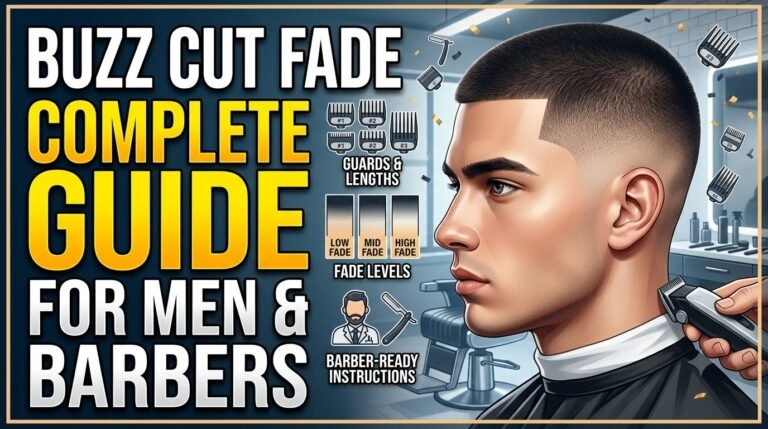
Related: Buzz Cut Fade Haircut: The Complete Guide to Fade Levels, Guards & Barber-Ready Instructions
Common Mistakes to Avoid
- Choosing too short a top guard for curly or coily hair — a #3 on curly hair often reads as a different, undesired texture once dry. Go longer than you think you need.
- Ignoring face shape when picking fade height — a high fade on an already long face shape can exaggerate length rather than balance it.
- Skipping neckline maintenance between cuts — the fade can still look sharp while an overgrown neckline makes the whole cut read as unkempt.
- Vague guard requests — “not too short” produces inconsistent results across visits; specific numbers remove the guesswork.
- Overusing product at short lengths — at #4 and under, heavy product usually looks greasy rather than styled.
- Waiting too long between touch-ups — the fade softens within 2–3 weeks even when the top still looks fine.
How It Compares to Other Popular Cuts
| Haircut | Top Length | Sides | Visit Frequency | Best For |
| Long Buzz Cut Fade | Guard #4–#7 | Faded/tapered | Every 2–3 weeks | Balanced, versatile, most face shapes |
| Buzz Cut Fade | Guard #2–#3 | Faded/tapered | Every 3 weeks | Maximum low-maintenance |
| Crew Cut | Guard #4–#6, slightly longer at front | Short, tapered | Every 3–4 weeks | Classic, professional |
| Ivy League | 1.5–2 in. on top | Short, tapered | Every 4 weeks | Combed styles, formal settings |
| French Crop | 1–1.5 in., textured fringe | Faded | Every 3 weeks | Fashion-forward, fringe-focused looks |
Visual Reference Guide
For anyone building a reference board or showing this article to a barber, here’s how to photograph each variation so it actually communicates the details that matter:
| Cut Variation | Best Angle | What to Look For | Suggested Caption |
| Low fade long buzz | Side profile | Fade start point above the ear | “Subtle contrast, office-appropriate” |
| Mid fade long buzz | 45° angle | Blend zone at the temple | “The balanced, most-requested option” |
| High fade long buzz | Back and side | Fade height relative to the crown | “Maximum contrast for a bolder look” |
| Skin fade long buzz | Close-up on fade zone | Gradient from skin to guarded length | “The sharpest possible fade line” |
| Curly top, mid fade | Top-down and 45° | Curl definition at #6–#7 | “Enough length for curls to actually show” |
| Beard fade pairing | Front-facing | Sideburn-to-beard blend | “Where the haircut and beard meet” |
FAQ
What guard number is a long buzz cut?
Most long buzz cuts use a #4 through #7 guard on top, with shorter guards or a skin fade on the sides for contrast.
Is a long buzz cut fade low maintenance?
Relatively, yes — daily styling is optional, but the fade needs a barber touch-up every 2–3 weeks to stay sharp.
Can I get a long buzz cut fade with curly hair?
Yes — it’s one of the best cuts for curly hair, since a #6–#7 top guard gives curls enough length to show their natural pattern.
What’s the difference between a taper and a fade? A
taper is a shorter, tighter blend close to the hairline and neckline; a fade sweeps further up the side of the head and can go all the way to skin.
Does a long buzz cut fade work for a receding hairline?
Yes — a slightly longer top guard (#5) with a low fade tends to work better than a high or skin fade, which can draw more attention to the receding area.
How long does my hair need to be to start with this cut?
Any length works, since the barber is cutting down to the guard length anyway — even hair that’s currently very long can go straight into a #4–#7 top with a fade.
Can I maintain the fade myself between visits?
You can safely touch up the neckline and sideburns at home. The fade blend itself is difficult to replicate without clipper-over-comb skill, and a botched attempt is harder to fix than simply waiting for your next appointment.
How often do I need it trimmed?
Every 2–3 weeks for the fade to stay defined; the top length can stretch slightly longer between visits if you don’t mind the fade softening.
Bottom Line
The long buzz cut fade earns its popularity honestly: it’s one of the few haircuts that works across hair textures, face shapes, and schedules without demanding a styling routine. The only real commitment is the fade touch-up cadence — get that right, and the cut takes care of the rest. Screenshot the guard number cheat sheet before your next appointment, or save this guide so you have the exact language ready when you sit down in the chair.

Daniel Carter is the Senior Men’s Grooming Editor at FadeBuzzCut, where he specializes in fade buzz cuts, barbering techniques, men’s hairstyles, and evidence-based grooming advice. With more than 12 years of experience researching haircut trends, clipper techniques, face shape recommendations, and hair care, he creates in-depth guides that help readers confidently choose, maintain, and style modern buzz cuts.
Daniel works closely with experienced barbers, grooming professionals, and trusted industry resources to ensure every guide reflects current barbering standards and practical, real-world advice. His editorial approach combines expert research, clear explanations, and user-focused recommendations to make men’s grooming accessible for beginners and experienced enthusiasts alike.
At FadeBuzzCut.com, Daniel oversees editorial quality, content accuracy, and regular updates so readers receive reliable, up-to-date information on fade buzz cuts, beard combinations, hairstyle trends, clipper guard lengths, maintenance routines, and grooming products. Every article is written with a commitment to Experience, Expertise, Authoritativeness, and Trustworthiness (EEAT) while delivering helpful answers for both readers and AI-powered search experiences.
Whether you’re choosing your first fade buzz cut, comparing low, mid, or high fades, or looking for practical maintenance tips, Daniel’s goal is to provide trustworthy guidance that helps you achieve the best possible results.