Curly Fringe Haircuts for Men: 12 Styles, Barber Tips and How to Style Them
A curly fringe puts your curls to work. Instead of pushing hair up and away, the front falls forward onto the forehead in springy, broken pieces that frame your face and give a cut instant personality. Done well, it looks relaxed on purpose. Done badly, it ends up in your eyes by Wednesday.
This guide covers who a curly fringe suits, twelve distinct ways to wear one, the exact words to use at the barber, and how to keep the front looking deliberate between cuts.
What Is a Curly Fringe for Men? (Quick Answer)
A curly fringe is a men’s haircut where the hair at the front hairline is left long enough to fall forward over the forehead, with the natural curl pattern doing the texture work. The sides and back are usually kept shorter (tapered, faded or trimmed neat) so the curls on top become the focal point. Fringe length typically sits somewhere between mid-forehead and the brows.
Will a Curly Fringe Suit You?
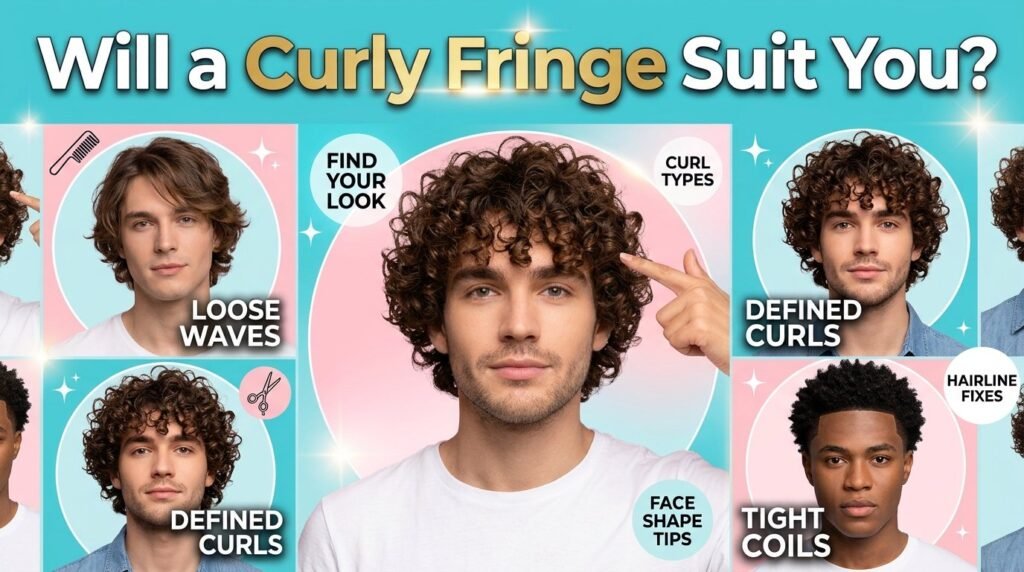
Most curl types can carry a fringe. What changes is how it is cut and how long it needs to be.
Curl type
- Loose waves to soft curls: the fringe falls longer and softer. You can wear it side-swept or parted with little effort.
- Defined springy curls: the classic candidate. The fringe holds a shape and bounces back, so it needs cutting a little longer than the length you want to see.
- Tight curls and coils: the fringe sits shorter and fuller, and looks best with a crisp edge and a clean taper around it.
Hairline and forehead
A fringe is flexible here. A long or high forehead can be balanced by a fuller, lower fringe. A receding or uneven hairline can be softened by bringing curls forward, which is why many men with thinning at the temples choose this style. It will not add hair that is not there, but the right length and direction can make the hairline look less defined.
Face shape
Oval and rectangular faces handle nearly any version. Rounder faces tend to look sharper with height on top and short sides. Square jaws can take a softer, rounder fringe to balance the angles. Treat this as a starting point for conversation with your barber, not a rule.
12 Curly Fringe Styles for Men
Each style below is genuinely different in length, shape or attitude. Pick the one that matches your curl pattern and how much time you want to spend in the morning.
1. The Textured Crop With a Taper
Short, tight and tidy. The top is cut close enough to stay defined, with a gentle taper at the sides. It is the easy choice for tighter curls and busy mornings, and it grows out gracefully.
2. Curly Fringe With a Skin Fade
The contrast option. Skin-short sides and back make the curls on top look fuller. It photographs well and looks sharp, but it needs a tidy-up often because the fade shows regrowth quickly.
3. Curly Fringe With a Low Taper
A softer cousin of the fade. Hair around the ears and neckline is trimmed short but never bare. This one suits offices and anyone who wants a neat finish without a dramatic look.
4. Side-Swept Curly Fringe
The curls are encouraged diagonally across the forehead. The sweep lengthens a rounder face and gives wavy or loosely curled hair a polished direction without heavy product.
5. Curly Curtain Fringe
The front parts in the middle and falls to each side like a curtain. It needs more length than most styles here, usually enough to reach the cheekbones, and works best on loose-to-medium curls that do not spring too high.
6. The Curly French Crop
Short, forward-combed and slightly blunt at the front. It is a good pick for men with strong, tight curls who want a structured fringe rather than a floppy one, and it is among the lowest-fuss options.
7. Blunt Curly Fringe (Edgar-Inspired)
Bold and graphic. The front is cut into a deliberate straight line across the forehead, usually paired with a sharp taper or fade. The look depends entirely on a precise cut, so choose a barber who is comfortable working with curls.
8. Curly Quiff With a Fringe
Volume at the front, swept up and slightly forward so a few curls drop onto the forehead. It suits medium-length curls and rewards a diffuser, but it asks for more styling time than most.
9. The Fluffy Top (Broccoli-Style) Fringe
Round, full and relaxed on top, short on the sides. The fringe is part of an overall soft silhouette instead of a sharp feature. Good for thick hair and for men who like a youthful, casual shape.
10. Curly Shag With a Fringe
Longer and layered all over, with the fringe blending into the rest of the hair. It has a lived-in, creative feel and suits men happy to grow their curls out, as long as they will keep up the shape with trims.
11. Messy Curly Fringe With a Disconnected Undercut
The top stays long and unruly while the sides are clipped short with a clear break between the two lengths. High contrast, low styling effort on the top, and a strong choice if you want your curls to look wild without looking neglected.
12. Coily Fringe With a Sharp Line-Up
For 4-type coils, a short, defined fringe on top with a crisp hairline edge and tapered sides creates clean structure. Twists or a twist-out on the front can add pattern and variety for men who like to change things up.
Related: Fringe Long Buzz Cut Fade: The Complete Guide
How to Ask Your Barber for a Curly Fringe
Curl cuts go wrong when the barber and the client picture different things. A few habits help:
- Bring photos of hair with a curl pattern similar to yours, not straight hair styled to look curly.
- Say how you wear it, for example: “I want the front to fall onto my forehead, with a short taper on the sides.”
- Talk about shrinkage. Curls spring up when they dry, so ask for the fringe to be cut longer than the length you want to see, or to be cut dry or in sections while the curls are dry.
- Name the sides separately: skin fade, low taper, scissor-cut or natural. This is where much of the personality comes from.
- Ask about thinning. If the top is dense, light thinning of the interior can reduce bulk without ruining the curl pattern.
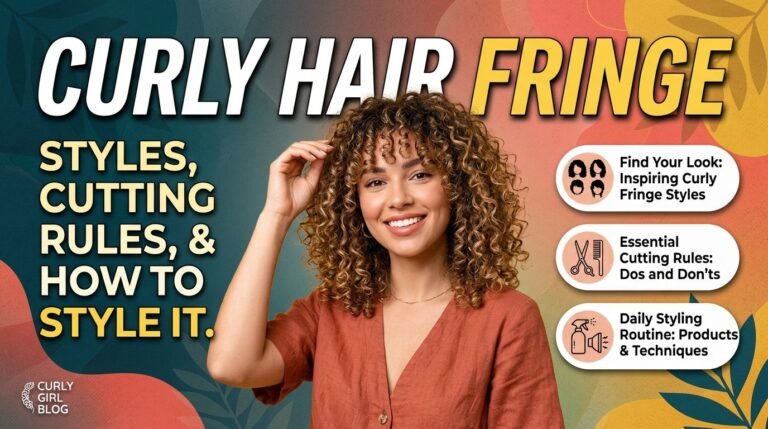
Related: Curly Hair Fringe: Styles, Cutting Rules and How to Style It
How to Style a Curly Fringe
Good styling is mostly about leaving curls alone once you have set them.
- Start with damp, not dripping, hair. Gently squeeze out excess water with a soft towel or old t-shirt rather than rubbing.
- Apply a leave-in or curl cream through the front and top, working it in with your fingers.
- Add a light hold product such as a gel or mousse if your curls tend to loosen or frizz. Choose a stronger hold for tighter shapes and a lighter one for waves.
- Shape the fringe with your fingers while the hair is still wet, directing the front where you want it to fall.
- Dry gently. Use a diffuser on low heat, or air-dry. Avoid touching the hair until it is dry, because touching early is the main cause of frizz.
- Break the cast if needed. If gel leaves the hair stiff, scrunch lightly with dry hands once it has dried for a softer finish.
On lazy days, a spritz of water and a little cream on the front is enough to refresh the fringe without restyling everything.
Maintenance: Trims, Growing Out and Daily Care
- Trim frequency: many barbers suggest every four to six weeks for a fringe with a taper or fade. Longer, layered versions can stretch further.
- Washing: curls usually do better with gentler cleansing and regular conditioning than with daily harsh shampooing. Adjust to your scalp and hair type.
- Sleep: a satin or silk pillowcase can cut down on friction and frizz at the front.
- Growing out a fringe: ask for a trim to keep the shape while the length builds. Pinning back or tucking the front can help through the in-between stage, and a barber can reshape it into a curtain style as it lengthens.
Common Mistakes to Avoid
- Cutting the fringe too short while the hair is wet, then watching it spring up above the forehead.
- Brushing dry curls, which pulls them into frizz. Use fingers or a wide-tooth comb on damp hair.
- Using too much product, which weighs the front down and flattens the curl.
- Skipping the tidy-up of the sides and neckline, which can make a strong fringe look unfinished.
- Choosing a style based on photos of a different curl type.
Frequently Asked Questions
Can men with short curly hair have a fringe?
Yes. Short curls can form a small, textured fringe that sits just above the brows. Tighter curls work well in a cropped, forward-facing shape, though you will need a little more length at the front than you want to see.
What is the best curly fringe haircut for a receding hairline?
A shorter, textured fringe brought slightly forward, with tidy sides, tends to soften the hairline without looking forced. The right option depends on how the hairline recedes, so show your barber the area and ask what direction works best.
How long does hair need to be for a curly fringe?
This depends on curl tightness. Waves need less allowance. Tight curls shrink noticeably, so the front often needs to be about half an inch to an inch longer than the finished look. Your barber can judge this by seeing how your curls behave.
Do curly fringes need a lot of products?
Not necessarily. A leave-in or curl cream is often enough. Add gel or mousse if your curls tend to frizz or drop.
How do I stop my curly fringe from falling in my eyes?
Ask for it to be cut to rest at mid-forehead, use a bit of hold product to direct it, or side-sweep it. If it is already long, pinning it back temporarily works while you decide how to reshape it.
Final Thoughts
The best curly fringe is the one that fits your curl pattern, your hairline and your routine. Start by choosing the sides, since a taper, fade or longer layers change the personality of the cut, then discuss fringe length with a barber who understands curls. With a good cut, a light styling routine and regular tidy-ups, the front of your hair becomes the easiest part of your look to love.

Daniel Carter is the Senior Men’s Grooming Editor at FadeBuzzCut, where he specializes in fade buzz cuts, barbering techniques, men’s hairstyles, and evidence-based grooming advice. With more than 12 years of experience researching haircut trends, clipper techniques, face shape recommendations, and hair care, he creates in-depth guides that help readers confidently choose, maintain, and style modern buzz cuts.
Daniel works closely with experienced barbers, grooming professionals, and trusted industry resources to ensure every guide reflects current barbering standards and practical, real-world advice. His editorial approach combines expert research, clear explanations, and user-focused recommendations to make men’s grooming accessible for beginners and experienced enthusiasts alike.
At FadeBuzzCut.com, Daniel oversees editorial quality, content accuracy, and regular updates so readers receive reliable, up-to-date information on fade buzz cuts, beard combinations, hairstyle trends, clipper guard lengths, maintenance routines, and grooming products. Every article is written with a commitment to Experience, Expertise, Authoritativeness, and Trustworthiness (EEAT) while delivering helpful answers for both readers and AI-powered search experiences.
Whether you’re choosing your first fade buzz cut, comparing low, mid, or high fades, or looking for practical maintenance tips, Daniel’s goal is to provide trustworthy guidance that helps you achieve the best possible results.