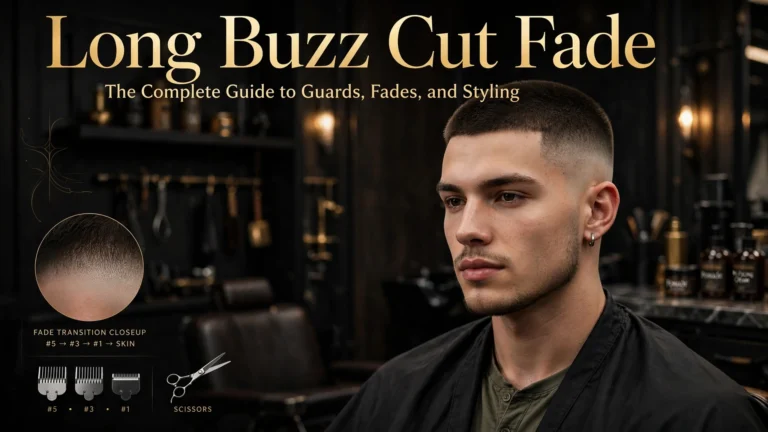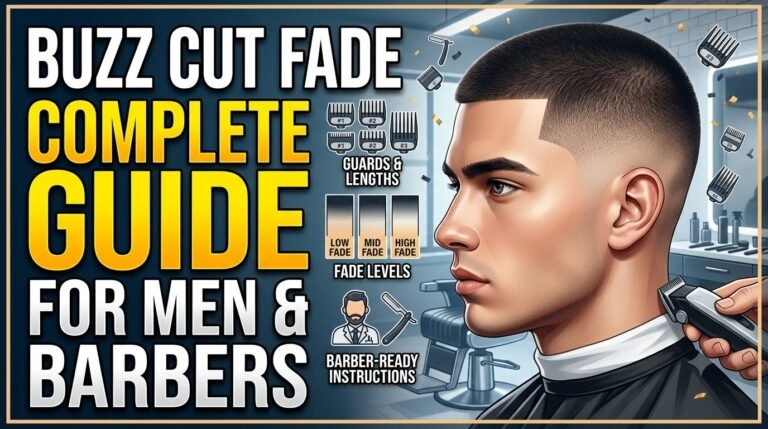
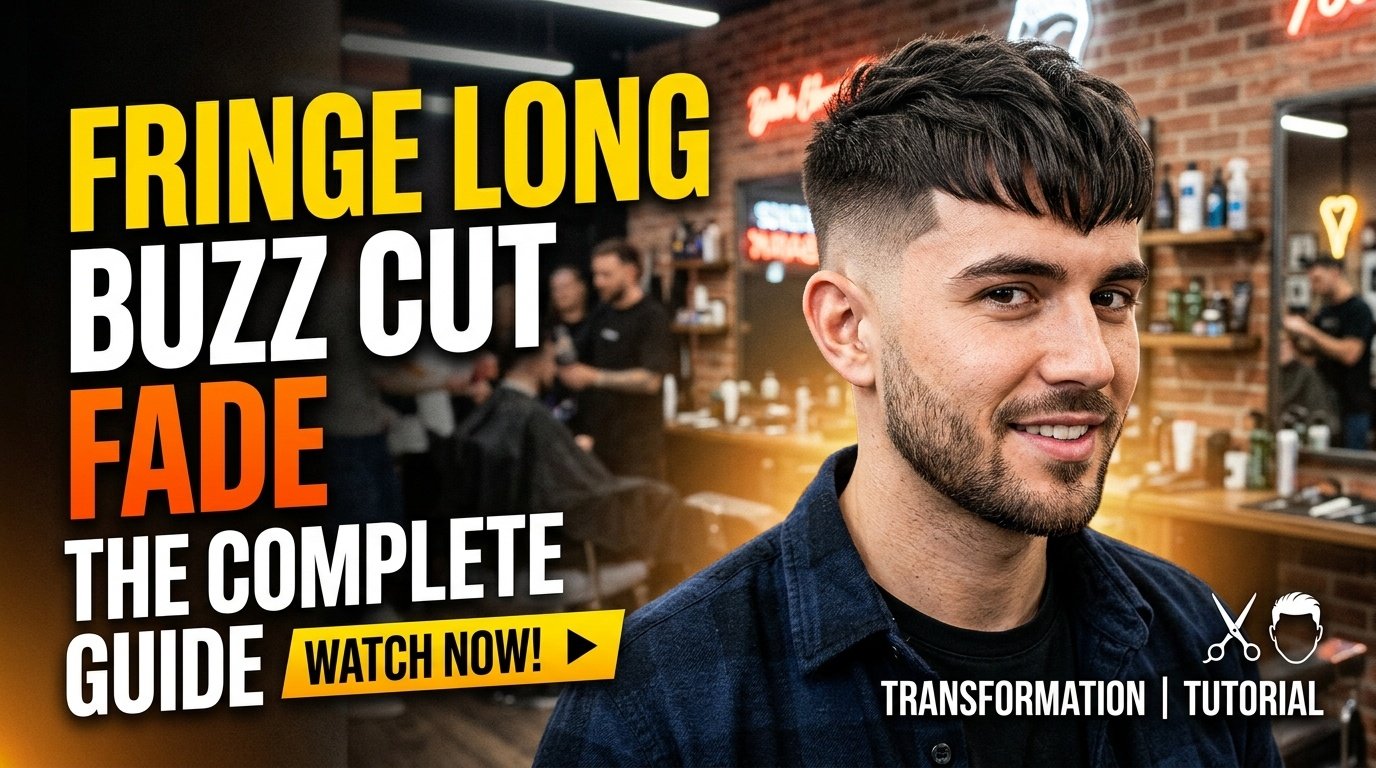
Fringe Long Buzz Cut Fade: The Complete Guide
Last reviewed: 01-09-2026. Reviewed by: Daniel Carter
Quick answer: A fringe long buzz cut fade is a clipper haircut with a longer top (usually a #4–#6 guard), enough front length to form a visible fringe, and a faded side — low, mid, or high. It sits between a classic buzz cut and a short crop, and the exact look depends on four variables: top length, fringe length, fade height, and hair texture.
At a Glance
| Attribute | Typical range |
|---|---|
| Top/guard length | #4–#6 (shorter reads as “buzz,” longer reads as “crop”) |
| Fringe length | Micro to longer — see Fringe Length Guide |
| Fade height | Low, mid, or high — see Fade Guide |
| Best for | Short hair with some front shape, moderate styling effort |
| Maintenance | Fade: every 2–3 weeks to stay sharp. Fringe: reshaped at each cut. |
| Works with | All hair types — texture changes the look, not the eligibility |
| Closely related to | Crew cut, French crop, textured crop, taper |
Quick Finder
| If you want to know… | Go to… |
|---|---|
| What this haircut actually is | Terminology Clarification |
| Whether a buzz cut can even have a fringe | Is It Still a Buzz Cut? |
| How long the top and fringe should be | Top Length & Guard Guide |
| Which fade to pick | Fade Guide |
| Whether it works with your hair | Hair Type Guide |
| How it compares to a crop, crew cut, or taper | Comparisons |
| What to say in the barber’s chair | Barber Communication |
| Different ways to wear it | Style Variations |
| How to keep it looking sharp | Maintenance & Grow-Out |
| Fast, direct answers | FAQs |
Terminology Clarification
- Buzz cut — a clipper-cut style kept short and largely uniform, usually with one guard across the whole head.
- Long buzz cut — the same family, cut with a longer guard (commonly #5–#8), leaving enough length to show texture and shape.
- Fringe — front hair styled or left to fall forward toward the forehead, rather than buzzed flush or brushed back.
- Fade — a graduated shortening on the sides and back, from longer near the top to short or skin-level near the ears and neckline.
Combined, this haircut is a longer buzz on top with enough front length to read as a fringe, finished with a faded side. It’s not one fixed cut — it’s a range, and where you land on that range changes what the barber actually needs to do.
Is a Buzz Cut With a Fringe Still a Buzz Cut?
Quick answer: Yes, up to a point. Past that point, it reads as a crop, not a buzz.
A buzz cut’s identity comes from short, uniform length. A fringe is, by definition, longer front hair styled forward — the two ideas only coexist cleanly at shorter lengths. A #5–#6 top with a slightly forward front still reads as a long buzz with a subtle fringe. Once the front needs product or scissor-texturing to hold shape, most barbers would call it a textured crop, French crop, or clipper crop instead. Neither label is more “correct” — barbershop terminology overlaps — which is why describing exact lengths beats naming a style.
Top Length & Guard Guide
Quick answer: #4–#5 is the most common starting point for a genuine “long buzz with fringe.” Below that, the fringe barely registers; above #6, the cut starts drifting toward a crop.
| Guard | Top appearance | Fringe potential |
|---|---|---|
| #2 | Very short, strongest classic-buzz identity | Minimal to none |
| #3 | Short, slight texture | A bare hint |
| #4 | Enough length for control | Compact, controlled fringe |
| #5 | Common “long buzz” starting point | Visible, still buzz-adjacent |
| #6 | Noticeably longer | Fringe becomes a real focal point |
| #7 | Approaching crop territory | Prominent, usually needs styling |
| #8 | Longest end of the buzz family | Prominent, often needs scissor work to look intentional |
Guard numbers are a starting point for the conversation, not a guarantee — the same number looks different depending on clipper brand, cutting technique, and your natural hair texture.
Related: 12 Guard Buzz Cut: The Complete Length, Look, and Barber Guide
Fringe Length Guide
The fringe is a separate decision from top length, not the same one.
| Fringe type | Description |
|---|---|
| Micro | Very short, close to the hairline; barely reads as a fringe |
| Short | Visible but compact; needs little to no product |
| Textured | Broken up via point-cutting; adds movement |
| Natural | Falls the way the hair naturally grows, minimal styling |
| Longer | Strong crop-like silhouette; usually needs product to hold shape and is the point most likely to get relabeled a “crop” |
Fringe × top length: the fringe can’t be judged alone. Same-length top and fringe blend together with no distinct break. A slightly longer front creates a subtle, controlled fringe without changing the cut’s buzz identity. A noticeably longer front makes the fringe the dominant feature and pushes the cut toward crop territory. This relationship — not the guard number alone — decides whether the result reads as “buzz with fringe” or “crop with faded sides.”
Fade Guide
Quick answer: Low fade = softer, more traditional. Mid fade = balanced contrast. High fade = maximum separation, fringe as the focal point.
| Fade | Where it starts | Effect |
|---|---|---|
| Low | Near the ears | Softer transition, retains side weight, blends the fringe in |
| Mid | Temple area | Balanced contrast without extremes |
| High | Well above the ears | Sharpest contrast, makes the fringe the clear focal point |
Skin fade vs. non-skin fade describes a separate axis — how short the fade finishes, not where it starts. A skin fade tapers to bare skin at its shortest point; a non-skin fade leaves a thin layer even at its shortest. Low/mid/high and skin/non-skin combine independently (e.g., a low skin fade, or a high non-skin fade) depending on how much contrast you want.
Fringe + fade relationship: a higher fade removes side weight, which makes the same top and fringe look fuller and more prominent by contrast. A lower fade keeps more side weight, making the identical fringe look more blended and traditional. The fade height changes how big the fringe looks, even when its actual length doesn’t change.
How It Compares to Similar Haircuts
Fringe Long Buzz Cut Fade vs. French/Fringe Crop
| Feature | Fringe Long Buzz Cut Fade | French/Fringe Crop |
|---|---|---|
| Top | Short, clipper-based | Longer, more shaped/textured |
| Fringe | Short to moderate, controlled | Longer, often the defining feature |
| Sides | Fade | Fade or high-contrast taper |
| Styling | Minimal to moderate | Moderate, usually needs product |
Is It the Same as a Crew Cut?
Quick answer: Not quite. A crew cut has more graduated length front-to-back; a long buzz with fringe is closer to one guard length with the front pushed forward.
Fade vs. Taper — What’s the Actual Difference?
Quick answer: A fade tapers progressively down to near-skin or skin shortness. A taper shortens more selectively — temples, sideburns, neckline — while leaving more length through the rest of the sides, producing a softer overall contrast on the same top and fringe.
Hair Type Guide
| Hair type | Effect at the same length | Barber note |
|---|---|---|
| Straight | Clean, predictable fringe direction, sharpest fringe/fade line | Easiest to read at a glance |
| Wavy | Natural movement, softer edge, looks slightly shorter than measured | Minimal styling usually needed |
| Curly | Visible texture plus shrinkage | Ask for the fringe cut slightly longer than the target visible length |
| Coily | Strong texture, pronounced shrinkage | Discuss target visible length explicitly before cutting |
| Thick | Fuller, denser fringe at the same guard | May need more frequent fade upkeep |
| Fine | More scalp visible, reads as less dense | A lower fade helps retain overall fullness |
No hair type is excluded — the same measurements simply produce different visible results.
Hairline & Face Shape
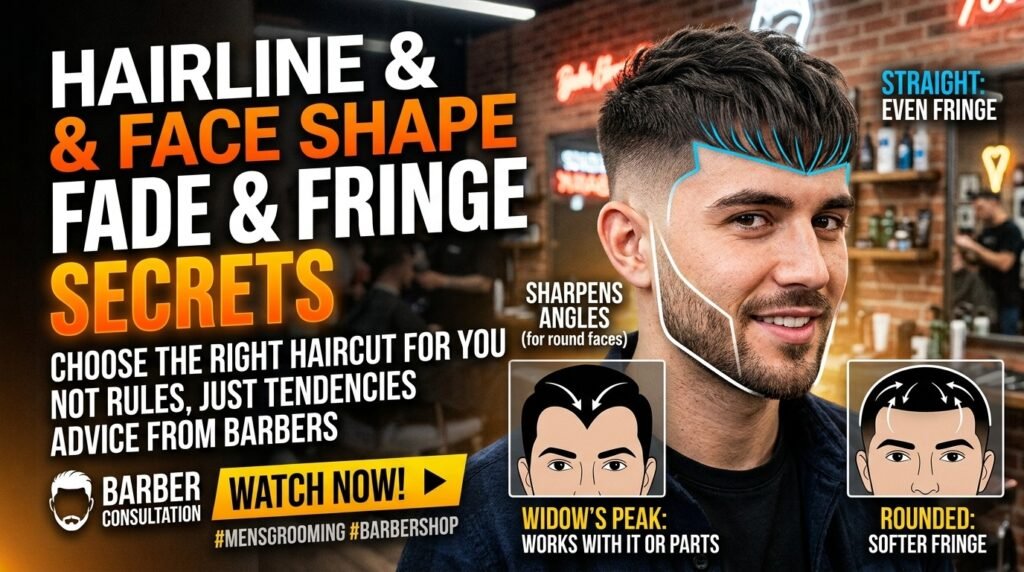
A straight hairline lets the fringe sit evenly; a rounded hairline suits a softer fringe shape; a widow’s peak will often part the fringe unless it’s cut to work with it. The fringe can visually balance an uneven or higher hairline but doesn’t alter it. Face shape works the same way — a shorter, higher-contrast version tends to sharpen angles (useful for rounder faces), while a longer, softer version adds width and softness (useful for narrower faces). These are tendencies to discuss with a barber, not rules that exclude any face shape from the style.
Fringe Shape Options
Straight/blunt (clean, structured line), soft (blended edges), textured (point-cut, broken up), choppy (deliberately uneven), side-directed (swept to one side), and natural forward (minimal shaping). Straight hair holds a blunt line most easily; curly and coily hair generally work better with textured or choppy shaping that follows the curl pattern instead of fighting it.
How to Communicate This Cut to Your Barber
Naming the style (“a long buzz cut with a fringe”) is the least reliable way to get a consistent result. Specifying top length + fringe length + fade height + finish in one sentence works better:
- Minimal: “A longer buzz on top with enough front length for a short fringe, and a low fade on the sides.”
- Specific: “Keep the top longer than a standard buzz, leave enough front length for a textured fringe, and fade the sides gradually without going too high.”
- High-contrast: “A longer clipper-cut top and front, with a high fade so the fringe stands out.”
Checklist to cover before the clippers start: top guard/length, fringe length (separate from top), fringe shape, fade height, fade finish (skin vs. non-skin), hairline/sideburn treatment, neckline, natural vs. styled finish, how much length to bank for future cuts.
On reference photos: useful, but a barber still has to translate a 2D image into an actual cut — it won’t communicate everything alone. Bring a front view, a side profile, and ideally a three-quarter view, and check that the model’s hair texture resembles yours before assuming the result will match exactly.
15 Style Variations
| # | Variation | Top | Fringe | Sides | Effect |
|---|---|---|---|---|---|
| 1 | Classic soft | Long | Natural | Low fade | Softest, most traditional-leaning |
| 2 | Balanced | Long | Textured | Mid fade | Visible contrast + front texture |
| 3 | High contrast | Long | Sharp | High fade | Fringe as clear focal point |
| 4 | Casual taper | Long | Soft | Taper | Gentler transition, casual look |
| 5 | Longer top, short front | Longer | Short | Any | More overall length, compact front |
| 6 | Longer top, long front | Longer | Longer | Fade | Closest to crop territory |
| 7 | Structured | Long | Blunt | Low fade | Defined line, subtle sides |
| 8 | Undone | Long | Choppy | Mid fade | Casual front, clear side definition |
| 9 | Natural movement | Long | Wavy | Low fade | Soft, low-effort |
| 10 | Curl-forward | Long | Curly | Taper | Leans into natural texture |
| 11 | Density balance | Long | Thick | High fade | Uses contrast to balance fullness |
| 12 | Fullness boost | Long | Fine | Low fade | Retains side weight |
| 13 | Clean line | Long | Straight | Mid fade | Defined front, balanced sides |
| 14 | Textured undone | Long | Messy | Low fade | Deliberately relaxed front |
| 15 | Minimalist | Long | Subtle | Any | Closest to a classic buzz |
Maintenance & Grow-Out
Two separate things: haircut maintenance (keeping the fade sharp, top consistent, fringe shaped — barber-dependent) and styling maintenance (day-to-day upkeep, driven by fringe length and texture — a short natural fringe needs little to no product; a longer, defined one usually needs at least a light hold product). There’s no universal trim schedule, but a skin-close fade shows grow-out sooner than a softer taper because the starting contrast is more extreme.
Grow-out progression: fresh cut (sharp fade, controlled fringe) → early grow-out (fade line softens, sides gain weight) → mid grow-out (top/fringe become more dominant) → longer grow-out (the cut drifts toward a crew cut, textured crop, French crop, or a longer tapered style). Planning for this means the first haircut isn’t the only decision point.
Common Mistakes
- Asking for “a long buzz” without a specific length or guard.
- Not separating fringe length from top length in the request.
- Picking a fade height without considering how it interacts with the top.
- Cutting the fringe too short to adjust later.
- Ignoring shrinkage on curly/coily hair when discussing target length.
- Bringing a reference photo without accounting for hair-type differences.
- Assuming every barber interprets “buzz cut” identically.
- Taking the fade higher than intended when a blended look was actually wanted.
- Not planning for the grow-out phase between visits.
- Treating fringe length and top length as one decision instead of two.
Who Should — and Shouldn’t — Get This Cut
Good fit if you want: short overall length with some front shape and texture, moderate-to-low daily styling, strong side contrast, and a fringe without committing to a fully long hairstyle.
Consider an alternative if you want: completely uniform length with zero fringe, the lowest possible daily maintenance from a fully uniform buzz, a long fringe with real styling flexibility, or minimal contrast between top and sides.
Pros and Cons
| Pros | Cons |
|---|---|
| Overall length stays short | Needs more precise communication than a plain buzz |
| Strong, deliberate side definition | Fade visibly softens between cuts |
| Fringe adds shape without a full crop commitment | Fringe needs intentional length — won’t happen by accident |
| Multiple fade options control contrast | Hair texture noticeably changes the outcome at identical measurements |
| Adaptable across hair textures | Terminology overlaps with other cuts, risking miscommunication |
| Generally easy to style day-to-day | May need more frequent visits than a uniform buzz to keep the fade sharp |
FAQs
What is a fringe long buzz cut fade? A clipper cut with the top and front long enough for a visible fringe, and the sides faded from longer to short or skin-level.
Can a buzz cut have a fringe? Yes, at shorter lengths. Past a certain front length, it reads as a crop rather than a buzz.
How long should the top be for a visible fringe? A #4–#6 guard is the common starting range; the exact length depends on desired fringe prominence and hair texture.
Is a long buzz cut the same as a crew cut? No — a crew cut has more graduated length front-to-back; this cut is closer to one length with the front pushed forward.
What’s the best fade for a long buzz cut? There’s no universal best: low fades look softer, high fades maximize contrast, mid fades balance the two.
Can you get a fringe with a high fade? Yes — a high fade actually makes the fringe look more prominent by removing side weight.
Does curly hair work with this cut? Yes, but shrinkage means the visible fringe is often shorter than the cut length — flag this with your barber in advance.
How do I ask my barber for this cut? State top length, fringe length, fade height, and finish in one sentence rather than using a style name alone.
How often does the fade need trimming? Varies by fade height and hair growth rate; skin-close fades generally need more frequent upkeep than soft tapers.
What does it grow into? The fade softens first, then the fringe becomes dominant, and the cut often drifts toward a crew cut, crop, or longer tapered style.
Key Takeaways
- This isn’t one fixed haircut — it’s four adjustable variables: top length, fringe length, fade height, and hair texture.
- A #4–#6 guard is the most common starting point for a genuine long buzz with a visible fringe.
- Fade height changes how prominent the fringe looks, independent of its actual length.
- Hair texture changes the visible result at identical measurements — curly and coily hair need a shrinkage conversation with the barber.
- The most useful thing to bring to an appointment is a specific description of top length, fringe length, fade height, and finish — not just the style’s name.

Daniel Carter is the Senior Men’s Grooming Editor at FadeBuzzCut, where he specializes in fade buzz cuts, barbering techniques, men’s hairstyles, and evidence-based grooming advice. With more than 12 years of experience researching haircut trends, clipper techniques, face shape recommendations, and hair care, he creates in-depth guides that help readers confidently choose, maintain, and style modern buzz cuts.
Daniel works closely with experienced barbers, grooming professionals, and trusted industry resources to ensure every guide reflects current barbering standards and practical, real-world advice. His editorial approach combines expert research, clear explanations, and user-focused recommendations to make men’s grooming accessible for beginners and experienced enthusiasts alike.
At FadeBuzzCut.com, Daniel oversees editorial quality, content accuracy, and regular updates so readers receive reliable, up-to-date information on fade buzz cuts, beard combinations, hairstyle trends, clipper guard lengths, maintenance routines, and grooming products. Every article is written with a commitment to Experience, Expertise, Authoritativeness, and Trustworthiness (EEAT) while delivering helpful answers for both readers and AI-powered search experiences.
Whether you’re choosing your first fade buzz cut, comparing low, mid, or high fades, or looking for practical maintenance tips, Daniel’s goal is to provide trustworthy guidance that helps you achieve the best possible results.