Bangs on Curly Hair: Which Styles Work, How to Get the Cut Right, and How to Live With Them
People with straight hair can walk out of a salon with new bangs and barely think about them again. Curls make the decision feel heavier, and for good reason. Bangs are the shortest, most visible part of any cut, and curly hair doesn’t stay where you put it. It springs, clumps, and changes length as it dries.
The good news is that curly bangs can look wonderful, and your texture often works in your favor. The gap between the photo you saved and the result you got usually comes down to four decisions made before the first snip: which shape, how long, how it’s cut, and who cuts it. This guide walks through each one, then covers styling, upkeep, and what to do if you change your mind.
Quick Answer: Can You Get Bangs With Curly Hair?
Yes. Every curl pattern can wear bangs. What changes is the shape you choose, the length you leave, and the technique your stylist uses. Ask for a cut on dry, styled curls from someone who regularly cuts curly hair, and start longer than you think you want. You can always trim more, but you can’t add length back.
Why Curly Bangs Behave Differently
Understanding a few quirks of curly hair explains most bang disasters, and most fixes.
- Shrinkage (spring). Wet or stretched curls look much longer than they end up once dry. The tighter the pattern, the bigger the change. Bangs cut to “eyebrow length” on wet hair can land well above the brow.
- Curls are three-dimensional. Each curl clump has its own spring and its own personality. A ruler-straight line that looks sleek on straight hair often turns bulky or shelf-like on curls.
- Volume goes out, not just down. Short front sections tend to puff outward, especially in humidity, so the shape you cut has to allow for width as well as length.
- Cowlicks wake up. Many people have a swirl or growth quirk at the front hairline. The weight of long hair usually keeps it flat. Shorten the front into bangs and that weight disappears.
- Forehead oil reaches the bangs. They sit against your skin all day, so they get greasy or limp sooner than the rest of your hair.
Related: Hairstyles for People With Bangs: What Works With Each Type of Fringe
The Best Types of Bangs for Curly Hair
No single style is “the” answer. These are the ones curl-savvy stylists work with most, roughly from most forgiving to least.
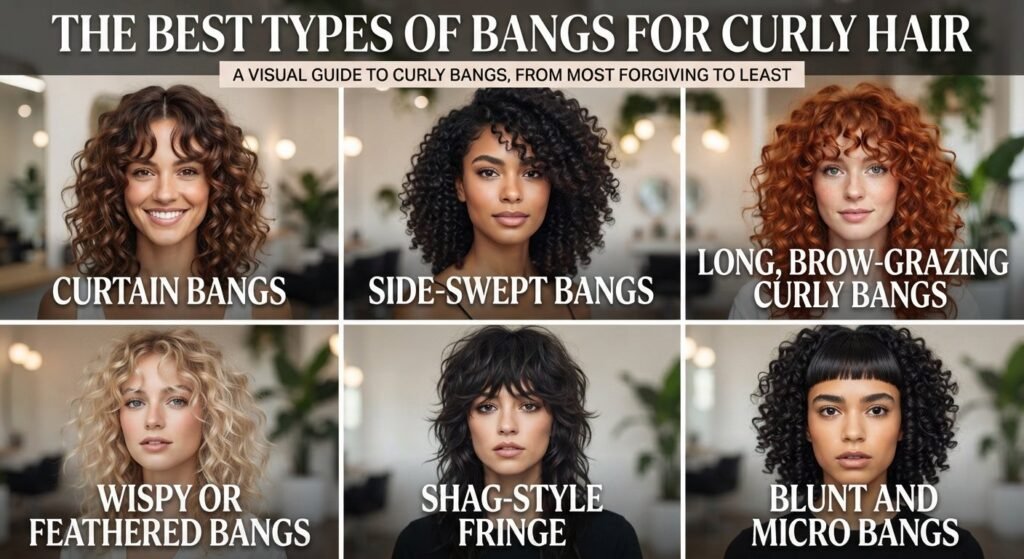
Curtain Bangs
Curtain bangs part in the middle and sweep to each side, shorter at the center and longer at the edges, so they melt into face-framing layers. They’re usually the easiest entry point for curls because they’re easy to grow out, easy to pin back, and flattering on a wide range of faces. They also work on short curly hair; keeping the center shorter and the edges longer helps them sit naturally.
The trade-off: a soft, undone look is simple, but a smooth, blown-out look usually takes diffusing or heat, and some stylists estimate 15 to 20 minutes of blow-drying for it on curly hair.
Side-Swept Bangs
These start from a side part and angle across the forehead. They’re flexible (sweep them, pin them, twist them back) and tend to be practical on tighter textures, since the angle softens the line and hides the awkward stage as they grow. They’re a little less dramatic than other styles and usually need a quick restyle each day.
Long, Brow-Grazing Curly Bangs
This is the “curly fringe” in its most natural form: bangs cut curl by curl so they land at the brow or just below it when dry. Many stylists treat this as the sweet spot for most curl patterns, since it’s long enough to leave room for spring. It frames the eyes, looks like your hair rather than a separate cut, and needs a daily refresh to keep the curls clumped.
Wispy or Feathered Bangs
A lighter, tapered section of curls that gets thinner toward the ends. This works for people who like an airy look. Because the section is thin, it can look see-through once the curls dry and frizz a little, so ask your stylist to leave enough density to read as bangs.
Shag-Style Fringe
Here the bangs are part of an overall layered shape, short toward the center and flowing into the layers around them. Names like “bottleneck bangs” or “curly shag fringe” mean slightly different things to different stylists, so don’t rely on the label. Bring a photo and describe where you want the shortest point to be.
Blunt and Micro Bangs
Straight-across or very short bangs leave the least room for error on curly hair. Shrinkage is unpredictable, a blunt line can turn bulky, and they’re the hardest to grow out. That said, a precise, graphic fringe can look striking on tighter coils when the stylist truly knows the texture. If this is the look you want, choose your stylist even more carefully, and know you’re choosing the high-maintenance, high-reward option.
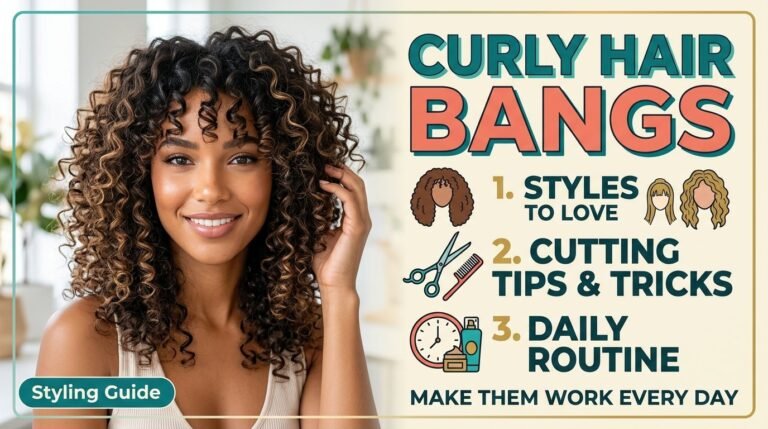
Related: Curly Hair Bangs: Styles, Cutting Tips, and How to Make Them Work Every Day
Which Bangs Suit Your Curl Pattern?
Treat these as starting points rather than rules. Strand thickness, density, and how your curls clump matter as much as the number on a curl chart.
- Waves (2A–2C): Little shrinkage, so you have the most flexibility. Bangs may fall softly on their own, but need light definition or a bit of smoothing if you want them tidy.
- Loose to medium curls (3A–3B): Curtain bangs and brow-grazing fringes both work well. Watch for spring, and leave extra length.
- Tight curls and coils (3C–4C): Expect significant shrinkage, so leave generous length. Curtain, side-swept, and curly fringes tend to be the most practical. Keep heavy butters and thick oils off the front, since they can weigh bangs down or make them look greasy fast.
Check These Before You Book
Your hairline and cowlicks. Pull your hair back when it’s dry and look at where the front grows. Note any swirl, any spot where your hair naturally parts, and how high your forehead is. A cowlick isn’t a dealbreaker. Cutting bangs slightly longer and heavier can keep it down, and some stylists cut to use the lift. One celebrity stylist’s trick for stubborn cowlicks is running a clean mascara wand through that piece while blow-drying.
Face shape, loosely. Stylists use it to decide where bangs begin and how wide they sweep. Curtain bangs suit nearly all shapes. Instead of memorizing rules, ask your stylist to hold up a section and show you the options on your own face.
Your routine. Will you diffuse daily, or do you want wash-and-go? Do you wear glasses? Do you often tie your hair up? A low-effort routine pairs best with curtain or side-swept bangs.
Your edges. If your front hairline is thin or you’re protecting your edges, mention it. Tension from tight clips or headbands is worth watching.
Related: Curly Hair With Straight Bangs: 15 Hairstyles and How to Make the Look Work
How to Get the Cut Right
Find a Stylist Who Actually Cuts Curls
This matters more than any product or technique. Look at portfolios for curl patterns like yours, ask friends with similar texture for names, or search for curl specialists in your area. Book a consultation first if you can.
Ask for a Dry Cut on Styled Curls
Most curl-focused stylists cut bangs dry, because it shows exactly where each curl falls, and wet hair stretches too much to judge the length. A fresh style on the day of the cut shows your curls at their curliest. Some stylists use a hybrid approach, and that’s fine; what counts is that the final length is judged on dry, styled hair.
Some red flags: starting with a spray bottle, combing the hair out with a fine-tooth comb first, or pulling curls straight and taut to cut across them.
What to Say in the Chair
- “I want them to land at my brow when dry, so please start longer.”
- “Cut them curl by curl instead of in a straight line.”
- “I have a cowlick right here. How do you want to handle it?”
- “Can you blend them into face-framing layers?”
- “What will this look like in three months, as it grows out?”
Bring two photos: one of bangs on a curl pattern similar to yours, and one showing how that style looks grown out.
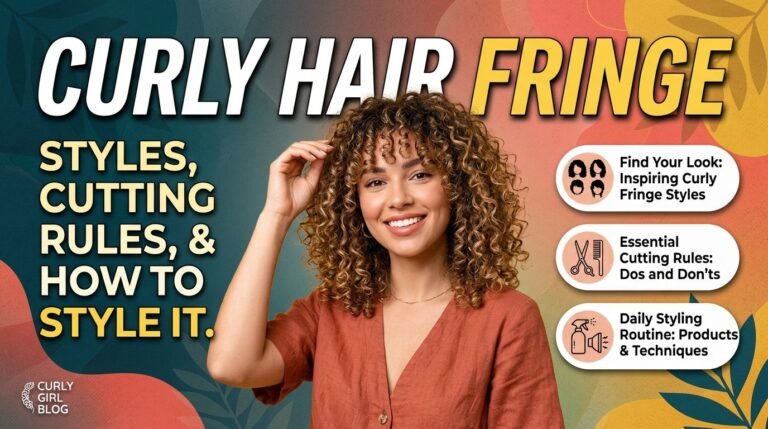
Related: Curly Hair Fringe: Styles, Cutting Rules and How to Style It
Think About the Rest of the Haircut
Bangs sitting on top of one-length hair can leave a visible ledge across the forehead. Curl experts often recommend face-framing layers so the fringe blends into the rest of the cut. Ask whether your current layers support the bangs you want.
Can You Cut Them Yourself?
Professionals strongly advise against blunt DIY bangs on curly hair, since mistakes show immediately. If you can’t resist, curtain bangs are the lowest-risk shape. Cut only when dry, on hair styled as usual, one curl at a time, in tiny amounts. Stop well before you think you should.
How to Style Curly Bangs Day to Day
- Start with wet, hydrated bangs. Wash them more often than the rest of your hair if forehead oil weighs them down. Many curly people wash less often elsewhere, but bangs usually need more attention.
- Use a small amount of lightweight product. A fingertip of leave-in or lotion applied to wet bangs forms the curl pattern better than product added after they dry. Heavier creams and butters belong farther back.
- Shape while wet. Part them, coil them around a finger, or scrunch them into place. This sets the direction.
- Dry gently. If you diffuse, hover over the bangs first to set the curl before you lift the roots. Or air-dry. Either way, don’t touch until fully dry, because that’s how frizz happens.
- Smooth them if you prefer. Some curly people blow out or flat-iron their bangs for a sleeker look. A mini flat iron or curling wand is also handy for fixing a stray curl.
- Refresh instead of re-wetting everything. A light mist of water and a dab of product can bring a collapsed curl back. A clip pinned behind the bangs keeps them front and center when the rest of your hair is pulled up.
At night: A tight bonnet can flatten bangs. Try a silk scarf tied loosely around the perimeter, leaving the bangs free.
Common Mistakes With Curly Bangs
- Cutting them wet, then being shocked by the dry length.
- Asking for the exact length in the photo instead of leaving room for shrinkage.
- Cutting a perfectly straight line across curls.
- Loading the front with heavy product.
- Brushing or touching them while they dry.
- Choosing a stylist based on a straight-hair portfolio.
- Skipping trims until they block your eyes.
How Often to Trim Curly Bangs
Most stylists suggest a small trim every four to six weeks, and shorter or blunter styles may need it sooner. Quick trims at the salon are often free or cheap, so ask. Regular trims keep the shape clean and prevent the in-between stage where the bangs stick out or poke your eyes.
Growing Out Curly Bangs
Plan for roughly three to six months before they can be pinned back or blended in. The good news is that curly texture helps. There’s so much movement that a growing fringe is less noticeable than it would be on straight hair.
- Ask your stylist for a few invisible layers around the forehead to ease the transition.
- Pin longer bangs back with a small clip while damp so they dry in place.
- Switch to a deep side part to sweep them into the rest of your hair.
- Go half-up or add a headband for the in-between weeks.
- Keep trimming the ends to avoid splits.
Are Curly Bangs Right for You?
Bangs tend to work well if:
- You enjoy styling your hair, or can live with a quick daily refresh.
- You’ve found (or can find) a stylist who knows curls.
- You’re happy with a rougher, more textured fringe.
It may be worth waiting if:
- You want zero daily effort.
- You have a strong cowlick and don’t want to work with it.
- You’re not ready for a possible three-to-six-month growing-out phase.
Still unsure? Ask your stylist for a trial run: a longer face-framing layer that you can pin back, or curtain bangs that start long.
FAQs About Bangs on Curly Hair
Do bangs look good on curly hair?
They can look great. Curly texture adds volume and movement, and the best results come from the right style for your pattern and a stylist who understands curls.
Should curly bangs be cut wet or dry?
Dry is the safer choice for most people. It shows the true length and shape, so shrinkage doesn’t surprise you later.
How short is too short for curly bangs?
Very short bangs above the eyebrows are riskier because shrinkage is hard to predict. Brow-length or just below the brow is the safest range for most curl patterns.
Do curtain bangs work on short curly hair?
Yes. Keeping the center shorter and the edges longer helps them sit naturally.
Can you get bangs with 4C hair?
Yes. Leave extra length for shrinkage, consider side-swept or longer curtain shapes for easier upkeep, and pick a stylist who has experience with coily textures.
Do I have to straighten curly bangs?
No. Many people wear them natural and defined. Smoothing them is a style choice, not a requirement.
The Bottom Line
Curly bangs aren’t a gamble when you plan them. Choose a shape that suits your curl pattern, find a stylist who cuts curls dry, leave extra length, and give yourself time to learn how your front curls like to behave. If they don’t work out, the grow-out is manageable, and you’ll know exactly what to ask for next time.

Daniel Carter is the Senior Men’s Grooming Editor at FadeBuzzCut, where he specializes in fade buzz cuts, barbering techniques, men’s hairstyles, and evidence-based grooming advice. With more than 12 years of experience researching haircut trends, clipper techniques, face shape recommendations, and hair care, he creates in-depth guides that help readers confidently choose, maintain, and style modern buzz cuts.
Daniel works closely with experienced barbers, grooming professionals, and trusted industry resources to ensure every guide reflects current barbering standards and practical, real-world advice. His editorial approach combines expert research, clear explanations, and user-focused recommendations to make men’s grooming accessible for beginners and experienced enthusiasts alike.
At FadeBuzzCut.com, Daniel oversees editorial quality, content accuracy, and regular updates so readers receive reliable, up-to-date information on fade buzz cuts, beard combinations, hairstyle trends, clipper guard lengths, maintenance routines, and grooming products. Every article is written with a commitment to Experience, Expertise, Authoritativeness, and Trustworthiness (EEAT) while delivering helpful answers for both readers and AI-powered search experiences.
Whether you’re choosing your first fade buzz cut, comparing low, mid, or high fades, or looking for practical maintenance tips, Daniel’s goal is to provide trustworthy guidance that helps you achieve the best possible results.