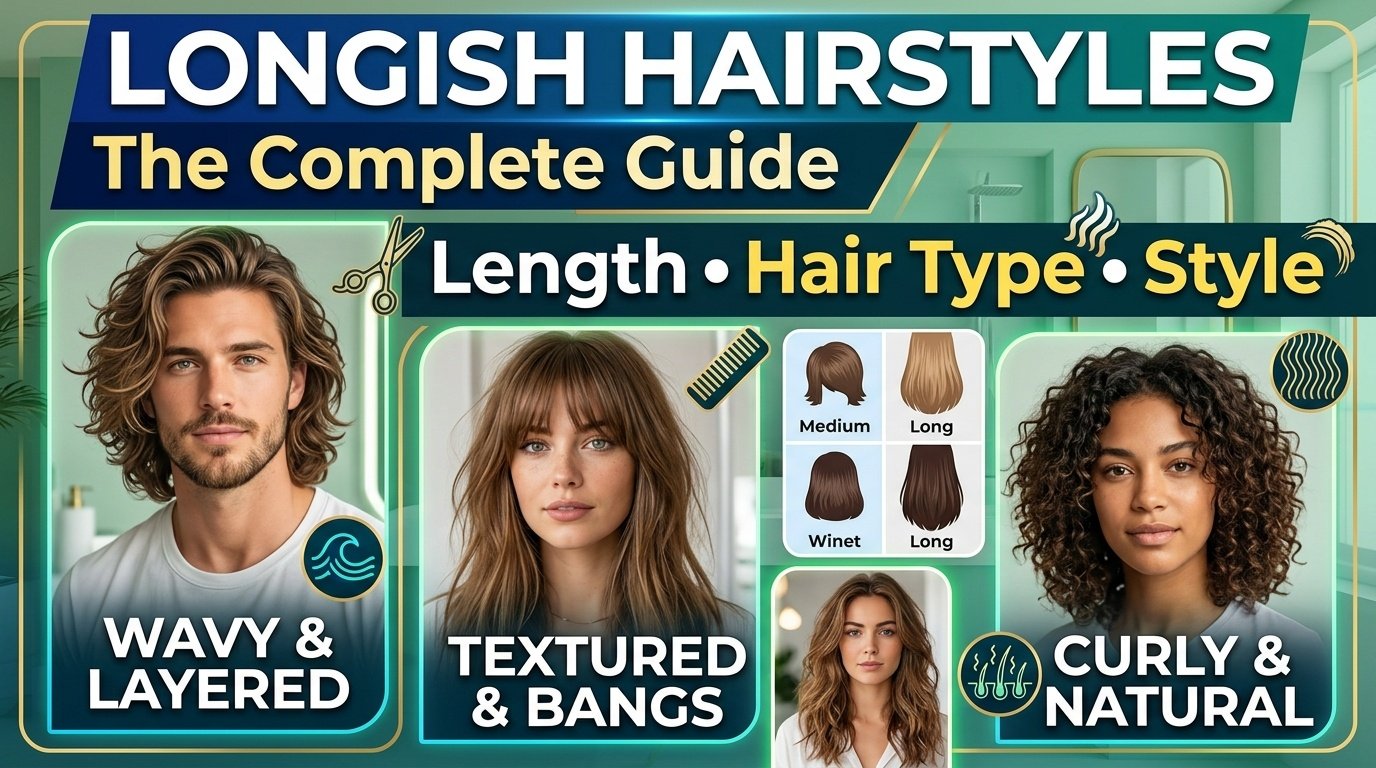
Longish Hairstyles: The Complete Guide to Length, Hair Type, and Style
Last reviewed: September 2026
How this guide was built: This article was developed by mapping the current top-ranking pages for “longish hairstyles” and its variants, identifying what they consistently leave unexplained, and structuring the content around those gaps — a working length framework, hair-type-specific guidance, and grow-out mechanics — rather than around another photo gallery. Where a claim depends on individual hair behavior (shrinkage, growth rate, styling time), it’s stated as a general tendency, not a guarantee, because individual results vary by strand.
Quick Answer
Longish hair is the zone between medium and long — roughly collarbone to a few inches past the shoulders — with no fixed inch measurement. What it looks like on you depends more on your texture, density, and shrinkage than on length alone: the same cut can read as “long” on fine, straight hair and merely “longish” on thick, curly hair.
Jump to: The Length Spectrum · 20 Styles by Hair Type · Maintenance Reality · Grow-Out Guide · FAQ
What Does “Longish Hair” Mean?
Longish hair describes hair that’s grown past a short or medium cut but hasn’t reached clearly “long” territory — commonly collarbone to a few inches past the shoulders. There’s no professional or industry-standard ruler measurement for it, because the same length reads differently depending on texture, curl pattern, density, and cutting technique.
That ambiguity is the point of the word. People searching “longish hairstyles” want more length and movement than a short or medium cut gives them, without committing to floor-grazing hair. It’s a feeling — noticeably longer, still manageable — more than a number.
Four variables move the goalposts on what “longish” actually looks like:
- Texture — straight hair shows every inch; curl patterns visually hide it.
- Density and thickness — thin, fine hair looks shorter and wispier than thick hair at the identical length.
- Shrinkage — curly and coily hair can visually “lose” several inches compared to its stretched length.
- Layering technique — heavy layers or a graduated shape change the visible endpoint even when the longest pieces are cut to the same length.
The Length Spectrum
Length works better as a spectrum with soft, overlapping zones than as a hard cutoff:
| Zone | Rough landmark | Feel |
|---|---|---|
| Short | Above the ears to chin | Cropped, structured |
| Longer short | Chin to jaw | Some movement, still compact |
| Medium | Jaw to collarbone | Balanced, flexible |
| Longish / medium-long | Collarbone to mid-shoulder-blade | Noticeable length and movement, not yet “long” |
| Long | Past the shoulder blades | Maximum length and styling range |
These are practical, visual bands, not a classification a stylist will measure you against. Use them to get oriented, then let texture and goals — not the table — decide where you land.
Why the Same Length Looks Different on Different Hair
This is the variable most hairstyle roundups skip entirely, and it matters more than any style name.
Straight hair shows length almost exactly as cut — if the ends sit at your collarbone, that’s where they’ll visually sit every day.
Wavy hair pulls up slightly with the wave pattern, so it can read a touch shorter than the same measured length in straight hair once it dries and the wave sets.
Curly hair shrinks, sometimes dramatically. A defined curl pattern can pull hair up several inches from its stretched length, so hair that measures “longish” wet or straightened may look closer to medium once it dries naturally.
Coily hair shows the most shrinkage of any texture. The same strand length can look drastically different styled in its natural state versus stretched, twisted out, or blown out.
Practical takeaway: if you have a curl or coil pattern and you’re chasing a specific “longish” look from a photo, ask your stylist to discuss length in its stretched state and talk through what it will look like once it springs back to its natural shape.
Related Terms You’ll Encounter
“Longish” overlaps with several named haircuts and trend terms you’ll see while researching this length. They aren’t synonyms — they’re specific structures that often land in the longish range:
- Lob (long bob) — a blunt or lightly layered cut usually sitting at the shorter end of longish, around collarbone.
- Clavicut — a cut ending precisely at the collarbone, a common landmark for the start of the longish zone.
- Butterfly cut — heavy, face-framing layers cut around the mid-lengths and ends; a specific layered structure, not a length.
- Wolf cut / shag — choppy, textured layering with volume at the crown; the shag-inspired family described below.
- Hush cut — a softer, more blended version of the wolf cut with less aggressive layering.
- Curtain bangs / XL curtain bangs — a face-framing fringe split down the middle; works at any base length, including longish.
- Taper / undercut — short sides and back with longer length on top; the primary structure behind most men’s “longish” results.
Knowing these names helps you communicate more precisely than “longish” alone, both to a search engine and to a stylist.
Haircut vs. Hairstyle: A Distinction Worth Knowing
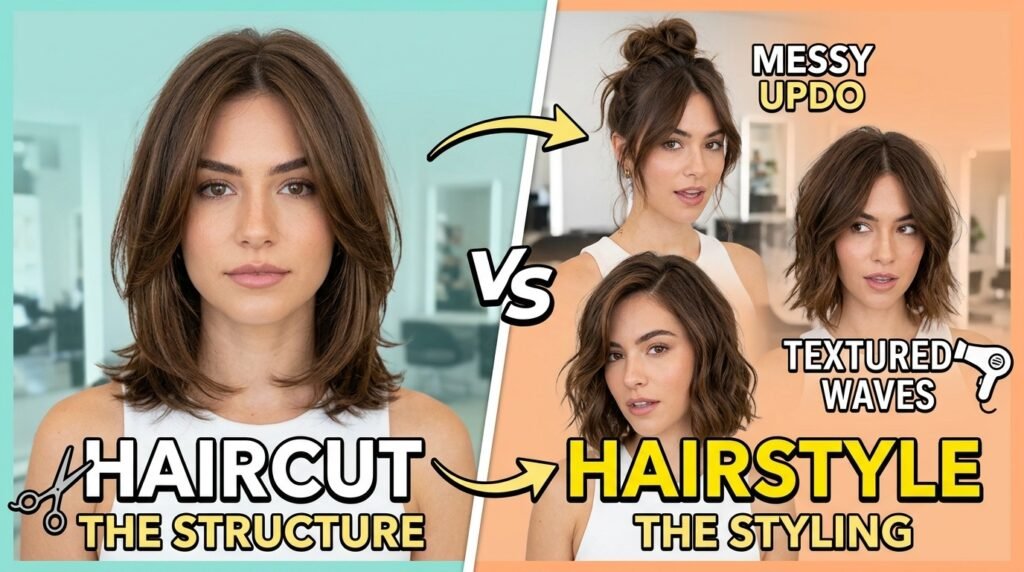
A haircut is the underlying structure — where it’s cut, how it’s layered, where the weight lives. A hairstyle is how that haircut is worn on a given day — parted, blown out, air-dried, tucked back, textured.
One longish layered haircut can become several different hairstyles depending on:
- Where you part it (middle, deep side, no part)
- Whether you dry it smooth or let natural texture show
- Whether front pieces are pushed back, tucked, or left to frame the face
- How much volume you build at the root
This matters because a photo you love might be one styling choice applied to a haircut that’s structurally very different from what you’re picturing.
Longish vs. Medium vs. Long
| Medium | Longish | Long | |
|---|---|---|---|
| Visible length | Jaw to collarbone | Collarbone to mid-back | Past shoulder blades |
| Movement | Moderate | More pronounced | Most pronounced |
| Styling range | Good, limited updos | Broader — low ponytails, half-ups, simple braids | Widest — full updos, elaborate braiding |
| Grow-out visibility | Manageable | More noticeable as shape shifts | Least noticeable relative to total length |
| Typical upkeep | Moderate trims | Moderate to higher, depending on layering | Depends heavily on ends and layering |
| Overall silhouette | Balanced, versatile | Elongated but controllable | Maximum length and drama |
The boundary between “longish” and “long” is genuinely subjective — the same length can read as long on fine, straight hair and merely longish on thick, wavy hair that carries more visual weight.
Related: Short Hairdressers: How to Find and Vet a Stylist Who’s Actually Good at Short Hair
Longish Hairstyle Families
Rather than a random photo dump, it helps to think in structural families first, then narrow down within one.
Layered — long layers cut throughout for movement without much length loss. Works across nearly every texture; the main variable is how short the shortest layer runs.
Face-framing / curtain — pieces around the face cut shorter and shaped to fall forward, fringe or not. Low daily effort with a deliberately “styled” look.
Textured / shag-inspired (wolf cut, hush cut) — choppier layering for a lived-in shape. Adds volume to fine hair, separates thick hair; needs more frequent reshaping to keep the choppy edges from growing into a blob.
Fringe-based (including curtain bangs) — a defined front section, from full and blunt to wispy and side-swept. Changes how much forehead shows and adds a strong line to the whole shape.
Undercut / tapered (predominantly men’s and unisex) — short or shaved sides and back with noticeably longer top length, which is what creates the “longish” impression even though the hair isn’t uniformly long.
Natural-flow — minimal layering, working with the hair’s own texture and direction. Lowest daily styling effort of any family.
Curly and coily structured cuts — layering built around how the curl pattern falls and shrinks, rather than around straight-hair proportions.
Also See: Hairdos for Long Hair With Layers: Styles, Cuts & How to Choose
Style Guide: 20 Longish Hairstyle Options
These are structurally distinct cuts, not the same style renamed. Use the “best for” column to shortlist fast, then check the notes below for the ones that need more explanation.
Layered, textured, and natural-flow styles
| Style | Length feel | Best for | Styling effort | Maintenance |
|---|---|---|---|---|
| Long-layered cut | Collarbone–mid-back | Anyone wanting movement without losing length | Low–moderate | Moderate |
| Face-framing layers | Collarbone–shoulder | Softening the face, minimal daily effort | Low | Moderate |
| Shag / wolf cut | Shoulder–mid-back | Wavy or thick hair needing separation | Moderate | Higher |
| Hush cut | Shoulder–mid-back | A softer, blended alternative to the shag | Moderate | Moderate–higher |
| Feathered layers | Shoulder–mid-back | Fine or straight hair needing lightness | Moderate | Moderate |
| Wavy layered cut | Collarbone–mid-back | Air-dry-friendly wavy texture | Low | Moderate |
| Curly layered shape | Shrinks up visually | Defined curls needing shape without weight | Moderate | Moderate–higher |
| Coily structured cut | Shrinks up significantly | Coily density needing planned shrinkage | Moderate–high | Higher |
| Natural-flow, minimal-layer cut | Collarbone–mid-back | Lowest possible daily styling | Very low | Lower |
| Butterfly cut | Collarbone–mid-back | Heavy face-framing without full re-layering | Low–moderate | Moderate |
| Grow-out transitional cut | Short-to-longish | Anyone growing out a shorter style | Low–moderate | Moderate |
Fringe, parting, and structured styles (including men’s/unisex)
| Style | Length feel | Best for | Styling effort | Maintenance |
|---|---|---|---|---|
| Curtain bangs | Any base length | Face-framing that grows out gracefully | Low–moderate | Moderate |
| XL curtain bangs | Any base length | More dramatic face-framing, longer fringe pieces | Moderate | Moderate |
| Side-swept fringe | Any base length | Softening without much forehead coverage | Low | Moderate |
| Textured, wispy fringe | Any base length | A softer line than a blunt fringe | Low–moderate | Moderate–higher |
| Middle-part natural style | Collarbone–mid-back | Symmetry, minimal styling | Very low | Lower |
| Swept-back / slicked style | Any base length | Polished, structured occasions | Moderate | Lower |
| Textured crop, grown out | Short sides, longer top | Men’s/unisex low-commitment length | Moderate | Higher |
| Undercut with longer top | Short sides, longish top | Strong contrast, men’s/unisex | Moderate–high | Higher |
| Taper with length on top | Short sides, longish top | A softer version of the undercut | Low–moderate | Higher |
| Men’s curtains (center-part) | Longish top only | ’70s-inspired, low daily effort | Low–moderate | Moderate |
Curtain bangs and XL curtain bangs split the front section and let it fall forward on both sides. They grow out more gracefully than a blunt fringe because there’s no hard line to maintain — a common reason stylists recommend them for people who want face-framing without frequent bang trims.
Shag and hush cuts rely on shorter, choppier pieces cut throughout. They add real volume to fine hair and break up bulk in thick hair, but the shortest layers need reshaping every 6–8 weeks or the structure starts to look like uneven growth rather than intentional texture.
Undercuts and tapers with longer tops create the “longish” impression through contrast, not uniform length — the top can be genuinely longish while the sides stay short. This is the dominant structure behind most “longish” results aimed at men, and it behaves differently from an all-over longish cut: the sides need far more frequent upkeep than the top.
Curly and coily structured cuts are shaped with the shrinkage already accounted for. A good curl-specific cut is usually done on dry, unstretched hair specifically so the stylist can see where the shape actually falls.
Choosing by Hair Type
Straight hair shows every layer and line exactly as cut. Longer layers preserve visual length; shorter face-framing pieces show up clearly. A blunt bottom edge reads especially crisp at this length.
Wavy hair benefits from layering that works with — not against — its natural bend. Too few layers can leave longish wavy hair heavy and flat at the ends; too many short layers can trigger frizz by cutting into the wave pattern awkwardly. Air-drying tends to reveal the cut’s true shape.
Curly hair needs layering planned around shrinkage. Ask about cutting on dry, unstretched curls so the visible result — not the stretched length — is what gets shaped. Some layering usually helps curls hold their pattern rather than pulling into a heavier, looser wave under their own weight.
Coily hair carries the most shrinkage of any texture, so length and shape should be discussed and cut with that in mind. Layering affects both visible shape and daily behavior; density and intended styling (twist-outs, wash-and-gos, protective styles) all factor into where layers should start.
Thick hair often needs layering specifically to remove bulk rather than add movement — without it, longish thick hair can feel heavy and hold its shape stiffly. Internal layering (weight removed from underneath, invisible from the top) lightens thick hair without shortening visible length.
Fine or thin hair has the opposite problem: too many short layers can leave it looking wispy and under-filled. Longer, more strategic layering — or minimal layering altogether — tends to preserve the appearance of density better than heavy texturizing.
How Longish Hair Interacts With Face Shape
No length or cut is universally “wrong” for a face shape — what changes is how volume, layers, fringe, and parting redistribute visual weight.
- Volume placement — height at the crown visually lengthens; width at the jawline visually widens.
- Layers — layers starting near the jaw or chin draw the eye to that width; layers starting lower keep the frame smoother.
- Fringe — a fuller fringe covers more forehead and shortens the face’s vertical line; a side-swept or gapped fringe keeps more forehead visible and softens rather than covers.
- Parting — a center part is symmetrical and can emphasize length down the middle; a deep side part shifts volume and can soften angular features.
Think in terms of “can emphasize” or “can soften,” not hard rules — the same longish cut with a center part versus a deep side part can read quite differently on the same face.
How Much Styling Will This Actually Take?
Minimal styling — natural air-dried texture, a simple part, little to no daily tool use. Best match: natural-flow cuts, minimal layering.
Moderate styling — some blow-drying or directional styling, texture product, deliberate fringe placement. Best match: most layered and face-framing styles.
Higher styling — defined curl or wave patterns created with tools, structured fringe, a voluminous blowout, or heavier layering that needs active styling to look intentional. Best match: shag/wolf/hush cuts and styles built around a specific curled or waved finish.
The Maintenance Reality Check
Low daily styling and low overall maintenance are not the same thing — this is where most “longish hair is low-maintenance” claims fall apart. Three separate kinds of upkeep are actually in play:
- Haircut maintenance — how often the shape, layers, or fringe need reshaping to stay intentional (roughly every 6–12 weeks, depending on the cut).
- Styling maintenance — how much daily effort it takes to achieve the look.
- Hair-care maintenance — how much attention the length itself needs: detangling, conditioning, managing dryness and split ends, which naturally increases as hair gets longer regardless of the cut.
A simple, natural-flow longish cut can be very low on styling effort but still need regular trims to control split ends. A heavily structured shag might need little daily styling once you learn the routine, but demand frequent salon visits to keep its choppy shape from growing out into something shapeless.
Growing Into Longish Hair
If you’re growing out a shorter cut, “longish” is often a deliberate waypoint, not a final destination. The general progression:
Short → longer short → medium → longish → long
Different sections behave differently at each stage:
- Fringe grows down and typically needs the most frequent trims to stay in proportion, or a deliberate decision to grow it out and blend it into the rest of the length.
- Layers shift and blend as the shortest pieces catch up; a light reshaping trim (not a big cut) keeps them from looking disconnected.
- Sides (especially on undercut or tapered styles) usually grow at a visibly different rate than the top — the main source of the “awkward stage.”
- Neckline can look untidy before the rest of the length catches up, since it’s often the shortest section to begin with.
Managing the Awkward Stage
The instinct to “just cut it all off and start the length again” usually defeats the purpose of growing hair out. A better approach:
- Get light, reshaping trims (not big cuts) every 8–10 weeks to control split ends and blend uneven sections without losing length.
- If a fringe is growing out, ask for it to be blended into face-framing layers rather than left as a hard line.
- If sides or an undercut are outgrowing the top, discuss whether to keep tapering them shorter for now or start blending them into the overall length.
- Expect a genuinely awkward middle stretch on most grow-outs — it’s temporary, and reshaping trims shorten how long it lasts without resetting progress.
How to Talk to Your Barber or Stylist
“I want it longish” gives a stylist almost nothing to work with — it can mean five different lengths depending on who’s saying it. Be specific about length, shape, and trade-offs.
Instead of “I want my hair longish,” try:
“I’d like to keep the overall length around collarbone to just past the shoulder, add movement with longer layers rather than short choppy ones, and keep enough length in front for a natural side-swept look.”
Useful add-ons depending on what you want:
- Fringe: “I want a soft, face-framing fringe I can grow out easily, not a hard blunt line.”
- Layers: “Please keep the shortest layer no shorter than [reference point] so I don’t lose too much length.”
- Curl/wave: “Please cut this dry, in its natural texture, not stretched.”
- Growing out: “I’m growing my hair out — I want a reshaping trim that blends things, not a fresh short cut.”
- Low maintenance: “I want something I can mostly air-dry and still look intentional.”
Bring reference photos — but treat them as a discussion starting point, not a blueprint to copy exactly.
How to Actually Read a Reference Photo
A photo communicates shape and proportion, not vibes. Before saving it, look specifically at:
- Length relative to a clear landmark (collarbone, shoulder, mid-back)
- Where the layers appear to start, not just that “there are layers”
- Fringe length and shape — blunt, wispy, side-swept, curtain
- Parting — center, deep side, none
- Texture — natural finish, blow-dried smooth, or curled/waved with tools
- Density compared to your own hair — the same length structure can look different at different densities
If the model’s texture is clearly different from yours, ask your stylist how the same structure would translate to your hair rather than assuming an identical result.
Related: What Is a Buzz Cut? The Complete Guide to Lengths, Styles, and Guard Numbers
Quick Decision Guide
- Want more movement? → Layered or shag/wolf/hush families.
- Want more forehead coverage? → Fuller or curtain fringe.
- Want an open forehead? → Middle or deep side part, minimal fringe.
- Have strong natural waves or curls? → Prioritize a curl-aware cut over straight-hair layering logic.
- Have thick hair? → Ask about internal, weight-removing layers, not all-over shortening.
- Have fine hair? → Favor longer, strategic layering over heavy texturizing.
- Growing out a short cut? → Prioritize reshaping trims over fresh cuts.
- Want the lowest possible daily effort? → Natural-flow or minimal-layer cuts, air-dry friendly.
Common Mistakes to Avoid
- Assuming “longish” means one exact length — anchor the conversation to a landmark (collarbone, shoulder) instead.
- Copying a reference photo without accounting for texture — the same cut looks different on different hair.
- Ignoring shrinkage if you have curls or coils, which leads to disappointment when “longish” wet or stretched turns into “medium” dry.
- Cutting too much length at once while growing hair out, resetting progress.
- Over-layering fine hair, leaving it looking sparse instead of voluminous.
- Leaving too much bulk in thick hair by skipping internal, weight-removing layers.
- Choosing a fringe length without considering forehead proportions or how it will grow out.
- Treating “low styling” and “low maintenance” as the same thing — they aren’t.
- Skipping reshaping trims during grow-out, making the awkward stage last longer, not shorter.
- Asking for “longish” without describing the shape you actually want.
Frequently Asked Questions
What counts as longish hair?
Longish hair generally means hair that’s grown past a short or medium cut but hasn’t reached clearly long territory — commonly collarbone to a few inches past the shoulders. The exact look depends heavily on texture and density, not just measured length.
Is longish hair the same as medium-length hair?
Not quite. Medium hair typically sits from jaw to collarbone, while longish hair extends further, toward the shoulder blades. The two ranges overlap, and the boundary is subjective.
Is longish hair hard to maintain?
Not automatically. Maintenance depends on the haircut’s structure and your texture — a simple natural-flow longish cut can require less daily effort than a short, heavily structured one. Longer hair does generally need more attention to detangling, conditioning, and split ends.
What longish hairstyles work best for curly hair?
Layered cuts planned around your specific curl pattern and shrinkage, ideally cut on dry, unstretched hair so the stylist can see the true visible shape rather than the stretched length.
How do I grow short hair into a longish hairstyle?
Expect a genuine awkward stage as sections like sides and fringe grow at different rates. Regular light, reshaping trims — not fresh cuts — control split ends and blend uneven growth without resetting progress.
What should I ask my stylist for if I just want “longish” hair?
Give a length landmark (collarbone, shoulder), describe how much movement or layering you want, and specify whether you want a fringe. “Longish” alone isn’t enough information to work from.
Is longish hair easier to style than long hair?
Often yes — it carries less overall weight and length to manage day to day, though the exact difference depends on the specific cut and texture.
How often should longish hair be trimmed?
Roughly every 6–12 weeks for shape and split-end control; heavily layered or shag/wolf-cut styles tend to need it more often to keep their structure looking intentional.
The Bottom Line
There’s no single “best” longish hairstyle — the right one depends on where you want your length to land, how your texture behaves at that length, how much daily styling you’ll actually do, and how often you’re willing to see your stylist. Use the length spectrum to get oriented, the hair-type guidance to narrow your options, and the stylist scripts above to make sure whoever’s cutting your hair understands exactly what “longish” means to you.
Next step: screenshot or save the style table for your hair type and bring it — along with a reference photo — to your next appointment. That combination gives a stylist a far clearer brief than the word “longish” ever could on its own.

Daniel Carter is the Senior Men’s Grooming Editor at FadeBuzzCut, where he specializes in fade buzz cuts, barbering techniques, men’s hairstyles, and evidence-based grooming advice. With more than 12 years of experience researching haircut trends, clipper techniques, face shape recommendations, and hair care, he creates in-depth guides that help readers confidently choose, maintain, and style modern buzz cuts.
Daniel works closely with experienced barbers, grooming professionals, and trusted industry resources to ensure every guide reflects current barbering standards and practical, real-world advice. His editorial approach combines expert research, clear explanations, and user-focused recommendations to make men’s grooming accessible for beginners and experienced enthusiasts alike.
At FadeBuzzCut.com, Daniel oversees editorial quality, content accuracy, and regular updates so readers receive reliable, up-to-date information on fade buzz cuts, beard combinations, hairstyle trends, clipper guard lengths, maintenance routines, and grooming products. Every article is written with a commitment to Experience, Expertise, Authoritativeness, and Trustworthiness (EEAT) while delivering helpful answers for both readers and AI-powered search experiences.
Whether you’re choosing your first fade buzz cut, comparing low, mid, or high fades, or looking for practical maintenance tips, Daniel’s goal is to provide trustworthy guidance that helps you achieve the best possible results.