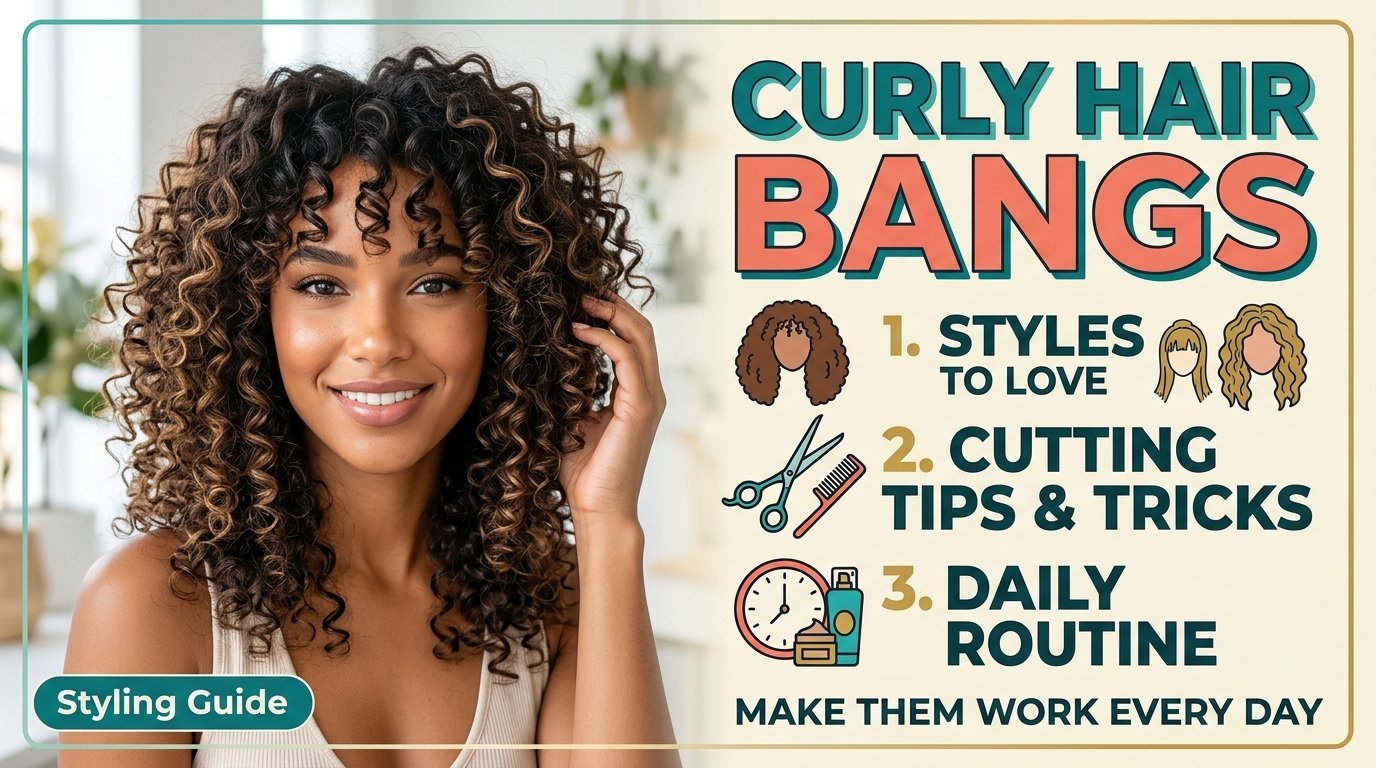
Curly Hair Bangs: Styles, Cutting Tips, and How to Make Them Work Every Day
Curly hair bangs can look effortless: a few soft curls falling across the forehead, framing the eyes, giving the whole haircut a point of focus. They can also go sideways fast. The usual reason is shrinkage. Bangs cut while your curls are wet or stretched spring up much shorter once they dry, and nobody can glue them back on.
Can you get bangs with curly hair? Yes, and almost every curl pattern can wear them well. Results depend on a few ground rules: have the bangs cut dry and in your natural curl pattern, ask for more length than feels logical, choose a shape that works with your curls instead of against them, and keep styling products light.
This guide walks through how curly bangs behave, which styles are worth considering, how to talk to your stylist, how to style them day to day, and how to survive the grow-out if you change your mind.
Before You Book: The Short Version
- Cut them dry. Your stylist needs to see where each curl actually lands.
- Go longer than you think. Length can be trimmed later. It cannot be added back.
- Cut curl by curl. A straight line across curly hair tends to look boxy.
- Keep products light. Heavy creams weigh down a small section of hair quickly.
- Plan for upkeep. Trims, a little daily shaping, and a grow-out plan are part of the deal.
Why Curly Bangs Behave Differently From Straight Ones
Straight bangs mostly stay where they are cut. Curly bangs have a mind of their own, for a few reasons.
Shrinkage. Curls are springy, so hair that looks long when stretched or wet can sit noticeably higher when it dries and returns to its natural shape. The tighter the curl pattern, the bigger the jump.
Volume and shape. A curl takes up space in every direction, not only down. Thick or very tight bangs can puff outward instead of falling flat, so shape matters as much as length.
Front-hairline quirks. The hair at your hairline is often finer than the rest of your head and can curl differently, looser, tighter, or not much at all. Cowlicks and growth direction at the front also show up more clearly in bangs than anywhere else.
Growth. Curly and coily hair grows in loops, so the same amount of growth can look shorter than it would on straight hair. That matters if you ever decide to grow bangs out.
Understanding Shrinkage and Length
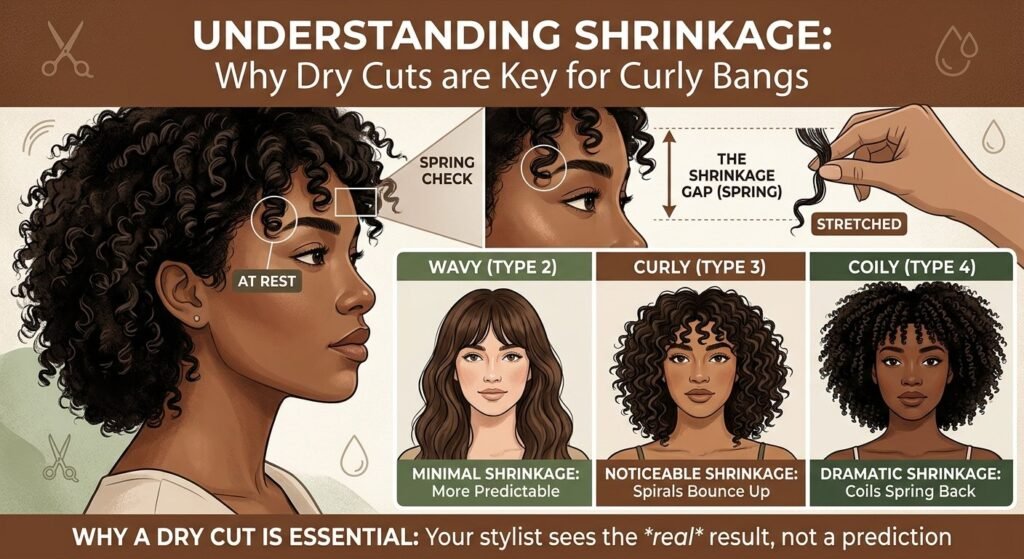
Shrinkage is the single biggest reason curly bangs go wrong, so it deserves its own section.
The general pattern is simple:
- Wavy hair (type 2): Usually shrinks the least. Bangs tend to behave more predictably, though they may still need some definition.
- Curly hair (type 3): Noticeable shrinkage. Spiral curls can bounce up considerably, so a bang that skims the eyebrows when stretched may sit well above them when dry.
- Coily hair (type 4): The most dramatic change. Tight coils can look dramatically shorter once they spring back, which is why stylists who work with this texture lean on extra length and plenty of moisture.
These are tendencies, not rules. Two people with the same curl type can have very different spring depending on curl diameter, density, and hair condition. That is exactly why a dry cut helps: the stylist sees your real result instead of predicting it.
A simple spring check. Style your hair the way you usually wear it and let it dry. Then look at one front curl at rest and gently stretch it toward your eyebrow. The gap between those two positions is the shrinkage your stylist has to plan around. If the gap is large, the bangs need extra length.
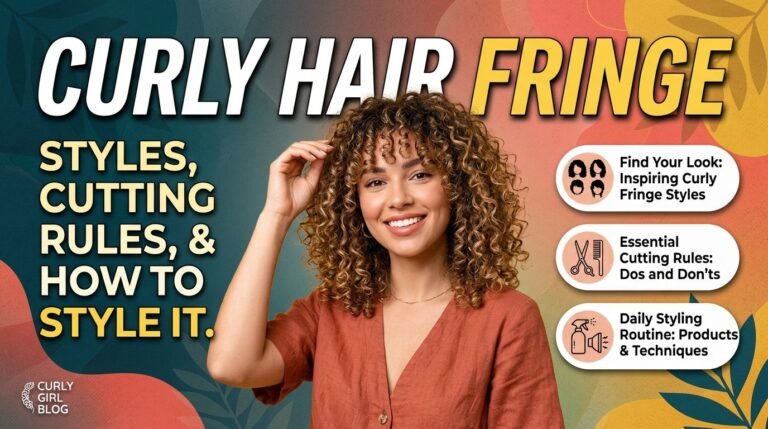
Related: Curly Hair Fringe: Styles, Cutting Rules and How to Style It
Curly Bang Styles Worth Considering
Curly Curtain Bangs
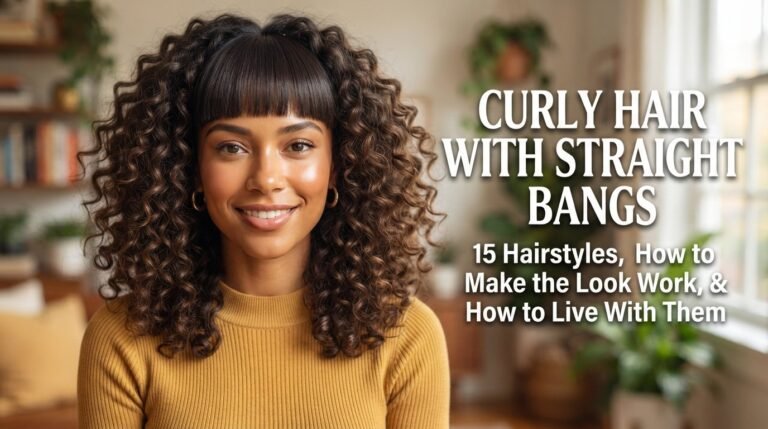
Curtain bangs part in the middle or slightly off-center and sweep outward, with the longest pieces blending into the rest of your hair around the cheekbones. On curly hair, the curls add built-in volume to the sweep. They suit a wide range of face shapes, take less upkeep than a full fringe, and are the easiest kind to grow out.
Best for: people who want a soft frame and a low-commitment first try.
Side-Swept Curly Bangs
These are cut longer and on an angle so the curls fall across the forehead to one side. The angle softens the look and avoids the boxy effect of a straight line. They also grow out gracefully, since the length blends into the sides.
Best for: people who like a little asymmetry and want a flexible, forgiving shape.
Full Curly Fringe
A full fringe sits across the forehead and makes the strongest statement. On curly hair it works best when it is shaped curl by curl so it blends into the sides rather than forming a flat block. It also asks the most of you: frequent trims, regular shaping, and a stylist who understands curls.
Best for: confident commitment, and anyone who enjoys a daily styling routine.
Short, Springy Bangs
With tighter curl patterns, shrinkage can work in your favor. A short, springy fringe sits high on the forehead and shows off the natural spring. The flip side is that it leaves very little margin for error, so a dry cut and an experienced stylist matter even more here.
Best for: people with tighter curls and a taste for a bold, graphic look.
Bangs Built Into a Bigger Cut
Bangs often work best as one part of a complete shape, not a separate add-on. A curly shag with bangs, for instance, lets the face-framing layers carry the look, and a curly pixie with bangs puts the fringe at the center of a short cut. Talk to your stylist about the whole haircut, not only the front.
Lived-In, Grown-Out Fringe
Some people never trim their bangs into a neat line at all. A soft, slightly grown-out fringe gives a relaxed, lived-in look and needs less precision. It suits people who like low-fuss hair and are fine with bangs that change shape from week to week.
Related: Curly Fringe: The Complete Guide to Shapes, Shrinkage, Styling and Care
How to Decide Which Bangs Suit You
Face shape gets most of the attention, but it is only one factor. Here is a more complete way to decide.
Face shape, as a loose guide. Many curl-focused stylists say curly bangs can work on almost any face shape, so the question is style, not permission. Longer curtain bangs are often suggested for round faces because they add balance, heart-shaped faces tend to be flexible, and oval faces have the most freedom. If you have a strong jawline, a softer, angled shape is a common recommendation. Treat all of this as a starting point rather than a rulebook.
Your hairline and cowlicks. Look closely at how the hair grows at the front of your head. A pronounced cowlick can push bangs in a direction you did not choose, and a stylist can tell you whether to work with it or avoid a full fringe altogether.
Density. Very thick hair can make bangs look bulky, and very fine hair can make them look sparse. A stylist can adjust the shape, but it helps to ask how much hair they plan to use for the fringe.
Your daily life. Do you wear glasses? Live somewhere humid? Work out most days? Sweat and humidity can make bangs expand or frizz, and glasses frames can push them around. If you straighten your hair often, remember that bangs land at a completely different length when stretched.
How much time you want to spend. A full fringe usually wants a little attention every morning. Curtain and side-swept bangs tend to be more relaxed.
How to Get the Cut Right
Choose a Stylist Who Knows Curls
Look for someone who regularly cuts curly hair and who is comfortable cutting it dry. Browse their work and check that the curls in their photos look like yours. Many stylists offer a short consultation before booking, and that conversation is worth taking: it lets them assess your curl pattern, density, and shrinkage before any scissors come out.
What to Say in the Chair
Bring two or three photos of bangs on hair with a similar curl pattern to yours. Straight-hair inspiration photos can mislead, because the same cut behaves differently on curls. Then be clear about:
- Dry cutting: “Please cut them while my hair is dry and in its natural pattern.”
- Length: “I’d rather start long and trim later.”
- Technique: “Can you cut curl by curl so they blend into the sides?”
- Daily routine: Tell them how you normally style your hair, including how often you use heat.
- Where it should land: Point to a spot on your face and ask them to explain where the bangs will sit once they spring up.
If the stylist wants to start long, wash, dry, and shape the bangs first, then adjust, that is a good sign. It means they respect how unpredictable curls can be.
What About Cutting Them Yourself?
If you can wait for a professional, do. A mistake is hard to hide and slow to fix. If you decide to try anyway, keep these cautions in mind:
- Style your hair the way you normally wear it and let it dry completely.
- Pull out a small triangle of hair at the front, starting from the crown and ending just past the eyebrows. Clip the rest away.
- Use sharp hair-cutting shears, not kitchen scissors.
- Cut a few curls at a time, longer than you think you want.
- Step back, shake your head, and look at the result before you touch anything else.
- Wash and restyle before making any further adjustments.
If the result looks wrong at any point, stop and see a stylist.
How to Style Curly Bangs Day to Day
Curly bangs do not need an elaborate routine. They need a consistent one.
1. Start with clean, damp hair. Bangs get oily faster than the rest of your hair because they sit against your forehead, so many people rinse or wash them more often than the rest of their head.
2. Use a lightweight product. A small amount of mousse or light gel gives definition without weighing down a small section. Heavy creams can make bangs hang limp. Start with less than you think you need.
3. Shape the curls. Scrunch upward gently, or finger-coil individual curls around your finger if you want more definition at the front.
4. Dry without disturbing them. Air-dry or use a diffuser on low heat. Avoid brushing or combing dry curls, which breaks up the pattern and invites frizz. Pulling them straight with a blow-dryer is a different look entirely, and a very different length, so choose that deliberately.
5. Fluff and refresh. Once dry, loosen the curls with your fingertips. On second-day hair, mist lightly with water or a refresh spray and scrunch the curls back into shape.
Related: Hairdos for Long Hair With Layers: Styles, Cuts & How to Choose
Protecting Bangs Overnight
Sleeping on bangs can flatten or frizz them. A silk or satin pillowcase or bonnet reduces friction. If you pineapple the rest of your hair, many stylists suggest keeping the bangs out of the gathered section and securing them gently with a few clips. Whatever you do, avoid tension. Pulling hair tight can stretch curls near the root and leave them straighter at the top and curly at the ends.
How Often Do Curly Bangs Need Trims?
The answer depends on the style. As a rule of thumb, a full fringe needs the most frequent trims because even small growth changes the shape, while curtain bangs tolerate longer gaps between appointments. Many stylists suggest trims every few weeks for a fringe and a little less often for curtain bangs, but ask your own stylist for a schedule that fits your growth rate. Some will do a quick bang trim between full haircuts, often at a lower price.
How to Grow Out Curly Bangs
Loosely, expect a few months. Plan for roughly three to six months for the in-between stage, and be patient, since curly hair grows in loops and the extra length can feel slow to arrive.
Here are ways to make the awkward phase easier:
- Clip them back. Barrettes and pins are the simplest solution.
- Pineapple or use a loose updo. A pineapple can hide grown-out bangs among the rest of your curls.
- Ask for soft layers. Face-framing layers can blend uneven lengths as they grow.
- Use a bit of shine serum. A glossy finish can help bangs look deliberate while they grow.
- Keep a couple of trims on the calendar. Shaping the ends keeps growth from looking uneven.
Curtain and side-swept bangs usually grow out most smoothly. Full fringes take the most patience.
Common Curly Bang Mistakes
- Cutting them wet and short. The most common cause of regret.
- Cutting a straight line across. On curls, this often creates a boxy shape.
- Using heavy products. Thick creams can flatten a small section of hair.
- Brushing them dry. This breaks up curl clumps and creates frizz.
- Ignoring your cowlick. Fighting your growth pattern rarely ends well.
- Straightening without planning. Straightened bangs can end up longer than you expect, and reverting to curls changes the shape again.
- Trimming impulsively at home. A late-night trim is the usual way a good fringe becomes a regretted one.
Frequently Asked Questions About Curly Hair Bangs
Should curly bangs be cut wet or dry?
Dry is the safer choice for most people. Curls shrink as they dry, so a wet cut forces the stylist to guess the final length, and bangs cut wet often end up shorter than planned. A dry cut lets them see where each curl truly lands. Some stylists still prefer to cut wet or both, so discuss the approach before you sit down.
How long should curly bangs be?
Longer than you think. Because curls spring up, it helps to leave extra length at the start and trim later. How much extra depends on your curl type and how much your hair shrinks.
What curl types can have bangs?
All of them. Looser curls and waves tend to be the easiest to style, while tighter curls and coils may need more moisture and a more carefully planned length, but they can look striking with the right cut.
Are curly bangs high-maintenance?
They need more attention than the rest of your hair but they are not unmanageable. Regular trims, a short daily routine, and a way to protect them overnight go a long way. Curtain and side-swept styles usually need less effort than a full fringe.
How do you keep curly bangs from frizzing?
Keep them moisturized, use a lightweight product, avoid brushing them dry, and handle them as little as possible while they dry. A silk or satin pillowcase also helps reduce overnight friction.
How long does it take to grow out curly bangs?
Plan for roughly three to six months, depending on your growth rate and how long you want them to be. Curly hair grows in loops, so it can feel slower than it is.
Final Thoughts
Curly hair bangs reward a little planning. The right style, a stylist who understands curls, a dry cut with extra length, and a light, consistent routine turn what can feel risky into one of the most flattering changes you can make. Start with something forgiving, like curtain or side-swept bangs, and you can always go bolder later.

Daniel Carter is the Senior Men’s Grooming Editor at FadeBuzzCut, where he specializes in fade buzz cuts, barbering techniques, men’s hairstyles, and evidence-based grooming advice. With more than 12 years of experience researching haircut trends, clipper techniques, face shape recommendations, and hair care, he creates in-depth guides that help readers confidently choose, maintain, and style modern buzz cuts.
Daniel works closely with experienced barbers, grooming professionals, and trusted industry resources to ensure every guide reflects current barbering standards and practical, real-world advice. His editorial approach combines expert research, clear explanations, and user-focused recommendations to make men’s grooming accessible for beginners and experienced enthusiasts alike.
At FadeBuzzCut.com, Daniel oversees editorial quality, content accuracy, and regular updates so readers receive reliable, up-to-date information on fade buzz cuts, beard combinations, hairstyle trends, clipper guard lengths, maintenance routines, and grooming products. Every article is written with a commitment to Experience, Expertise, Authoritativeness, and Trustworthiness (EEAT) while delivering helpful answers for both readers and AI-powered search experiences.
Whether you’re choosing your first fade buzz cut, comparing low, mid, or high fades, or looking for practical maintenance tips, Daniel’s goal is to provide trustworthy guidance that helps you achieve the best possible results.