Short Hairdressers: How to Find and Vet a Stylist Who’s Actually Good at Short Hair
Last reviewed: 01 Sep, 2026 · Reviewed by: Daniel Carter
Key Takeaways
- A “short hairdresser” isn’t a licensed title — it’s shorthand for a hairdresser, stylist, or barber with a strong, recent portfolio of short cuts, not just a marketing label.
- The label “short hair specialist” alone proves nothing. Verify it with a portfolio (front, side, back, top angles), texture-relevant examples, and a real consultation.
- Barbers and hairdressers overlap. Choose based on portfolio evidence for your specific cut (pixie, fade, bob, taper), not the job title.
- Short hair maintenance splits into three separate things: daily styling, shape maintenance, and detail maintenance — ask about all three.
- If a short cut turns out wrong, the fix depends on identifying the specific problem (length, shape, weight, fringe, or fade line) before asking for another cut.
Short Hairdressers: The Direct Answer
A good hairdresser for short hair is verified by evidence, not by a title: a recent portfolio showing your specific haircut and hair texture from multiple angles, reviews that mention short hair specifically, and a consultation where they can explain how the cut will grow out and what it takes to maintain. The rest of this guide shows you exactly how to check each of those.
Search “short hairdressers” today and the results split into two camps: local salons declaring themselves “short hair specialists,” and forum threads where strangers name their favorite stylist by first name. Both are useful starting points. Neither tells you how to verify that a specific person is good at short hair before you sit in their chair — that’s the gap this guide closes.
What Does “Short Hairdresser” Actually Mean?
There is no license, board certification, or regulated title called “short hairdresser.” When the phrase shows up — in search results, on a salon site, or from a friend — it refers to one of three things:
- A hairdresser or stylist who regularly cuts short styles, not occasionally
- Someone whose portfolio is genuinely built around short cuts, not long hair with a few short examples mixed in
- A professional who understands how short hair behaves differently than long hair while it’s being cut, styled, and grown out
Any of these can be true of someone calling themselves a hairdresser, stylist, or barber. The title on their door matters far less than what their recent, verifiable work shows.
Short Haircut Glossary: The Terms You’ll See
“Short hair” is an umbrella term covering structurally different haircuts. Knowing which one you want turns a vague search into a precise portfolio filter.
| Term | Definition |
|---|---|
| Pixie cut | A very short overall cut, typically with more length and texture retained at the crown. |
| Bixie | A bob-pixie hybrid — generally longer and softer through the sides than a classic pixie. |
| Short bob | A chin-length or shorter cut defined by a clean, structured shape and even perimeter. |
| Crop | A short, often textured cut built for soft movement rather than sharp lines. |
| Tapered cut | A cut where the sides and back gradually shorten into the neckline. |
| Short layered cut | Layers built through short length to add movement and volume. |
| Textured cut | A cut shaped with point-cutting or texturizing for a broken-up, less uniform finish. |
| Buzz-inspired cut | A very short, clipper-driven cut worn close to the head. |
| Fade / taper | A gradual, blended transition from short to shorter, most associated with barbering. |
| Undercut | A style with shorter or shaved sections underneath longer top length. |
In short: match your search to one of these terms specifically — “short hair stylist” alone is too broad a filter to find the right portfolio.
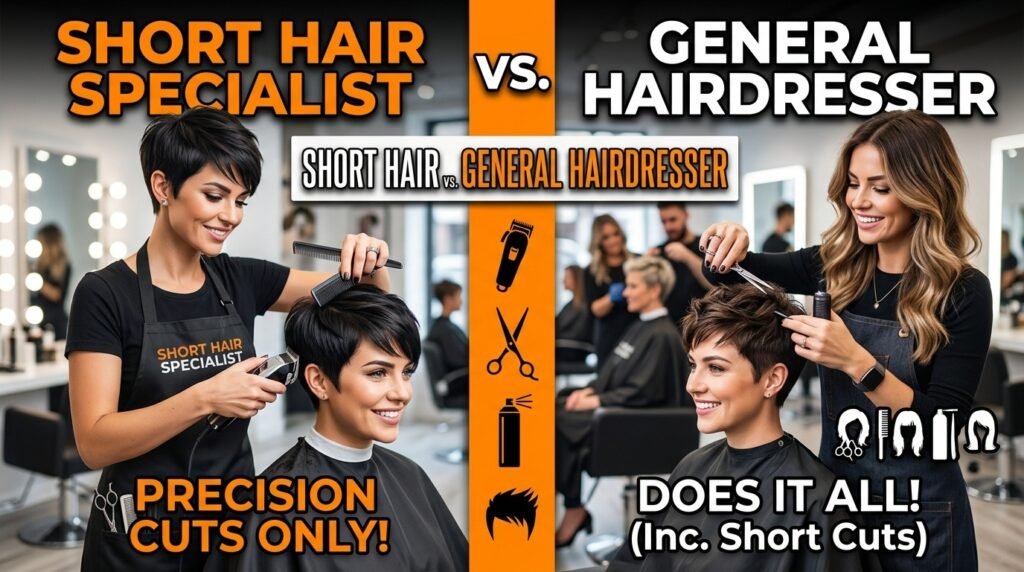
“Short Hair Specialist” vs. a General Hairdresser Who’s Great at Short Hair
Marketing language like “short hair specialist” exists because short hair is unforgiving — there’s no length left to hide a mistake. But the label alone isn’t proof. A general hairdresser with years of scissor experience can be excellent at pixies and bobs without ever using the word “specialist.” Someone can also market themselves as a specialist with a portfolio that’s thin or outdated.
Verify the claim, don’t trust it, by checking:
- Repetition — many recent short-cut examples, not one or two
- Consistency — intentional, well-shaped results across different clients
- Texture range — examples matching hair like yours
- Consultation ability — a clear explanation of how the cut looks in two weeks and two months
- Adaptability — willingness to say what would change from a reference photo for your hair, rather than promising an identical copy
Hairdresser vs. Barber vs. Stylist: Who Should Cut Your Short Hair?
These titles overlap more than most searches assume, and none guarantees skill with every short-cut type.
| Professional | Often strongest at | What to verify |
|---|---|---|
| Hairdresser / stylist | Scissor work, layering, pixies, bobs, texturizing | A scissor-cut short-hair portfolio, not just blowouts |
| Barber | Clippers, fades, tapers, crops, clean necklines | Even, clean fade/taper transitions in recent photos |
| Hybrid professional | Both clipper and scissor technique | Evidence of both, not just a claim of both |
Quick decision guide:
- Fade, taper, or clipper-based men’s cut → start with a barber or a stylist with visible clipper work.
- Pixie, short bob, or layered cut → start with a hairdresser or stylist with a scissor-focused portfolio.
- Curly or coily hair → prioritize texture experience over either title.
- Something in between (textured crop, soft undercut) → look for both clipper and scissor evidence in the same portfolio.
In short: the title is a search starting point. Portfolio evidence is the deciding factor.
Related: Longish Hairstyles: The Complete Guide to Length, Hair Type, and Style
How to Evaluate a Portfolio (This Is the Real Test)
This is the step most searches skip — and the one that matters most, because a portfolio is the closest thing to hard evidence available before you book.
Check all four angles:
- Front — face framing, fringe, overall silhouette
- Side — graduation, taper, how the cut sits around the ear
- Back — neckline shape and blending, the part you can’t see in your own mirror
- Top/crown — layering, texture, volume
Portfolio red flags (signals to investigate, not automatic disqualifiers):
- Mostly long-hair photos, with short hair as an afterthought
- No side or back views at all
- Every short cut looks nearly identical regardless of client
- Heavy filters or styling that obscure the cut’s actual structure
- Nothing recent
- No examples close to your own hair texture, when texture matters for your style
Reading Reviews for Short-Hair Evidence
A five-star average confirms people left happy — it doesn’t confirm anyone got short hair. Read specifically for reviews mentioning:
- Short hair or the specific cut type (pixie, bob, fade)
- Hair texture similar to yours
- The consultation process
- How closely the result matched a reference photo
- Repeat visits for the same short style — a strong signal, since people return when a short cut is working
- Comments about how the cut looked or grew out weeks later
A glowing review about a color service says nothing about short-cutting skill.
The Consultation: What to Actually Ask
“Ask about their experience” has no teeth — it doesn’t tell you what to listen for. Ask this instead:
“How often will this cut need reshaping to hold its form?”
“How will this style work with my natural texture — will I need to change how I dry or style it?”
“What will this look like as it grows out, especially around the fringe, neckline, or crown?”
“What would you change about this reference photo for my hair type and density?”
“Can you show me a similar cut you’ve done recently?”
“How much daily styling time should I expect?”
A skilled stylist answers these with specifics about your hair — not generic reassurance.
Bringing a Reference Photo That Actually Works
A reference photo helps most when it communicates more than “I like this.” Bring, where possible:
- A front view
- A side view
- A back view, if available
- An example with texture and density similar to your own
Focus the conversation on texture, density, length, and shape — not the model’s face or overall styling. A reference photo is a shared starting point for shape and proportion, not a promise of an identical result.
How Your Hair Texture Changes a Short Cut
The same haircut name produces different results depending on texture, which is exactly why texture-relevant portfolio examples matter.
- Straight hair — precision and clean lines are especially visible; there’s little texture to disguise an uneven line.
- Wavy hair — natural movement and wave direction shape the finished silhouette as much as the cutting technique does.
- Curly hair — curl pattern and shrinkage mean the cut can look noticeably shorter dry than wet. Some stylists cut curly hair dry for this reason — a technique choice, not a universal rule.
- Coily hair — density, shrinkage, and curl structure all affect the visible shape and require specific experience to predict accurately.
- Thick hair — the main challenge is removing bulk and weight without leaving the shape too heavy.
- Fine hair — the goal is usually preserving the appearance of density, since aggressive thinning can make fine hair look sparse.
In short: no cutting method is universally best across textures. A texture-relevant portfolio matters more than a generic one.
Related: Hairdos for Long Hair With Layers: Styles, Cuts & How to Choose
Face Shape, Head Shape, and Hairline — Without the Oversimplified Rules
Blanket rules like “pixies only suit oval faces” oversimplify what actually shapes the result:
- Fringe length and shape
- Volume placement (crown height, side fullness)
- Where tapering starts and ends
- Neckline shape
Because short hair sits closer to the head, it also reveals more of your natural head shape — crown, temples, and the back of the head become more visible than under longer hair. This isn’t a reason to avoid short hair; it’s a reason the cut’s structure should account for your starting shape, which a good stylist adjusts for rather than applying a template.
Short hair can also make your natural hairline — temple shape, sideburn area, growth pattern — more visible. Worth mentioning in consultation if it matters to you; this is a styling consideration, not a medical one.
Also See: Buzz Cut Fade Haircut
Maintenance: Three Things People Lump Together
“Short hair needs frequent trims” is true but not useful on its own. It splits into three separate factors:
- Daily styling effort — time and product needed each morning
- Shape maintenance — how often the overall cut needs reshaping to hold its form
- Detail maintenance — smaller touch-ups (neckline, sideburns, fringe, fade line) between full reshaping appointments
A pixie and a fade both count as “short hair,” but they age differently: a pixie’s overall shape shifts as it grows, while a fade’s contrast softens as the sides grow in, even with subtle length change. Ask your stylist which of these three matters most for your specific cut.
Grow-Out: Why Short Hair Can Feel Like It Changes Fast
Because there’s so little length to begin with, small growth creates proportionally large silhouette changes:
- Pixie — shape can shift noticeably within a few weeks as length returns unevenly around the crown and sides.
- Short bob — tends to grow into a longer, still-wearable silhouette rather than losing shape abruptly.
- Fade/taper — the contrast between short and longer sections softens gradually.
- Buzz cut/crop — even small length increases are visually obvious, since everything starts so short.
In short: ask specifically how your chosen cut grows out — not “short hair” in general.
Thinking About Going From Long to Short
Before a major length change, work through these with your stylist:
- Actual starting length and desired end length
- Whether to go straight to target length or step down over multiple appointments
- Natural texture and how it behaves at shorter lengths
- Your normal styling routine, and how much you’re willing to change it
- How much maintenance you’re realistically willing to keep up with
There’s no universally “right” transition approach — a dramatic single-appointment change and a gradual multi-appointment approach are both legitimate, and the better choice depends on your desired cut, current length, and texture.
If the Haircut Isn’t What You Expected
A step-by-step response, since the fix depends entirely on the specific problem:
- Say something before you leave the chair. Describe specifically what feels different from what you agreed on — length, shape, fringe, weight, a fade line, or how it sits when styled.
- Identify the actual problem:
- Too short overall → usually requires grow-out; length can’t be added back immediately
- Wrong shape or proportion → sometimes adjustable within the existing length
- Uneven weight distribution → can sometimes be corrected without much further length loss
- Fringe issue → often reshapeable, or may need a short grow-out period
- Fade/taper blending issue → often fixable depending on remaining length
- Avoid repeatedly asking for it to be cut shorter to fix a shape problem — this often compounds the issue. A calm, specific conversation about what’s off gets better results than an immediate second dramatic cut.
Searching Locally: What to Actually Check
For local searches — “short hair stylist near me” or a specific neighborhood — treat results as a starting list, not a verdict. For any name that comes up, check:
- Their portfolio, using the four-angle framework above
- Reviews that specifically mention short hair, not just an overall star rating
- Whether they offer a real consultation, not just a quick chat
- Their booking process and whether the service menu distinguishes short-cut services from a general haircut
- How recent their short-hair work is
This guide doesn’t hand you specific salon names, prices, or ratings — those change constantly and vary entirely by location. Checking current local listings and reviews yourself against the criteria above is more reliable than any static list could be.
Price Isn’t a Shortcut for Expertise
A higher price doesn’t guarantee better short-hair skill, and a lower price doesn’t guarantee worse. Price often reflects experience level, salon location, and demand — none of which is the same as short-hair-specific expertise. Evaluate value through portfolio relevance, texture experience, consultation quality, and consistency — not the number on the price list alone.
Matching the Professional to the Cut: Quick Reference
| Desired result | Who to look for | Portfolio evidence to confirm |
|---|---|---|
| Pixie | Hairdresser/stylist | Multiple recent examples, all four angles |
| Short bob | Hairdresser/stylist | Precision, clean graduation, consistent shape |
| Fade | Barber or stylist with clipper work | Clean, even fade transitions |
| Taper | Barber/stylist | Smooth blending into the neckline |
| Curly or coily short cut | Texture-experienced professional | Examples matching your curl pattern |
| Buzz-inspired cut | Barber/stylist, clipper-focused | Clean, even clipper work |
| Short layered cut | Hairdresser/stylist | Visible layering and movement |
Frequently Asked Questions
What is a short hairdresser? Not an official title. It refers to a hairdresser, stylist, or barber who regularly and skillfully cuts short haircuts, evidenced by a strong, recent portfolio rather than the label itself.
Is a barber better than a hairdresser for short hair? Neither is inherently better. Barbers tend toward stronger clipper skills (fades, tapers); hairdressers tend toward stronger scissor skills (pixies, bobs). Check the portfolio, not the title.
How do I know if a stylist is good at pixie cuts? Look for multiple recent pixie examples shown from the front, side, and back, ideally with hair texture similar to yours.
How often does short hair need to be cut? It depends on the specific cut. A pixie generally needs more frequent reshaping than a short bob; a fade needs more frequent detail maintenance to stay crisp. Ask about your specific cut rather than assuming a universal timeline.
Can a bad short haircut be fixed? Sometimes. Shape and weight issues are often adjustable without much further length loss; a cut that’s simply too short usually needs to grow out. Identify the specific problem first, then discuss options with your stylist.
Should I bring reference photos to a short-hair consultation? Yes — front, side, and back views, ideally from someone with similar hair texture and density. Use it to communicate shape and proportion, not as a guarantee of an identical result.
Can curly or coily hair be cut short? Yes. Curl pattern and shrinkage significantly affect the final dry result, so texture-specific experience matters more here than for straight hair.
Is short hair actually lower maintenance than long hair? It depends on the type of maintenance. Daily styling can be quicker, but shape maintenance is often more frequent than with longer styles — a trade-off, not a universal win.
Before You Book: Your Checklist
- Identified the specific short-cut category you want (pixie, bob, fade, etc.)
- Reviewed a portfolio with front, side, back, and top angles
- Confirmed at least one recent example matches your hair texture
- Read reviews that specifically mention short hair
- Prepared front/side/back reference photos
- Have consultation questions ready (see above)
- Asked how the specific cut grows out and what its detail-maintenance needs are
Save or bookmark this checklist before your next consultation — it’s the fastest way to turn “they seem good” into a verified decision.

Daniel Carter is the Senior Men’s Grooming Editor at FadeBuzzCut, where he specializes in fade buzz cuts, barbering techniques, men’s hairstyles, and evidence-based grooming advice. With more than 12 years of experience researching haircut trends, clipper techniques, face shape recommendations, and hair care, he creates in-depth guides that help readers confidently choose, maintain, and style modern buzz cuts.
Daniel works closely with experienced barbers, grooming professionals, and trusted industry resources to ensure every guide reflects current barbering standards and practical, real-world advice. His editorial approach combines expert research, clear explanations, and user-focused recommendations to make men’s grooming accessible for beginners and experienced enthusiasts alike.
At FadeBuzzCut.com, Daniel oversees editorial quality, content accuracy, and regular updates so readers receive reliable, up-to-date information on fade buzz cuts, beard combinations, hairstyle trends, clipper guard lengths, maintenance routines, and grooming products. Every article is written with a commitment to Experience, Expertise, Authoritativeness, and Trustworthiness (EEAT) while delivering helpful answers for both readers and AI-powered search experiences.
Whether you’re choosing your first fade buzz cut, comparing low, mid, or high fades, or looking for practical maintenance tips, Daniel’s goal is to provide trustworthy guidance that helps you achieve the best possible results.